
















Reading: Robert Frost (1874-1963)
Respuesta rápida
a) Rural life and civilization. b) Clear and simple. c) "The Road Not Taken".
Solución — Página 85
Uérakua anapu uantakua. Projects and Readings. Libro de Educación Telesecundaria Grado 1° Ciclo Escolar 2025 - 2026
Ejercicio a
What themes did Robert Frost often explore in his poems?
- El texto dice: "His work often explores the contrast between rural life and modern civilization".
- Eso corresponde a la opción Rural life and civilization.
- Las demás opciones (urban life and technology, political revolutions, sports and entertainment) no aparecen en el texto.
Respuesta: Rural life and civilization.
Ejercicio b
How would you describe Robert Frost's writing style?
- El texto afirma: "Frost's poetry is known for its clear and straightforward language".
- "Clear and straightforward" equivale a Clear and simple.
- Las opciones complex/ambiguous, abstract/surreal y dramatic/theatrical contradicen el texto.
Respuesta: Clear and simple.
Ejercicio c
Which of Frost's poems is most famous for its exploration of choices and decision-making?
- El texto menciona que sus poemas "reflect his interest in the choices individuals make".
- Entre los poemas citados, "The Road Not Taken" trata precisamente de una decisión en un camino que se bifurca.
- "The Waste Land" es de T. S. Eliot, "Howl" de Allen Ginsberg y "Ode to a Nightingale" de John Keats.
Respuesta: "The Road Not Taken".
Nota de verificación
La propia página incluye la clave al pie: Answers: a) Rural life and civilization. b) Clear and simple. c) "The Road Not Taken", lo que confirma las tres respuestas.
Contenido de la página
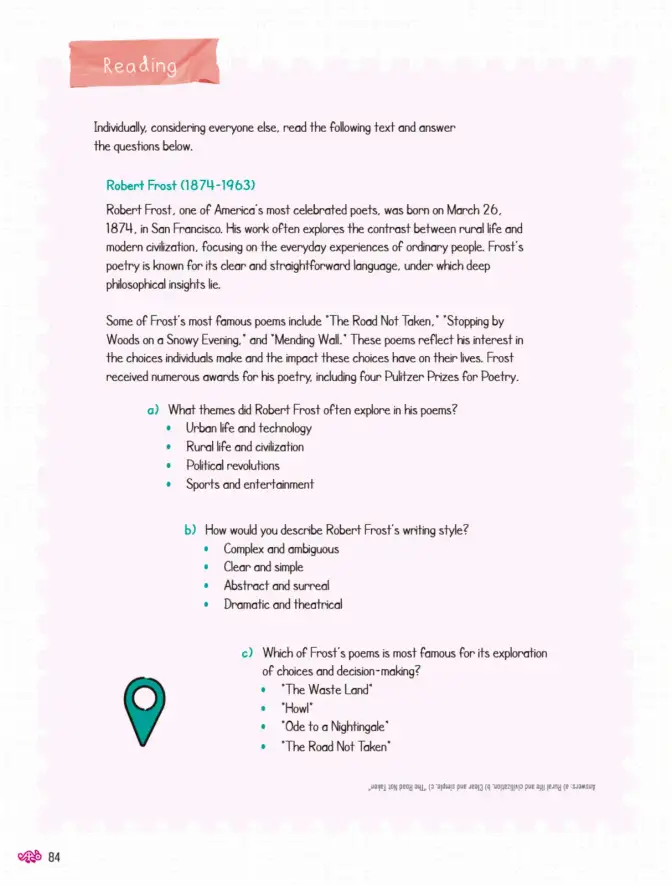
Reading
Individually, considering everyone else, read the following text and answer the questions below.
Robert Frost (1874-1963)
Robert Frost, one of America's most celebrated poets, was born on March 26, 1874, in San Francisco. His work often explores the contrast between rural life and modern civilization, focusing on the everyday experiences of ordinary people. Frost's poetry is known for its clear and straightforward language, under which deep philosophical insights lie.
Some of Frost's most famous poems include "The Road Not Taken," "Stopping by Woods on a Snowy Evening," and "Mending Wall." These poems reflect his interest in the choices individuals make and the impact these choices have on their lives. Frost received numerous awards for his poetry, including four Pulitzer Prizes for Poetry.
a) What themes did Robert Frost often explore in his poems?
- Urban life and technology
- Rural life and civilization
- Political revolutions
- Sports and entertainment
b) How would you describe Robert Frost's writing style?
- Complex and ambiguous
- Clear and simple
- Abstract and surreal
- Dramatic and theatrical
c) Which of Frost's poems is most famous for its exploration of choices and decision-making?
- "The Waste Land"
- "Howl"
- "Ode to a Nightingale"
- "The Road Not Taken"
Answers: a) Rural life and civilization. b) Clear and simple. c) "The Road Not Taken"
Glosario (6)
- celebrated
- famoso, reconocido
- rural life
- vida del campo
- straightforward
- directo, sencillo
- insights
- reflexiones, percepciones profundas
- Pulitzer Prize
- premio estadounidense de periodismo, literatura y música
- choices
- decisiones, elecciones
Temas y conceptos clave
Figuras de la página (1)

Preguntas que la gente también hace
¿Quién fue Robert Frost y por qué es famoso?
¿Cuáles son los poemas más conocidos de Robert Frost?
¿Qué temas trata la poesía de Robert Frost?
- • Vocabulario básico en inglés sobre biografías y poesía
- • Identificar ideas principales en un texto breve
- • Reconocer el presente simple y el pasado simple en inglés
📝 Transcripción de la página (texto seleccionable) 1342 caracteres
Reading
Individually, considering everyone else, read the following text and answer the questions below.
Robert Frost (1874-1963)
Robert Frost, one of America's most celebrated poets, was born on March 26,1874, in San Francisco. His work often explores the contrast between rural life and modern civilization, focusing on the everyday experiences of ordinary people. Frost's poetry is known for its clear and straightforward language, under which deep philosophical insights lie.
Some of Frost's most famous poems include 'The Road Not Taken,""Stopping by Woods on a Snowy Evening."and "Mending Wall. These poems reflect his interest in the choices individuals make and the impact these choices have on their lives. Frost received numerous awards for his poetry, including four Pulitzer Prizes for Poetry.
a) What themes did Robert Frost often explore in his poems? Urban life and technology 福Rural life and civilization Political revolutions
Sports and entertainment
b) How would you describe Robert Frost's writing style? 0Complex and ambiguous 家Clear and simple
曲Abstract and surreal 编Dramatic and theatrical
c)Which of Frost's poems is most famous for its exploration of choices and decision-making?
"The Waste Land" "Howl" "Ode to a Nightingale" "The Road Not Taken"

a
84
Otros libros recomendados
Historia del pueblo mexicano. Multigrado Libro de Educación Telesecundaria Grado 1° Ciclo Escolar 2025 - 2026
SEP/CONALITEG
331 págs.
Colección Ximhai. Lenguajes. Libro de Educación Telesecundaria Grado 1° Ciclo Escolar 2025 - 2026
SEP/CONALITEG
323 págs.
Colección Ximhai. Ética, naturaleza y sociedades. Libro de Educación Telesecundaria Grado 1° Ciclo Escolar 2025 - 2026
SEP/CONALITEG
355 págs.
Uérakua anapu uantakua. Projects and Readings. Libro de Educación Telesecundaria Grado 3° Ciclo Escolar 2025 - 2026
SEP/CONALITEG
187 págs.
Uérakua anapu uantakua. Projects and Readings. Libro de Educación Telesecundaria Grado 2° Ciclo Escolar 2025 - 2026
SEP/CONALITEG
171 págs.
Colección Ximhai. De lo humano y lo comunitario. Libro de Educación Telesecundaria Grado 1° Ciclo Escolar 2025 - 2026
SEP/CONALITEG
259 págs.
Colección Ximhai. Nuestro libro de Proyectos. Tomo II. Libro de Educación Telesecundaria Grado 1° Ciclo Escolar 2025 - 2026
SEP/CONALITEG
267 págs.
Un libro sin recetas para la maestra y el maestro. Fase 6. Libro de Educación Telesecundaria Grado 1°, 2°, 3° Ciclo Escolar 2025 - 2026
SEP/CONALITEG
203 págs.