















Approach & Planning: Creating an Anthology of Folktales and Legends
Respuesta rápida
Proyecto: antología de folktales y legends. Cronograma: investigar, recolectar y redactar, componer y ensayar, presentar oralmente. Planeación: equipos, un país angloparlante por continente y fuentes .edu, .gov, .org.
Solución — Página 134
Uérakua anapu uantakua. Projects and Readings. Libro de Educación Telesecundaria Grado 2° Ciclo Escolar 2025 - 2026
Approach
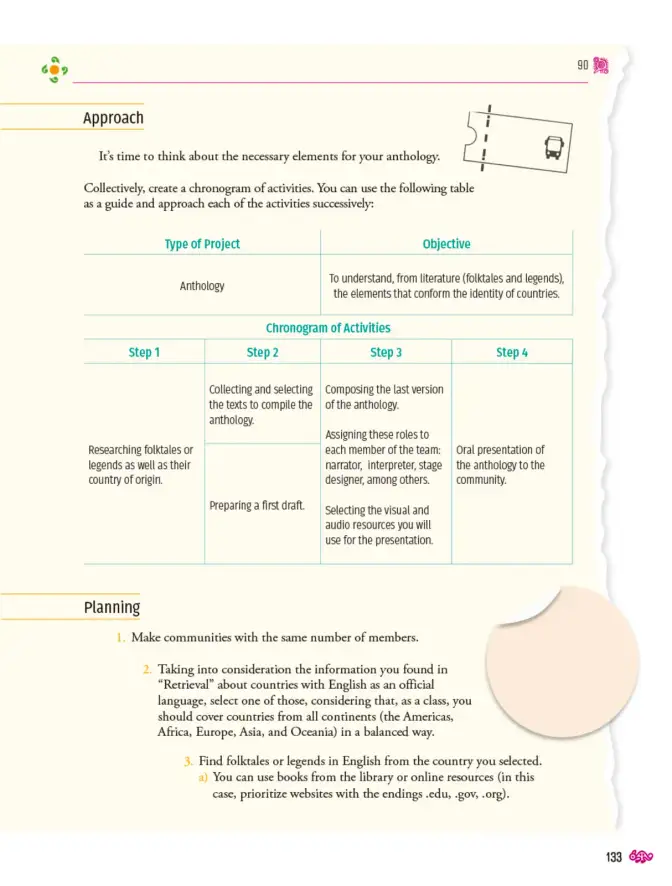
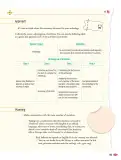
It's time to think about the necessary elements for your anthology. Collectively, create a chronogram of activities. You can use the following table as a guide and approach each of the activities successively.
Type of Project
| Type of Project | Objective |
|---|---|
| Anthology | To understand, from literature (folktales and legends), the elements that conform the identity of countries. |
Chronogram of Activities
| Step 1 | Step 2 | Step 3 | Step 4 |
|---|---|---|---|
| Researching folktales or legends as well as their country of origin. | Collecting and selecting the texts to compile the anthology. / Preparing a first draft. | Composing the last version of the anthology. Assigning these roles to each member of the team: narrator, interpreter, stage designer, among others. Selecting the visual and audio resources you will use for the presentation. | Oral presentation of the anthology to the community. |
Planning
- Make communities with the same number of members.
- Taking into consideration the information you found in "Retrieval" about countries with English as an official language, select one of those, considering that, as a class, you should cover countries from all continents (the Americas, Africa, Europe, Asia, and Oceania) in a balanced way.
- Find folktales or legends in English from the country you selected. a) You can use books from the library or online resources (in this case, prioritize websites with the endings .edu, .gov, .org).
Respuesta orientativa:
- Formar equipos de 4 integrantes (uno por cada Step del cronograma) para cubrir los roles de narrator, interpreter, stage designer y editor.
- Elegir un país de habla inglesa por equipo, cuidando que la clase cubra los cinco continentes: por ejemplo, Estados Unidos (América), Nigeria (África), Irlanda (Reino Unido) (Europa), India (Asia) y Australia (Oceanía).
- Buscar folktales o legends en inglés del país elegido, priorizando fuentes académicas y oficiales con dominios .edu, .gov y .org, y registrando la referencia bibliográfica completa.
Contenido de la página
Approach
It's time to think about the necessary elements for your anthology.
Collectively, create a chronogram of activities. You can use the following table as a guide and approach each of the activities successively:
| Type of Project | Objective |
|---|---|
| Anthology | To understand, from literature (folktales and legends), the elements that conform the identity of countries. |
Chronogram of Activities
| Step 1 | Step 2 | Step 3 | Step 4 |
|---|---|---|---|
| Researching folktales or legends as well as their country of origin. | Collecting and selecting the texts to compile the anthology. / Preparing a first draft. | Composing the last version of the anthology. Assigning these roles to each member of the team: narrator, interpreter, stage designer, among others. Selecting the visual and audio resources you will use for the presentation. | Oral presentation of the anthology to the community. |
Planning
- Make communities with the same number of members.
- Taking into consideration the information you found in "Retrieval" about countries with English as an official language, select one of those, considering that, as a class, you should cover countries from all continents (the Americas, Africa, Europe, Asia, and Oceania) in a balanced way.
- Find folktales or legends in English from the country you selected. a) You can use books from the library or online resources (in this case, prioritize websites with the endings .edu, .gov, .org).
Tablas (2)
| Type of Project | Objective |
|---|---|
| Anthology | To understand, from literature (folktales and legends), the elements that conform the identity of countries. |
| Step 1 | Step 2 | Step 3 | Step 4 |
|---|---|---|---|
| Researching folktales or legends as well as their country of origin. | Collecting and selecting the texts to compile the anthology. / Preparing a first draft. | Composing the last version of the anthology. Assigning roles: narrator, interpreter, stage designer, among others. Selecting visual and audio resources. | Oral presentation of the anthology to the community. |
Diagrama
flowchart LR
  A[Step 1: Researching folktales and legends] --> B[Step 2: Collecting, selecting and drafting]
  B --> C[Step 3: Composing final version and assigning roles]
  C --> D[Step 4: Oral presentation to the community]
Glosario (8)
- Anthology
- Colección de textos literarios seleccionados y organizados por un criterio común.
- Folktale
- Relato tradicional transmitido oralmente de generación en generación.
- Legend
- Narración popular que mezcla hechos históricos con elementos fantásticos.
- Chronogram
- Cronograma o calendario que organiza las actividades de un proyecto en pasos y tiempos.
- Draft
- Borrador o versión preliminar de un texto antes de su versión final.
- Narrator
- Persona que cuenta o relata la historia ante el público.
- Interpreter
- Persona que representa o da voz a un personaje durante la presentación.
- Stage designer
- Encargado de la escenografía y los recursos visuales de la presentación.
Preguntas para practicar
Why is it important to cover countries from all continents?
Porque permite comparar cómo distintas culturas angloparlantes construyen su identidad a través de la literatura y evita una visión sesgada del mundo anglosajón.
What is the difference between a folktale and a legend?
Un folktale es un relato anónimo de tradición oral con personajes ficticios; una legend se basa en un hecho o personaje real al que se le añaden elementos fantásticos.
Temas y conceptos clave
Fuentes y referencias
- Sitios web con dominio .edu, .gov y .org para consultar folktales y legends en inglés
Figuras de la página (2)

Preguntas que la gente también hace
¿Qué es una antología de folktales y legends en inglés?
¿Qué países tienen el inglés como lengua oficial en cada continente?
¿Cómo se organiza un cronograma de actividades para un proyecto escolar?
- • Vocabulario básico sobre países y nacionalidades en inglés
- • Identificación de elementos de un cuento (personajes, trama, moraleja)
- • Uso de fuentes de información confiables
📝 Transcripción de la página (texto seleccionable) 1770 caracteres
Approach
It's time to think about the necessary elements for your anthology.
Collectively, create a chronogram of activities. You can use the following table as a guide and approach each of the activities successively:
Planning
Make communities with the same number of members.
Taking into consideration the information you found in "Retrieval" about countries with English as an oficial language, select one of those, considering that, as a class, you should cover countries from all continents (the Americas,Africa, Europe, Asia, and Oceania) in a balanced way.
Find folktales or legends in English from the country you selected.a) You can use books from the library or online resources (in this case, prioritize websites with the endings .edu, .gov, .org).
90

| Type of Project | objective |
| Anthology | To understand, from literature (folktales and legends), the elements that conform the identity of countries. |
Chronogram of Activities
| Step1 | Step 2 | Step 3 | Step4 |
| Researching folktales or legends as well as their country of origin. | Collecting and selecting the texts to compile the anthology. | Composing the last version of the anthology. Assigning these roles to each member of the team: narrator, interpreter, stage | Oral presentation of the anthology to the community. |
| Preparing a first draft. | designer, among others. Selecting the visual and audio resources you will use for the presentation. |

133
乐
Otros libros recomendados
Colección Sk´asolil. Lenguajes. Libro de Educación Telesecundaria Grado 2° Ciclo Escolar 2025 - 2026
SEP/CONALITEG
323 págs.
Colección Sk´asolil. Saberes y pensamiento científico. Libro de Educación Telesecundaria Grado 2° Ciclo Escolar 2025 - 2026
SEP/CONALITEG
339 págs.
Colección Sk´asolil. Ética, naturaleza y sociedades. Libro de Educación Telesecundaria Grado 2° Ciclo Escolar 2025 - 2026
SEP/CONALITEG
355 págs.
Uérakua anapu uantakua. Projects and Readings. Libro de Educación Telesecundaria Grado 3° Ciclo Escolar 2025 - 2026
SEP/CONALITEG
187 págs.
Colección Sk´asolil. De lo humano y lo comunitario. Libro de Educación Telesecundaria Grado 2° Ciclo Escolar 2025 - 2026
SEP/CONALITEG
259 págs.
Colección Sk´asolil. Nuestro libro de Proyectos. Tomo II. Libro de Educación Telesecundaria Grado 2° Ciclo Escolar 2025 - 2026
SEP/CONALITEG
259 págs.
Colección Sk´asolil. Nuestro libro de Proyectos. Tomo I. Libro de Educación Telesecundaria Grado 2° Ciclo Escolar 2025 - 2026
SEP/CONALITEG
291 págs.
Colección Sk´asolil. Nuestro libro de Proyectos. Tomo III. Libro de Educación Telesecundaria Grado 2° Ciclo Escolar 2025 - 2026
SEP/CONALITEG
291 págs.