
















Saltar al contenido
MisLibrosTexto
Ad

Seek and Find: medición indirecta y unidades fundamentales

📄 ejercicios matematica 🎓 otro · 2° TELESECUNDARIA México 🇲🇽 MX 🗣 Español
Página 65
65 de 171
Página 65 de Uérakua anapu uantakua. Projects and Readings.  Libro de Educación Telesecundaria Grado 2°  Ciclo Escolar 2025 - 2026
Anterior Página 65 / 171 Siguiente

Respuesta rápida

  1. Situaciones de medición sin instrumento. 2) a) magnitud y datos; b) planificar y verificar; c) método indirecto. 3) h = d \cdot \tan\theta \approx 7.00\,\text{m}. 4) Consultar fuentes. 5) Registrar datos. 6) Unidades SI. Find and Learn: métodos indirectos.
📚 exercise matematica ⭐⭐ Dificultad 2/5 ⏱ 8 min lectura

Solución — Página 65

Uérakua anapu uantakua. Projects and Readings. Libro de Educación Telesecundaria Grado 2° Ciclo Escolar 2025 - 2026

1
Ejercicio 1

In communities, each member talks about a situation where you needed to measure something, but you didn't have the right instrument for doing it.

  1. Se comparte en comunidad una situación real de medición sin instrumento adecuado.
  2. Ejemplos típicos: medir la altura de un poste sin cinta métrica larga, medir el ancho de un río sin regla, medir la masa de una piedra sin balanza.
  3. Se registra cada caso en el cuaderno para usarlo en los ejercicios siguientes.

Respuesta orientativa: Situaciones como medir la altura de un árbol o poste sin cinta métrica, el ancho de un río sin regla o la masa de un objeto sin balanza; todas requieren métodos indirectos o instrumentos alternativos.

2
Ejercicio 2

Choose one of the situations just described in community, and answer the following questions in your notebook.

a
Parte 2.a

¿Qué necesitabas saber para resolver esa situación?

  1. Identificar la magnitud que se quería medir (longitud, masa, tiempo, etc.).
  2. Reconocer los datos disponibles y las relaciones geométricas o físicas aplicables.
  3. Determinar el instrumento o método indirecto adecuado.
Respuesta

Necesitaba conocer la magnitud a medir, los datos disponibles y la relación matemática que permite calcularla sin el instrumento directo.

b
Parte 2.b

¿Qué harías si estuvieras en esa misma situación otra vez?

  1. Planificar la medición antes de actuar.
  2. Elegir el instrumento o método indirecto correcto.
  3. Verificar el resultado con una segunda medición o estimación.
Respuesta

Planificaría la medición, elegiría un método indirecto adecuado y verificaría el resultado con una segunda medición.

c
Parte 2.c

¿Cuál es la forma correcta de resolver ese problema?

  1. Aplicar el método indirecto correspondiente (semejanza de triángulos, trigonometría, etc.).
  2. Sustituir los datos medidos en la fórmula.
  3. Comprobar unidades y coherencia del resultado.
Respuesta

Usar el método indirecto adecuado, sustituir los datos y comprobar que el resultado tenga las unidades correctas.

3
Ejercicio 3

Search in the School Library or on the internet how to calculate the height of a given object, based on one of the distances and the inclination angle, calculated with your measuring instrument. Obtain the height of the object.

  1. Se mide la distancia horizontal d desde el punto de observación hasta la base del objeto.
  2. Se mide el ángulo de inclinación \theta con el instrumento disponible (transportador, clinómetro, etc.).
  3. Se aplica la razón trigonométrica: \tan\theta = \frac{h}{d} \Rightarrow h = d \cdot \tan\theta
  4. Ejemplo numérico: si d = 10\,\text{m} y \theta = 35^\circ, entonces h = 10 \cdot \tan 35^\circ \approx 10 \cdot 0.7002 \approx 7.00\,\text{m}.
Respuesta

h = d \cdot \tan\theta; con d = 10\,\text{m} y \theta = 35^\circ, h \approx 7.00\,\text{m}.

Ad
4
Ejercicio 4

Based on your results, look for the information you need for answering the previous questions. Some useful sources will be your School Library, the book Colección Sk'asolil. Saberes y pensamiento científico. Segundo grado, or any other pertinent material.

  1. Consultar la biblioteca escolar o internet sobre medición indirecta.
  2. Revisar el libro Colección Sk'asolil. Saberes y pensamiento científico. Segundo grado.
  3. Contrastar la información encontrada con los resultados obtenidos.

Respuesta orientativa: Se consultan fuentes como la biblioteca escolar, el libro Colección Sk'asolil y sitios confiables de internet para fundamentar el método de medición indirecta.

5
Ejercicio 5

Take note of the information in your notebook and have it at hand; you will need it to develop your project.

  1. Registrar en el cuaderno los datos, fórmulas y resultados.
  2. Organizar la información por pasos para el proyecto.
  3. Tener a mano el registro para las siguientes actividades.

Respuesta orientativa: Se anotan en el cuaderno los datos, fórmulas y resultados, organizados por pasos, para usarlos en el desarrollo del proyecto.

6
Ejercicio 6

Now, let's solve some situations involving the fundamental measuring units.

  1. Identificar las magnitudes fundamentales: longitud, masa, tiempo, temperatura, corriente eléctrica, cantidad de sustancia e intensidad luminosa.
  2. Reconocer sus unidades en el SI: metro (m), kilogramo (kg), segundo (s), kelvin (K), ampere (A), mol (mol), candela (cd).
  3. Aplicar conversiones cuando sea necesario.

Respuesta orientativa: Las unidades fundamentales del SI son metro, kilogramo, segundo, kelvin, ampere, mol y candela; se usan para expresar cualquier medición física.

Find and Learn

How can you describe an object based on characteristics that cannot be measured directly?

  1. Se plantea el problema de describir propiedades no medibles directamente (volumen de un sólido irregular, altura de un edificio, etc.).
  2. Se realizan experimentos: medir volumen por desplazamiento de agua, medir altura por sombras o trigonometría.
  3. Se concluye que se usan métodos indirectos basados en relaciones matemáticas.

Respuesta orientativa: Un objeto con características no medibles directamente se describe mediante métodos indirectos, como el desplazamiento de agua para el volumen o la trigonometría para alturas, aplicando relaciones matemáticas entre magnitudes conocidas y desconocidas.

Contenido de la página

Seek and Find

  1. In communities, each member talks about a situation where you needed to measure something, but you didn't have the right instrument for doing it.

  2. Choose one of the situations just described in community, and answer the following questions in your notebook:

a) What did you need to know to solve that situation? b) What would you do if you were in that same situation again? c) What is the correct way to solve that problem?

  1. Search in the School Library or on the internet how to calculate the height of a given object, based on one of the distances and the inclination angle, calculated with your measuring instrument. Obtain the height of the object.

  2. Based on your results, look for the information you need for answering the previous questions. Some useful sources will be your School Library, the book Colección Sk'asolil. Saberes y pensamiento científico. Segundo grado, or any other pertinent material.

  3. Take note of the information in your notebook and have it at hand; you will need it to develop your project.

  4. Now, let's solve some situations involving the fundamental measuring units.

Find and Learn

How can you describe an object based on characteristics that cannot be measured directly? In order to answer this question, perform the following experiments:

Ejemplos resueltos

Calcular la altura de un objeto si la distancia horizontal es d = 10\,\text{m} y el ángulo de inclinación es \theta = 35^\circ.

  1. Se identifica la fórmula: h = d \cdot \tan\theta.
  2. Se sustituyen los valores: h = 10 \cdot \tan 35^\circ.
  3. Se calcula: \tan 35^\circ \approx 0.7002, entonces h \approx 10 \cdot 0.7002 = 7.002\,\text{m}.

Respuesta: h \approx 7.00\,\text{m}.

Fórmulas y ecuaciones

h = d \cdot \tan\theta

\tan\theta = \frac{h}{d}

h = d \cdot \tan\theta

Glosario (3)

Medición indirecta
Determinación de una magnitud a partir de otras magnitudes relacionadas matemáticamente.
Ángulo de inclinación
Ángulo formado entre la horizontal y la línea de visión hacia un objeto.
Unidades fundamentales
Unidades básicas del SI: metro, kilogramo, segundo, kelvin, ampere, mol y candela.

Preguntas para practicar

How can you describe an object based on characteristics that cannot be measured directly?

Un objeto con características no medibles directamente se describe mediante métodos indirectos, como el desplazamiento de agua para el volumen o la trigonometría para alturas, aplicando relaciones matemáticas entre magnitudes conocidas y desconocidas.

Temas y conceptos clave

Medición indirectaUnidades fundamentales de medidaProyecto de investigaciónMedición indirectaÁngulo de inclinaciónDistancia horizontalUnidades del SIInstrumentos de medición

Fuentes y referencias

  • Colección Sk'asolil. Saberes y pensamiento científico. Segundo grado
  • Biblioteca escolar
  • Internet
¿Te fue útil esta página?

Figuras de la página (2)

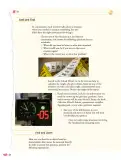
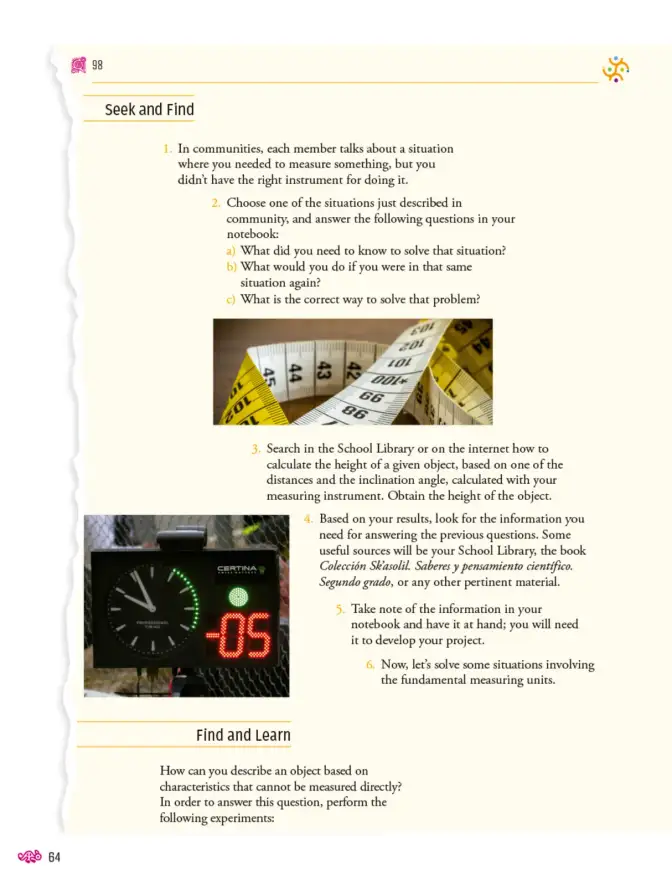
Cinta métrica amarilla enrollada mostrando números y marcas de medición.
Figura 1 image
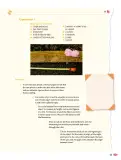
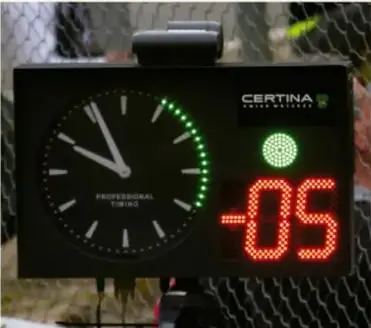
Reloj digital y analógico marca Certina con display rojo que muestra '-05'.
Figura 2 image

Preguntas que la gente también hace

¿Cómo calcular la altura de un objeto usando distancia y ángulo?
Consulta la solución completa arriba o explora el libro entero para temas relacionados.
¿Cuáles son las unidades fundamentales del Sistema Internacional?
Consulta la solución completa arriba o explora el libro entero para temas relacionados.
¿Qué métodos indirectos existen para medir magnitudes?
Consulta la solución completa arriba o explora el libro entero para temas relacionados.
¿Cómo medir el volumen de un sólido irregular?
Consulta la solución completa arriba o explora el libro entero para temas relacionados.
📌 Antes de leer esto
  • • Concepto de magnitud y unidad
  • • Operaciones básicas
  • • Nociones de triángulos rectángulos
Siguiente tema sugerido
Experimentos de medición indirecta y unidades fundamentales
📝 Transcripción de la página (texto seleccionable) 1404 caracteres

Seek and Find

  1. In communities, each member talks about a situation where you needed to measure something, but you didn't have the right instrument for doing it.

2.Choose one of the situations just described in community, and answer the following questions in your notebook:

a) What did you need to know to solve that situation?b) What would you do if you were in that same situation again?

c) What is the correct way to solve that problem?

  1. Search in the School Library or on the internet how to calculate the height of a given object, based on one of the distances and the inclination angle, calculated with your measuring instrument. Obtain the height of the object.

  2. Based on your results, look for the information you need for answering the previous questions. Some useful sources will be your School Library, the book Colección Sk'asolil. Saberes y pensamiento cientifico.Segundo grado, or any other pertinent material.

  3. Take note of the information in your notebook and have it at hand; you will need it to develop your project.

  4. Now, let's solve some situations involving the fundamental measuring units.

Find and Learn

How can you describe an object based on characteristics that cannot be measured directly?In order to answer this question, perform the following experiments:

0 8

8

![](page=0,bbox=[383, 574, 889, 766])

![](page=0,bbox=[151, 928, 522, 1256])

乐

64

Ad

Otros libros recomendados

Ver todos →
Ad

Usamos cookies propias y de terceros para personalizar contenido, mostrar publicidad y analizar el tráfico. Las cookies necesarias siempre están activas.