Saltar al contenido
MisLibrosTexto
Ad

Self-Reflection: Appreciating My Path

📄 ejercicios ingles 🎓 otro · 2° TELESECUNDARIA México 🇲🇽 MX 🗣 Español
Página 84
84 de 171
Página 84 de Uérakua anapu uantakua. Projects and Readings.  Libro de Educación Telesecundaria Grado 2°  Ciclo Escolar 2025 - 2026
Anterior Página 84 / 171 Siguiente

Respuesta rápida

  1. Lista de cotejo marcada según desempeño personal. 2. Respuestas de reflexión sobre mejora, dificultad, facilidad y aplicación futura. 3. Acuerdos de asamblea sobre unidades e instrumentos de medición.
📚 exercise ingles ⭐ Dificultad 1/5 ⏱ 4 min lectura

Solución — Página 84

Uérakua anapu uantakua. Projects and Readings. Libro de Educación Telesecundaria Grado 2° Ciclo Escolar 2025 - 2026

1
Ejercicio 1

Individually, without forgetting community work, use the following checklist as a guide to identify the important points in the development and execution of the project.

Respuesta orientativa: Esta lista de cotejo es de autoevaluación personal; cada estudiante marca Achieved o Not Achieved según su desempeño real. Un ejemplo de registro completo sería:

Indicator Achieved Not Achieved
I connected the hypothesis to the problem posed. ✓
I consulted reliable sources and verified information in different places. ✓
I identified the importance of verifying the hypothesis and the information obtained from the application of the aforesaid hypothesis. ✓
I shared my doubts and knowledge about the topic. ✓
I designed a legible poster with the required information. ✓
I presented my work in the classroom and before the community. ✓
I identified areas of improvement for future projects. ✓
2
Ejercicio 2

Answer the following questions in your notebook.

a
Parte 2.a

What would you improve about the project?

Respuesta orientativa: I would improve the time management during the investigation stage, because we spent too many days looking for sources and then we had little time to design the poster. I would also assign specific roles from the beginning so that everyone contributes equally.

b
Parte 2.b

What stage was the most difficult for you?

Respuesta orientativa: The most difficult stage was verifying the hypothesis, because some sources gave contradictory information and we had to compare data from different places before reaching a conclusion. It was hard to decide which source was reliable.

c
Parte 2.c

What moment was the easiest for you?

Respuesta orientativa: The easiest moment was designing the poster, because we had already organized all the information and we only had to choose images and write short, clear texts. Working as a team made this stage fast and enjoyable.

d
Parte 2.d

How will you apply what you learned from now on?

Respuesta orientativa: I will apply what I learned by verifying information in reliable sources before accepting it as true, and by working collaboratively with my community. I will also use the checklist method to evaluate my own progress in future projects.

3
Ejercicio 3

Finally, write in your notebooks the assembly agreements reached by the community to apply your knowledge about quantities, units of measurement, and measuring instruments to count or measure very large or very small quantities.

Respuesta orientativa: Un ejemplo de acuerdos de asamblea sería:

  1. Usar instrumentos adecuados según la cantidad: regla o vernier para longitudes pequeñas, cinta métrica para distancias mayores y balanza para masas.
  2. Registrar siempre la unidad de medida (mm, cm, m, km, mg, g, kg) para evitar confusiones.
  3. Para cantidades muy grandes o muy pequeñas, usar notación científica y múltiplos o submúltiplos del Sistema Internacional.
  4. Revisar en equipo las mediciones antes de presentarlas a la comunidad.
  5. Compartir los resultados con la localidad mediante carteles o una exposición.

Contenido de la página

c) After the presentation:

  • Remember that being respectful in the community is very important. Ask your classmates if they have any questions or comments. This will help you improve in future projects. When others present their work, if you can, contribute with ideas, comment on them respectfully and empathetically.
  • Describe how you felt while doing this project, what you would like to improve or add, and what other things you would like to investigate.

At the end of everyone's presentations, reflect on the conclusions you reached. Find a way to present them to the community, both at school and in your locality.


SELF-REFLECTION

Appreciating My Path

After completing the project, talk to the classroom community about the achievements made and the difficulties met from the beginning until the presentation of your project:

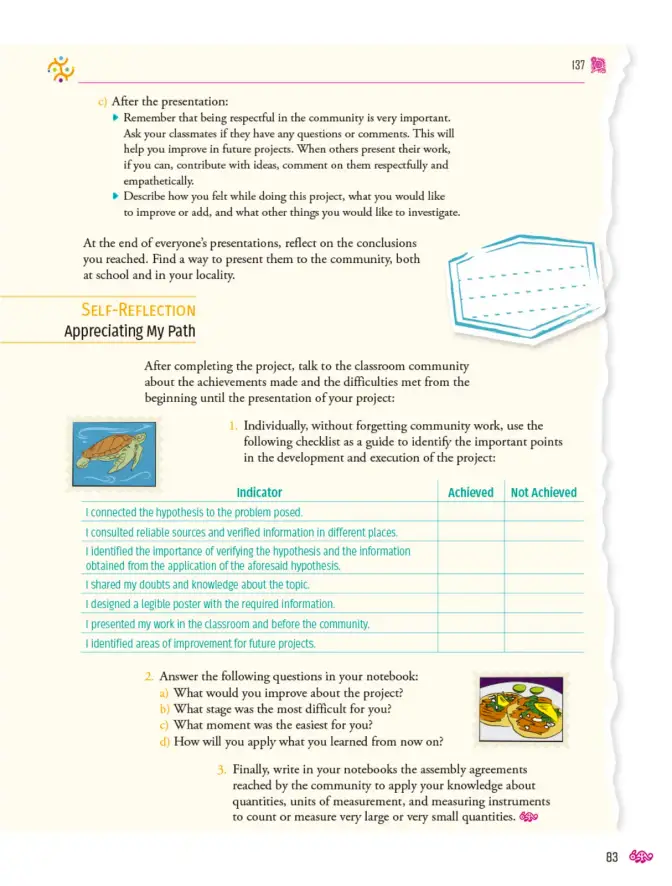
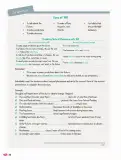
  1. Individually, without forgetting community work, use the following checklist as a guide to identify the important points in the development and execution of the project:
Indicator Achieved Not Achieved
I connected the hypothesis to the problem posed.
I consulted reliable sources and verified information in different places.
I identified the importance of verifying the hypothesis and the information obtained from the application of the aforesaid hypothesis.
I shared my doubts and knowledge about the topic.
I designed a legible poster with the required information.
I presented my work in the classroom and before the community.
I identified areas of improvement for future projects.
  1. Answer the following questions in your notebook: a) What would you improve about the project? b) What stage was the most difficult for you? c) What moment was the easiest for you? d) How will you apply what you learned from now on?

  2. Finally, write in your notebooks the assembly agreements reached by the community to apply your knowledge about quantities, units of measurement, and measuring instruments to count or measure very large or very small quantities.

Tabla

Indicator Achieved Not Achieved
I connected the hypothesis to the problem posed.
I consulted reliable sources and verified information in different places.
I identified the importance of verifying the hypothesis and the information obtained from the application of the aforesaid hypothesis.
I shared my doubts and knowledge about the topic.
I designed a legible poster with the required information.
I presented my work in the classroom and before the community.
I identified areas of improvement for future projects.

Glosario (8)

Self-reflection
Reflexión personal sobre el propio aprendizaje y desempeño.
Checklist
Lista de cotejo con indicadores para verificar el cumplimiento de tareas.
Achieved
Logrado; indica que el indicador se cumplió.
Not Achieved
No logrado; indica que el indicador aún no se cumple.
Hypothesis
Hipótesis; suposición que se busca comprobar.
Reliable sources
Fuentes confiables de información.
Assembly agreements
Acuerdos de asamblea tomados en comunidad.
Units of measurement
Unidades de medida (mm, cm, m, kg, etc.).

Preguntas para practicar

What would you improve about the project?

I would improve time management and role assignment during the investigation stage.

What stage was the most difficult for you?

Verifying the hypothesis, because some sources gave contradictory information.

What moment was the easiest for you?

Designing the poster, because the information was already organized.

How will you apply what you learned from now on?

By verifying reliable sources and working collaboratively in community projects.

Temas y conceptos clave

Autoevaluación de proyectosReflexión sobre el proceso de aprendizajeAcuerdos comunitariosUnidades de medida e instrumentosSelf-reflectionChecklistAchieved / Not AchievedHypothesisReliable sourcesAssembly agreementsUnits of measurement
¿Te fue útil esta página?

Figuras de la página (3)

Recuadro hexagonal con líneas punteadas para escribir conclusiones.
Figura 1 image
Ilustración de una tortuga marina nadando.
Figura 2 image
Ilustración de un plato con alimentos saludables (frutas y verduras).
Figura 3 image

Preguntas que la gente también hace

¿Cómo se completa una lista de cotejo de autoevaluación en inglés?
Consulta la solución completa arriba o explora el libro entero para temas relacionados.
¿Qué preguntas de reflexión se hacen al final de un proyecto escolar?
Consulta la solución completa arriba o explora el libro entero para temas relacionados.
¿Cómo aplicar las unidades de medida en un proyecto comunitario?
Consulta la solución completa arriba o explora el libro entero para temas relacionados.
📌 Antes de leer esto
  • • Vocabulario básico en inglés sobre proyectos y trabajo en equipo
  • • Conocimiento de las etapas de un proyecto de investigación
  • • Nociones de unidades de medida y notación científica
Siguiente tema sugerido
Presentación de conclusiones del proyecto a la comunidad
📝 Transcripción de la página (texto seleccionable) 2433 caracteres

c) After the presentation:

Remember that being respectful in the community is very important.Ask your classmates if they have any questions or comments. This will help you improve in future projects. When others present their work,if you can, contribute with ideas, comment on them respectfully and empathetically.

Describe how you felt while doing this project, what you would like to improve or add, and what other things you would like to investigate.

At the end of everyone's presentations, reflect on the conclusions you reached. Find a way to present them to the community, both at school and in your locality.

SELF-REFLECTION Appreciating My Path

After completing the project, talk to the classroom community about the achievements made and the difficulties met from the beginning until the presentation of your project:

  1. Individually, without forgetting community work, use the following checklist as a guide to identify the important points in the development and execution of the project:

  2. Answer the following questions in your notebook:a) What would you improve about the project? b) What stage was the most difficult for you? c)What moment was the easiest for you? d) How will you apply what you learned from now on?

  3. Finally, write in your notebooks the assembly agreements reached by the community to apply your knowledge about quantities, units of measurement, and measuring instruments to count or measure very large or very small quantities.

🎉

137

![](page=0,bbox=[806, 417, 1102, 628])

![](page=0,bbox=[127, 756, 281, 878])

Indicator
I connected the hypothesis to the problem posed.
I consulted reliable sources and verified information in different places.
Iidentified the importance of verifying the hypothesis and the information obtained from the application of the aforesaid hypothesis.
I shared my doubts and knowledge about the topic.
I designed a legible poster with the required information.
I presented my work in the classroom and before the community
I identified areas of improvement for future projects.

![](page=0,bbox=[862, 1217, 1016, 1339])

83

8
Ad

Otros libros recomendados

Ver todos →
Ad

Usamos cookies propias y de terceros para personalizar contenido, mostrar publicidad y analizar el tráfico. Las cookies necesarias siempre están activas.