Saltar al contenido
MisLibrosTexto
Ad

Building and/or Proving: The Possible Paths - Acid Rain Experiment

📄 ejercicios ciencias-naturales 🎓 otro · 3° TELESECUNDARIA México 🇲🇽 MX 🗣 Español
Página 161
161 de 187
Página 161 de Uérakua anapu uantakua. Projects and Readings.  Libro de Educación Telesecundaria Grado 3°  Ciclo Escolar 2025 - 2026
Anterior Página 161 / 187 Siguiente

Respuesta rápida

6-7: Tabla de observaciones diarias. 1a-h: Análisis de indicadores, efectos y reacciones. 2a-b: Cartel con información química y ambiental.

📚 exercise ciencias-naturales ⭐⭐ Dificultad 2/5 ⏱ 10 min lectura

Solución — Página 161

Uérakua anapu uantakua. Projects and Readings. Libro de Educación Telesecundaria Grado 3° Ciclo Escolar 2025 - 2026

6
Ejercicio 6

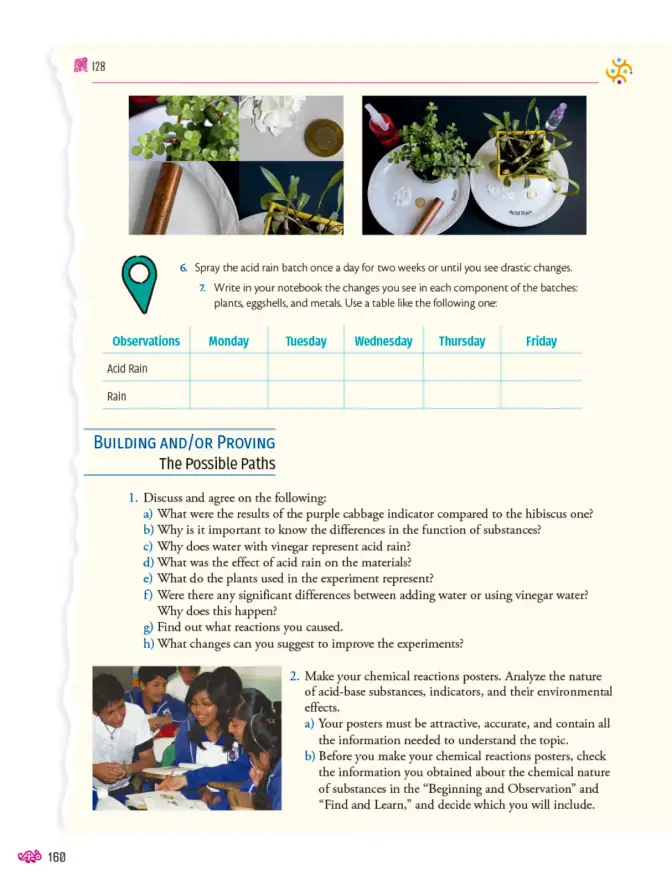
Spray the acid rain batch once a day for two weeks or until you see drastic changes.

  1. Se rocía el lote de lluvia ácida una vez al día durante dos semanas.
  2. Se observan cambios drásticos en plantas, cáscaras de huevo y metales.
  3. Se registran los cambios en el cuaderno.
Respuesta

Registro diario en tabla de observaciones (ver Ejercicio 7).

7
Ejercicio 7

Write in your notebook the changes you see in each component of the batches: plants, eggshells, and metals. Use a table like the following one.

  1. Se preparan dos lotes: uno con lluvia ácida (agua con vinagre) y otro con lluvia normal (agua).
  2. Cada día se observan los tres componentes: plantas, cáscaras de huevo y metales.
  3. Se anotan los cambios en la tabla.
Observations Monday Tuesday Wednesday Thursday Friday
Acid Rain Hojas verdes, sin cambio Bordes de hojas amarillentos Cáscara de huevo se ablanda Metal con manchas oscuras Hojas marchitas, metal corroído
Rain Sin cambio Sin cambio Sin cambio Sin cambio Sin cambio
Respuesta

Tabla completada con observaciones diarias (ejemplo orientativo):

1
Ejercicio 1

Discuss and agree on the following:

a
Parte 1.a

What were the results of the purple cabbage indicator compared to the hibiscus one?

  1. El indicador de col morada cambia de color según el pH: rojo en ácido, verde en base.
  2. El indicador de hibisco (flor de Jamaica) también cambia, pero su rango de viraje es menos amplio.
  3. La col morada mostró colores más variados y definidos.
Respuesta

La col morada dio una gama más amplia de colores; el hibisco cambió menos.

b
Parte 1.b

Why is it important to know the differences in the function of substances?

  1. Conocer la función de las sustancias permite predecir reacciones.
  2. Ayuda a identificar ácidos y bases en la vida diaria.
  3. Permite tomar decisiones seguras en el laboratorio y el ambiente.
Respuesta

Porque permite predecir, identificar y usar sustancias de forma segura.

c
Parte 1.c

Why does water with vinegar represent acid rain?

  1. El vinagre contiene ácido acético (CH_3COOH).
  2. La lluvia ácida contiene ácidos como H_2SO_4 y HNO_3.
  3. Ambos tienen pH menor a 5.6 y reaccionan con materiales.
Respuesta

Porque el vinagre aporta acidez similar a la de la lluvia ácida real.

d
Parte 1.d

What was the effect of acid rain on the materials?

  1. Las cáscaras de huevo (carbonato de calcio) se ablandaron.
  2. Los metales se oxidaron y mancharon.
  3. Las plantas se marchitaron y amarillearon.
Respuesta

Corrosión de metales, ablandamiento de cáscaras y daño a plantas.

e
Parte 1.e

What do the plants used in the experiment represent?

  1. Representan la vegetación expuesta a la lluvia ácida.
  2. Muestran el daño en hojas y tallos.
  3. Simbolizan el impacto en los ecosistemas.
Respuesta

Representan la vegetación afectada por la lluvia ácida.

f
Parte 1.f

Were there any significant differences between adding water or using vinegar water? Why does this happen?

  1. Sí, hubo diferencias: el agua con vinagre causó cambios visibles.
  2. El agua sola no reacciona con los materiales.
  3. El vinagre (ácido) reacciona con carbonatos y metales.
Respuesta

Sí; el vinagre reacciona químicamente y el agua no.

g
Parte 1.g

Find out what reactions you caused.

  1. Reacción ácido-base: vinagre + cáscara de huevo (CaCO_3).
  2. Liberación de CO_2 (burbujas).
  3. Oxidación de metales por acidez.
Respuesta

Reacciones ácido-base con carbonatos y oxidación de metales.

h
Parte 1.h

What changes can you suggest to improve the experiments?

  1. Usar más réplicas para mayor confiabilidad.
  2. Medir pH con papel indicador.
  3. Controlar temperatura y luz.
Respuesta

Aumentar réplicas, medir pH y controlar variables.

Ad
2
Ejercicio 2

Make your chemical reactions posters. Analyze the nature of acid-base substances, indicators, and their environmental effects.

a
Parte 2.a

Your posters must be attractive, accurate, and contain all the information needed to understand the topic.

  1. Incluir título, introducción y objetivos.
  2. Mostrar ejemplos de ácidos y bases con fórmulas.
  3. Explicar indicadores y efectos ambientales.
Respuesta

Cartel con información completa, clara y visual.

b
Parte 2.b

Before you make your chemical reactions posters, check the information you obtained about the chemical nature of substances in the "Beginning and Observation" and "Find and Learn," and decide which you will include.

  1. Revisar notas de las secciones previas.
  2. Seleccionar datos relevantes sobre ácidos, bases e indicadores.
  3. Decidir qué incluir en el cartel.
Respuesta

Selección de información de las secciones previas para el cartel.

Contenido de la página

  1. Spray the acid rain batch once a day for two weeks or until you see drastic changes.

  2. Write in your notebook the changes you see in each component of the batches: plants, eggshells, and metals. Use a table like the following one:

Observations Monday Tuesday Wednesday Thursday Friday
Acid Rain
Rain

BUILDING AND/OR PROVING The Possible Paths

  1. Discuss and agree on the following:

a) What were the results of the purple cabbage indicator compared to the hibiscus one? b) Why is it important to know the differences in the function of substances? c) Why does water with vinegar represent acid rain? d) What was the effect of acid rain on the materials? e) What do the plants used in the experiment represent? f) Were there any significant differences between adding water or using vinegar water? Why does this happen? g) Find out what reactions you caused. h) What changes can you suggest to improve the experiments?

  1. Make your chemical reactions posters. Analyze the nature of acid-base substances, indicators, and their environmental effects.

a) Your posters must be attractive, accurate, and contain all the information needed to understand the topic. b) Before you make your chemical reactions posters, check the information you obtained about the chemical nature of substances in the "Beginning and Observation" and "Find and Learn," and decide which you will include.

Tabla

Observations Monday Tuesday Wednesday Thursday Friday
Acid Rain
Rain

Fórmulas y ecuaciones

pH = -\log[H^+]

CH_3COOH

CaCO_3

H_2SO_4

HNO_3

Glosario (3)

Acid rain
Lluvia con pH menor a 5.6 por óxidos de azufre y nitrógeno.
Indicator
Sustancia que cambia de color según el pH.
Batch
Lote o muestra preparada para el experimento.

Preguntas para practicar

What were the results of the purple cabbage indicator compared to the hibiscus one?

La col morada mostró una gama más amplia de colores que el hibisco.

Why is it important to know the differences in the function of substances?

Para predecir reacciones y usar sustancias de forma segura.

Why does water with vinegar represent acid rain?

Porque el vinagre aporta acidez similar a la lluvia ácida.

What was the effect of acid rain on the materials?

Corrosión de metales, ablandamiento de cáscaras y daño a plantas.

What do the plants used in the experiment represent?

La vegetación afectada por la lluvia ácida.

Were there any significant differences between adding water or using vinegar water? Why does this happen?

Sí; el vinagre reacciona químicamente y el agua no.

Find out what reactions you caused.

Reacciones ácido-base con carbonatos y oxidación de metales.

What changes can you suggest to improve the experiments?

Aumentar réplicas, medir pH y controlar variables.

Temas y conceptos clave

Lluvia ácidaIndicadores naturalesReacciones ácido-baseImpacto ambientalpHácido acéticocarbonato de calciooxidaciónindicador natural
¿Te fue útil esta página?

Preguntas que la gente también hace

¿Cómo afecta la lluvia ácida a las plantas?
Consulta la solución completa arriba o explora el libro entero para temas relacionados.
¿Qué indicador natural es mejor para medir pH?
Consulta la solución completa arriba o explora el libro entero para temas relacionados.
¿Por qué el vinagre simula la lluvia ácida?
Consulta la solución completa arriba o explora el libro entero para temas relacionados.
📌 Antes de leer esto
  • • Concepto de pH
  • • Ácidos y bases
  • • Observación experimental
Siguiente tema sugerido
Contaminación atmosférica y sus efectos
📝 Transcripción de la página (texto seleccionable) 1751 caracteres
  1. Write in your notebook the changes you see in each component of the batches:plants, eggshells, and metals. Use a table like the following one:

BUILDING AND/OR PROVING The Possible Paths

  1. Discuss and agree on the following:

a) What were the results of the purple cabbage indicator compared to the hibiscus one?b) Why is it important to know the differences in the function of substances?

c) Why does water with vinegar represent acid rain?

d) What was the effect of acid rain on the materials?

e) What do the plants used in the experiment represent?

f) Were there any significant differences between adding water or using vinegar water?Why does this happen?

g) Find out what reactions you caused.

h) What changes can you suggest to improve the experiments?

  1. Make your chemical reactions posters. Analyze the nature of acid-base substances, indicators, and their environmental effects.

a) Your posters must be attractive, accurate, and contain all the information needed to understand the topic.

b) Before you make your chemical reactions posters, check the information you obtained about the chemical nature of substances in the "Beginning and Observation"and "Find and Learn," and decide which you will include.

128

![](page=0,bbox=[230, 168, 1057, 422])

  1. Spray the acid rain batch once a day for two weeks or until you see drastic changes.

![](page=0,bbox=[216, 457, 284, 565])

observationsMondayTuesdayWednesdayThursdayFriday
Acid Rain
Rain

![](page=0,bbox=[165, 1200, 506, 1461])

乐

160

Ad

Otros libros recomendados

Ver todos →
Ad

Usamos cookies propias y de terceros para personalizar contenido, mostrar publicidad y analizar el tráfico. Las cookies necesarias siempre están activas.