













Saltar al contenido
MisLibrosTexto
Ad

Communication: I Got It — Sharing Project Results

📄 ejercicios ciencias-naturales 🎓 otro · 3° TELESECUNDARIA México 🇲🇽 MX 🗣 Español
Página 48
48 de 187
Página 48 de Uérakua anapu uantakua. Projects and Readings.  Libro de Educación Telesecundaria Grado 3°  Ciclo Escolar 2025 - 2026
Anterior Página 48 / 187 Siguiente

Respuesta rápida

Proyecto de comunicación científica: elegir un compuesto (ej. NaCl), describir clasificación, enlace iónico, solubilidad, conductividad y usos; difundir en tres fases (antes, durante, después) con lenguaje claro y conclusiones experimentales.

📚 exercise ciencias-naturales ⭐⭐ Dificultad 2/5 ⏱ 8 min lectura

Solución — Página 48

Uérakua anapu uantakua. Projects and Readings. Libro de Educación Telesecundaria Grado 3° Ciclo Escolar 2025 - 2026

4
Ejercicio 4

As it's important for science that the results are disseminated, as a community, decide what visual or audiovisual material you will generate for this purpose, such as videos, infographics, or posters, among others.

a
Parte 4.a

Select an element or compound from the ones studied.

Respuesta orientativa: Se puede elegir, por ejemplo, el cloruro de sodio (NaCl) o el **agua (H_{2}O)**, compuestos estudiados previamente en el bloque de enlace químico. La elección debe justificarse por su relevancia cotidiana y por la disponibilidad de datos experimentales obtenidos en el aula.

b
Parte 4.b

Develop all the points that you investigated in the classroom: classification of the substance, type of bond, solubility, conduction of electricity, and uses.

Respuesta orientativa (ejemplo con NaCl):

  1. Clasificación: compuesto inorgánico binario, sal haloidea.
  2. Tipo de enlace: iónico, formado por transferencia de electrones entre Na (metal alcalino) y Cl (halógeno).
  3. Solubilidad: soluble en agua (35.7\,\text{g}/100\,\text{mL} a 25^\circ\text{C}); insoluble en disolventes apolares como el hexano.
  4. Conducción eléctrica: no conduce en estado sólido; fundido o disuelto en agua conduce la corriente porque libera iones \text{Na}^{+} y \text{Cl}^{-}.
  5. Usos: condimento alimentario, conservación de alimentos, materia prima para obtener cloro e hidróxido de sodio, y en medicina como suero fisiológico.
c
Parte 4.c

With the support of your teacher, share your results with the school, the town, and on social networks.

Respuesta orientativa: Se sugiere presentar el material en una feria de ciencias escolar, publicarlo en el periódico mural y difundirlo mediante un video corto en redes sociales, siempre con la supervisión del docente y citando las fuentes consultadas.

d
Parte 4.d

Include enough information written in a clear and simple way so that the people who read it can understand it.

Respuesta orientativa: El material debe usar lenguaje accesible, evitar tecnicismos innecesarios, incluir ejemplos cotidianos y apoyarse en imágenes o esquemas que expliquen el enlace iónico y la conductividad sin requerir conocimientos avanzados.

e
Parte 4.e

Integrate into your material the conclusions you reached from experimentation and the hypothesis or hypotheses you chose at the beginning of your project.

Respuesta orientativa: Se debe contrastar la hipótesis inicial (por ejemplo, "las disoluciones salinas conducen electricidad") con los resultados experimentales obtenidos, señalando si se confirmó o se rechazó, y explicando las razones con base en la teoría del enlace iónico.

COMMUNICATION — I Got It

It's time to share the results of the project.

Paso 1. Before

Get together in communities and decide how to spread your results.

Respuesta orientativa:

  • 1.a Revisar y leer el contenido antes de presentarlo para evitar confusiones e imprecisiones; definir la fecha de presentación.
  • 1.b Reunir los materiales necesarios para crear el medio (cartulinas, cámara, computadora) y, si se requiere, fijar una fecha de retroalimentación previa a la entrega.
  • 1.c Usar lenguaje científico correcto, pero asegurándose de que el público lo comprenda.

Paso 2. During

Take care of the details in the creation of your content, try to have good diction and avoid fillers. If you use a visual material, try to make it pleasant and understandable at sight.

Respuesta orientativa: Durante la presentación se debe hablar con claridad, modular la voz, evitar muletillas y cuidar el diseño visual para que el mensaje sea comprensible a primera vista.

Paso 3. At the end

After finishing the community presentation, talk about the areas of opportunity and improvement for each one, so that your future presentations and projects have a greater impact on the audience.

Respuesta orientativa: Al finalizar, el equipo debe autoevaluarse identificando fortalezas y áreas de mejora (organización, claridad, dominio del tema) para optimizar futuras presentaciones.
Contenido de la página

4. Dissemination of results

As it's important for science that the results are disseminated, as a community, decide what visual or audiovisual material you will generate for this purpose, such as videos, infographics, or posters, among others.

  • a) Select an element or compound from the ones studied.
  • b) Develop all the points that you investigated in the classroom:
    • Classification of the substance, type of bond, solubility, conduction of electricity, and uses.
  • c) With the support of your teacher, share your results with the school, the town, and on social networks.
  • d) Include enough information written in a clear and simple way so that the people who read it can understand it.
  • e) Integrate into your material the conclusions you reached from experimentation and the hypothesis or hypotheses you chose at the beginning of your project.

COMMUNICATION — I Got It

It's time to share the results of the project.

  1. Before. Get together in communities and decide how to spread your results.
    • a) For visual or audiovisual material, it is suggested that you review and read the content before presenting it, to avoid confusion and inaccuracies. Define a date on which to present your work.
    • b) Get the necessary materials to create your media. If it's required, set a date to provide feedback before submitting the work.
    • c) Remember that the use of scientific language is important, but you and the audience must understand the information shared.
  2. During. Take care of the details in the creation of your content, try to have good diction and avoid fillers. If you use a visual material, try to make it pleasant and understandable at sight.
  3. At the end. After finishing the community presentation, talk about the areas of opportunity and improvement for each one, so that your future presentations and projects have a greater impact on the audience.

Tabla

Fase Acción clave Producto
Antes Revisar contenido y reunir materiales Plan de presentación
Durante Exponer con claridad y buen material Presentación comunitaria
Después Evaluar áreas de mejora Retroalimentación

Diagrama

flowchart TD
  A[Proyecto de ciencias] --> B[Antes: planear difusión]
  A --> C[Durante: presentar con claridad]
  A --> D[Después: evaluar y mejorar]
  B --> B1[Revisar contenido]
  B --> B2[Reunir materiales]
  B --> B3[Definir fecha]
  C --> C1[Buena dicción]
  C --> C2[Material visual claro]
  D --> D1[Áreas de oportunidad]
  D --> D2[Mejora continua]

Glosario (5)

disseminate
difundir o dar a conocer información a un público amplio
infographic
representación visual de información que combina texto e imágenes
diction
manera de pronunciar y expresar las palabras al hablar en público
fillers
muletillas o palabras de relleno que interrumpen el discurso
feedback
retroalimentación o comentarios para mejorar un trabajo

Preguntas para practicar

¿Por qué es importante difundir los resultados científicos?

Porque la ciencia avanza cuando el conocimiento se comparte y se somete a revisión pública, permitiendo que otras personas lo validen, lo apliquen o lo mejoren.

¿Qué diferencia hay entre un elemento y un compuesto?

Un elemento está formado por un solo tipo de átomo, mientras que un compuesto combina dos o más elementos unidos químicamente en proporciones fijas.

Temas y conceptos clave

Comunicación de resultados científicosDifusión de proyectos escolaresPropiedades de compuestos químicosDivulgación científicaMaterial visual y audiovisualHipótesis y conclusionesLenguaje científico accesible
¿Te fue útil esta página?

Figuras de la página (3)

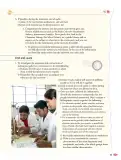
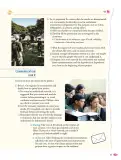
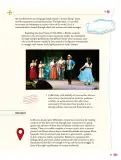
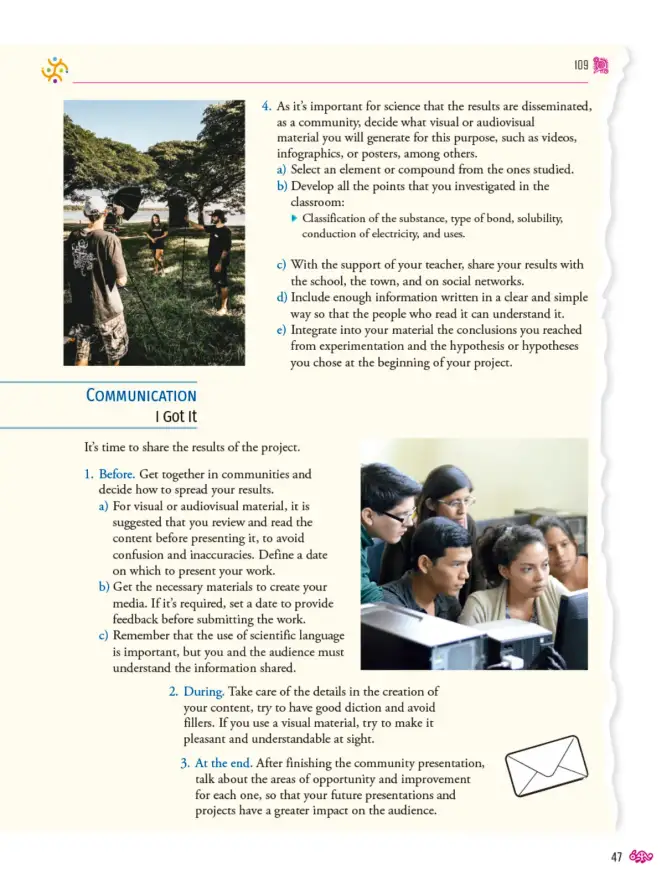
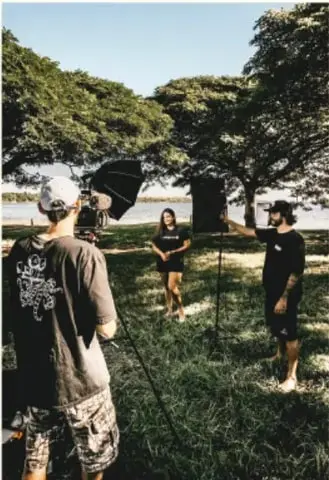
Estudiantes grabando un video al aire libre con equipo profesional, como ejemplo de material audiovisual científico.
Figura 1 image
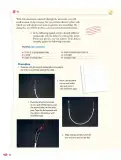
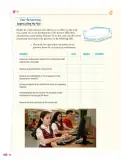
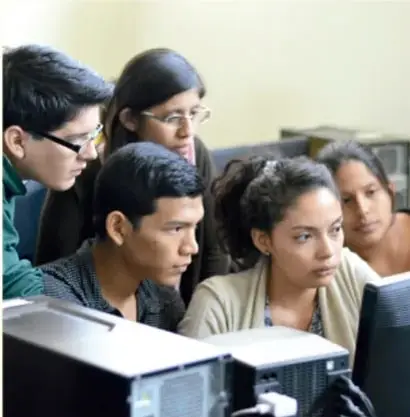
Grupo de estudiantes trabajando frente a computadoras, elaborando material digital para difundir su proyecto.
Figura 2 image
Ilustración de un sobre de carta que simboliza la comunicación y difusión de resultados.
Figura 3 image

Preguntas que la gente también hace

¿Cómo se difunde un proyecto científico escolar?
Consulta la solución completa arriba o explora el libro entero para temas relacionados.
¿Qué es el enlace iónico y cómo se explica en Telesecundaria?
Consulta la solución completa arriba o explora el libro entero para temas relacionados.
¿Por qué las disoluciones salinas conducen electricidad?
Consulta la solución completa arriba o explora el libro entero para temas relacionados.
📌 Antes de leer esto
  • • Clasificación de la materia (elemento y compuesto)
  • • Tipos de enlace químico
  • • Propiedades de compuestos iónicos y covalentes
Siguiente tema sugerido
Evaluación final del proyecto y autoevaluación de aprendizajes
📝 Transcripción de la página (texto seleccionable) 1967 caracteres
  1. As it's important for science that the results are disseminated,as a community, decide what visual or audiovisual material you will generate for this purpose, such as videos,infographics, or posters, among others.

a) Select an element or compound from the ones studied.

b) Develop all the points that you investigated in the classroom:

Classification of the substance, type of bond, solubility,conduction of electricity, and uses.

2With the support of your teacher, share your results with the school, the town, and on social networks.

d) Include enough information written in a clear and simple way so that the people who read it can understand it.

Integrate into your material the conclusions you reached from experimentation and the hypothesis or hypotheses you chose at the beginning of your project.

COMMUNICATION I Got It

It's time to share the results of the project.

  1. Before. Get together in communities and decide how to spread your results.

a) For visual or audiovisual material, it is suggested that you review and read the content before presenting it, to avoid confusion and inaccuracies. Define a date on which to present your work.

b) Get the necessary materials to create your media. If it's required, set a date to provide feedback before submitting the work.

c)) Remember that the use of scientifi c language is important, but you and the audience must understand the information shared.

  1. During. Take care of the details in the creation of your content, try to have good diction and avoid fillers. If you use a visual material, try to make it pleasant and understandable at sight.

  2. At the end. After finishing the community presentation,talk about the areas of opportunity and improvement for each one, so that your future presentations and projects have a greater impact on the audience.

109

![](page=0,bbox=[113, 178, 442, 658])

![](page=0,bbox=[649, 791, 1059, 1208])

![](page=0,bbox=[910, 1323, 1061, 1439])

47

Ad

Otros libros recomendados

Ver todos →
Ad

Usamos cookies propias y de terceros para personalizar contenido, mostrar publicidad y analizar el tráfico. Las cookies necesarias siempre están activas.