
















Ejercicio f
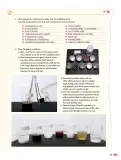
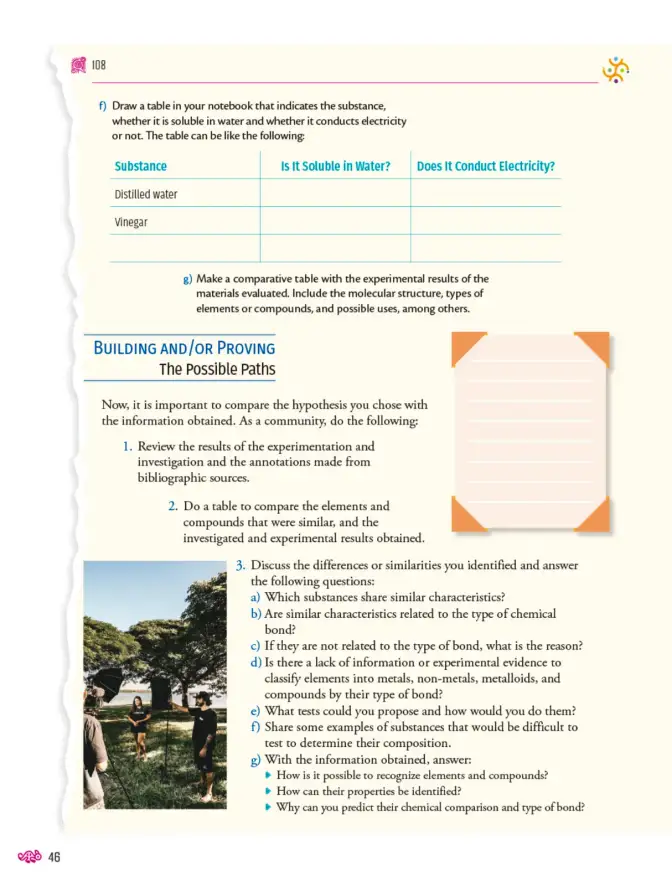
Draw a table in your notebook that indicates the substance, whether it is soluble in water and whether it conducts electricity or not.
- Se identifican las sustancias de la tabla: agua destilada y vinagre.
- Se completa con base en las propiedades conocidas: el agua destilada es soluble en agua (es el disolvente) y no conduce electricidad porque no tiene iones libres.
- El vinagre (ácido acético diluido) es soluble en agua y conduce electricidad débilmente porque se ioniza parcialmente.
Respuesta:
| Substance | Is It Soluble in Water? | Does It Conduct Electricity? |
|---|---|---|
| Distilled water | Yes (it is the solvent) | No (no free ions) |
| Vinegar | Yes | Yes, weakly (weak electrolyte) |
| Example: table salt (NaCl) | Yes | Yes, in aqueous solution |
Ejercicio g
Make a comparative table with the experimental results of the materials evaluated. Include the molecular structure, types of elements or compounds, and possible uses, among others.
- Se organizan los materiales evaluados en columnas: sustancia, tipo (elemento o compuesto), estructura, solubilidad, conductividad y usos.
- Se clasifica cada uno según su enlace: iónico, covalente polar, covalente no polar o metálico.
- Se relaciona la estructura con las propiedades observadas.
Respuesta:
| Material | Type | Structure / Bond | Soluble in water? | Conducts electricity? | Uses |
|---|---|---|---|---|---|
| Distilled water | Compound | Covalent polar (H₂O) | — (solvent) | No | Solvent, experiments |
| Vinegar | Compound | Covalent polar (CH₃COOH) | Yes | Weakly | Food, cleaning |
| Table salt | Compound | Ionic (NaCl) | Yes | Yes (dissolved or molten) | Seasoning, industry |
| Copper wire | Element | Metallic (Cu) | No | Yes | Electrical wiring |
| Sugar | Compound | Covalent polar (C₁₂H₂₂O₁₁) | Yes | No | Food |
Paso 1
Review the results of the experimentation and investigation and the annotations made from bibliographic sources.
Respuesta orientativa: Se comparan los datos experimentales con la bibliografía; se anotan coincidencias y diferencias, por ejemplo, que el azúcar se disuelve pero no conduce electricidad, mientras que la sal se disuelve y sí conduce.
Paso 2
Do a table to compare the elements and compounds that were similar, and the investigated and experimental results obtained.
Respuesta orientativa:
| Aspect | Elements | Compounds |
|---|---|---|
| Composition | One type of atom | Two or more elements combined |
| Bond | Metallic, covalent, etc. | Ionic or covalent |
| Conductivity | Metals conduct | Only if ionic or acid/base in solution |
| Solubility | Variable | Variable, depends on polarity |
Paso 3
Discuss the differences or similarities you identified and answer the following questions.
Which substances share similar characteristics?
Las sustancias iónicas (sal) y los ácidos (vinagre) comparten que se disuelven en agua y conducen electricidad en disolución; los compuestos covalentes no electrolitos (azúcar) se disuelven pero no conducen.
Are similar characteristics related to the type of chemical bond?
Sí. La conductividad eléctrica en disolución depende de la presencia de iones libres, propia de compuestos iónicos y de ácidos/bases fuertes; la solubilidad depende de la polaridad del enlace y de la molécula.
If they are not related to the type of bond, what is the reason?
Puede deberse al tamaño de las moléculas, a la presencia de grupos funcionales, a la temperatura o a la concentración, factores que modifican la solubilidad y la conductividad sin cambiar el tipo de enlace.
Is there a lack of information or experimental evidence to classify elements into metals, non-metals, metalloids, and compounds by their type of bond?
No necesariamente; las propiedades físicas (brillo, maleabilidad, conductividad) y químicas permiten clasificar elementos. En compuestos, la conductividad en disolución y la diferencia de electronegatividad orientan sobre el tipo de enlace, aunque se requiere más evidencia experimental.
What tests could you propose and how would you do them?
Pruebas de solubilidad (mezclar pequeñas muestras con agua y agitar), de conductividad (usar un circuito con foco o multímetro y electrodos), de punto de fusión y de reacción con ácidos. Se realizan con muestras pequeñas, bajo supervisión y con equipo de seguridad.
Share some examples of substances that would be difficult to test to determine their composition.
Mezclas complejas como la leche, el petróleo, el aire o los plásticos, porque contienen muchas sustancias y sus propiedades dependen de la mezcla, no de un solo compuesto.
With the information obtained, answer:
How is it possible to recognize elements and compounds? Los elementos tienen un solo tipo de átomo y aparecen en la tabla periódica; los compuestos se forman por dos o más elementos unidos químicamente en proporciones fijas.
How can their properties be identified? Mediante pruebas de solubilidad, conductividad, punto de fusión/ebullición, densidad y reactividad química.
Why can you predict their chemical comparison and type of bond? Porque la posición en la tabla periódica y la diferencia de electronegatividad permiten predecir si el enlace será iónico, covalente polar, covalente no polar o metálico, y con ello sus propiedades.