
















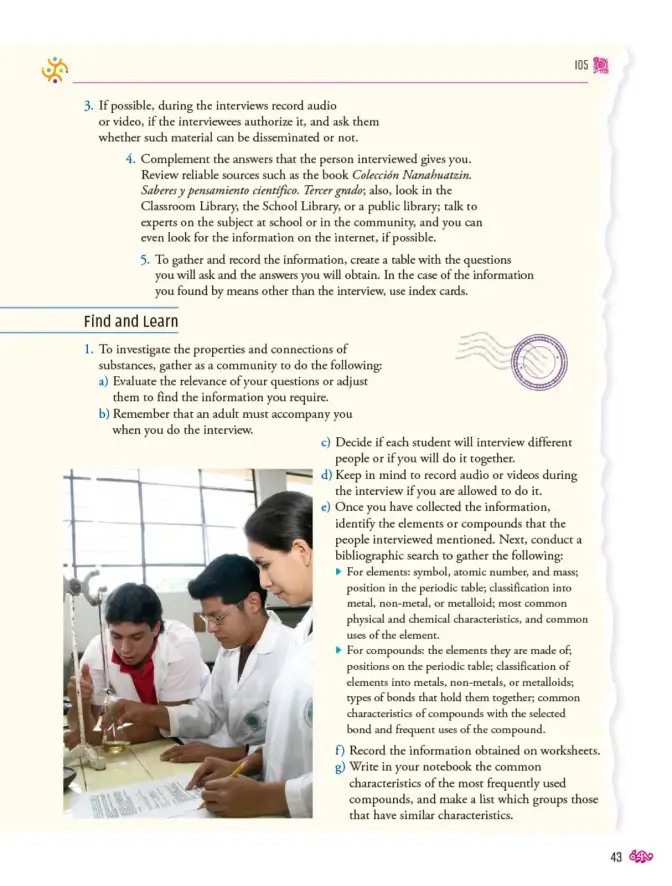
Enunciado (ES): Para investigar las propiedades y conexiones de las sustancias, reúnanse en comunidad y realicen lo siguiente. EN: To investigate the properties and connections of substances, gather as a community to do the following.
Enunciado: Evalúen la pertinencia de sus preguntas o ajústenlas para encontrar la información que requieren.
- Revisen cada pregunta y pregunten: ¿es clara, medible y responde al objetivo (propiedades y conexiones de sustancias)?
- Eliminen preguntas ambiguas (ej. "¿qué sabes de química?") y reemplácenlas por preguntas concretas (ej. "¿qué elemento o compuesto usa en su trabajo y para qué?").
- Ordenen las preguntas de lo general a lo específico y verifiquen que un adulto pueda responderlas en pocos minutos.
Respuesta orientativa: Las preguntas deben ser claras, breves y enfocadas en elementos o compuestos concretos; se ajustan eliminando ambigüedades y añadiendo ejemplos cotidianos.
Enunciado: Recuerden que un adulto debe acompañarlos durante la entrevista.
- Identifiquen al adulto responsable (docente, tutor o familiar).
- Acuerden fecha, hora y lugar de la entrevista con su supervisión.
- Informen al entrevistado que un adulto estará presente y pidan su autorización.
Respuesta orientativa: La presencia del adulto garantiza seguridad, respeto y validez de la información recabada.
Enunciado: Decidan si cada estudiante entrevistará a personas distintas o si lo harán juntos.
- Si el grupo es numeroso, distribuyan entrevistados distintos para ampliar la muestra.
- Si el grupo es pequeño, realicen la entrevista en equipo para registrar mejor las respuestas.
- Definan roles: quien pregunta, quien graba y quien toma notas.
Respuesta orientativa: Ambas opciones son válidas; lo importante es cubrir varios oficios o especialistas para comparar elementos y compuestos.
Enunciado: Tengan en cuenta grabar audio o video durante la entrevista si se les permite.
- Pidan permiso explícito antes de encender el dispositivo.
- Expliquen el uso académico del material y su posible difusión.
- Si no autorizan, tomen notas escritas o usen fichas.
Respuesta orientativa: La grabación es opcional y siempre requiere consentimiento; sin él, se registra por escrito.
Enunciado: Una vez recabada la información, identifiquen los elementos o compuestos mencionados y hagan una búsqueda bibliográfica.
- Listen los elementos y compuestos que aparecieron en las entrevistas.
- Para cada elemento, busquen: símbolo, número atómico, masa, posición en la tabla periódica, clasificación (metal, no metal o metaloide), propiedades físicas y químicas comunes y usos.
- Para cada compuesto, busquen: elementos que lo forman, posiciones en la tabla periódica, clasificación de esos elementos, tipo de enlace, características comunes y usos frecuentes.
- Registren todo en una tabla comparativa.
Respuesta orientativa: Ejemplo de ficha de elemento: hierro (Fe), Z=26, masa 55{,}85\,\text{u}, grupo 8, metal de transición, buen conductor, se usa en estructuras y herramientas. Ejemplo de compuesto: cloruro de sodio (NaCl), formado por Na (metal, grupo 1) y Cl (no metal, grupo 17), enlace iónico, sólido cristalino soluble en agua, se usa como sal de mesa.
Enunciado: Registren la información obtenida en hojas de trabajo.
- Diseñen columnas: sustancia, tipo (elemento/compuesto), símbolo o fórmula, datos y usos.
- Anoten la fuente de cada dato (libro, entrevista, internet).
- Revisen que no falte ningún campo solicitado.
Respuesta orientativa: La hoja de trabajo funciona como matriz de vaciado y permite comparar todas las sustancias en un solo formato.
Enunciado: Escriban en el cuaderno las características comunes de los compuestos más usados y elaboren una lista que agrupe los de características similares.
- Revisen sus hojas de trabajo y detecten patrones (por ejemplo, todos los que tienen enlace iónico son sólidos cristalinos).
- Agrupen por tipo de enlace, solubilidad o uso.
- Redacten una conclusión breve por grupo.
Respuesta orientativa: Agrupación posible: (a) sales iónicas (NaCl, KCl) — sólidas, cristalinas, solubles en agua; (b) óxidos metálicos (Fe₂O₃, CaO) — sólidos, básicos; (c) compuestos covalentes (H₂O, CO₂) — moléculas, puntos de fusión bajos.