
















Saltar al contenido
MisLibrosTexto
Ad

Verbos seguidos de infinitivo o gerundio: formas afirmativa, negativa e interrogativa

📄 teoria ingles 🎓 otro · 3° TELESECUNDARIA México 🇲🇽 MX 🗣 Español
Página 55
55 de 187
Página 55 de Uérakua anapu uantakua. Projects and Readings.  Libro de Educación Telesecundaria Grado 3°  Ciclo Escolar 2025 - 2026
Anterior Página 55 / 187 Siguiente

Respuesta rápida

Afirmativa, negativa e interrogativa con to + verbo o verbo + -ing. Verbos de infinitivo, gerundio y ambos según listas.

📚 theory ingles ⭐⭐ Dificultad 2/5 ⏱ 6 min lectura

Solución — Página 55

Uérakua anapu uantakua. Projects and Readings. Libro de Educación Telesecundaria Grado 3° Ciclo Escolar 2025 - 2026

1
Ejercicio 1

In communities, observe the following table with groups or categories of verbs.

a
Parte 1.a

Affirmative

  1. Estructura con infinitivo: sujeto + verbo 1 + to + verbo 2 en infinitivo + objeto.
  2. Ejemplo: She loves to walk her dog in the park.
  3. Estructura con gerundio: sujeto + verbo 1 + verbo 2 terminado en -ing + objeto.
  4. Ejemplo: I finished studying my math lesson.
Respuesta

Se usa to + verbo o verbo + -ing según el verbo principal; ambos son correctos en afirmativa.

b
Parte 1.b

Negative

  1. Estructura con infinitivo: sujeto + auxiliar + not + verbo 1 + to + verbo 2 + objeto.
  2. Ejemplo: I didn't forget to buy you a present.
  3. Estructura con gerundio: sujeto + auxiliar + not + verbo 1 + verbo 2 en -ing + objeto.
  4. Ejemplo: We don't mind going by bus.
Respuesta

La negación se forma con auxiliar + not antes del verbo principal.

c
Parte 1.c

Interrogative

  1. Estructura con infinitivo: auxiliar + sujeto + verbo 1 + to + verbo 2 + objeto + ?
  2. Ejemplo: Do you agree to invite her to the party?
  3. Estructura con gerundio: auxiliar + sujeto + verbo 1 + verbo 2 en -ing + objeto + ?
  4. Ejemplo: Do you prefer eating pizza tonight?
Respuesta

En preguntas el auxiliar va antes del sujeto y se conserva el patrón to + verbo o verbo + -ing.

2
Ejercicio 2

Remember: There is no rule to establish when to use an infinitive or a gerund after the verb, so it is necessary to learn it from practice. The easiest way to deal with this is to memorize a list like the following:

  1. Verbos seguidos de infinitivo: agree, ask, decide, forget, help, learn, need, offer, plan, promise, want.
  2. Verbos seguidos de gerundio: avoid, enjoy, finish, imagine, mind, spend, suggest, recommend.
  3. Verbos que aceptan ambos: begin, bother, continue, hate, like, love, prefer, start, remember, try, stop.
Respuesta

No hay regla fija; se memorizan listas de verbos según rijan infinitivo, gerundio o ambos.

Contenido de la página

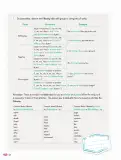
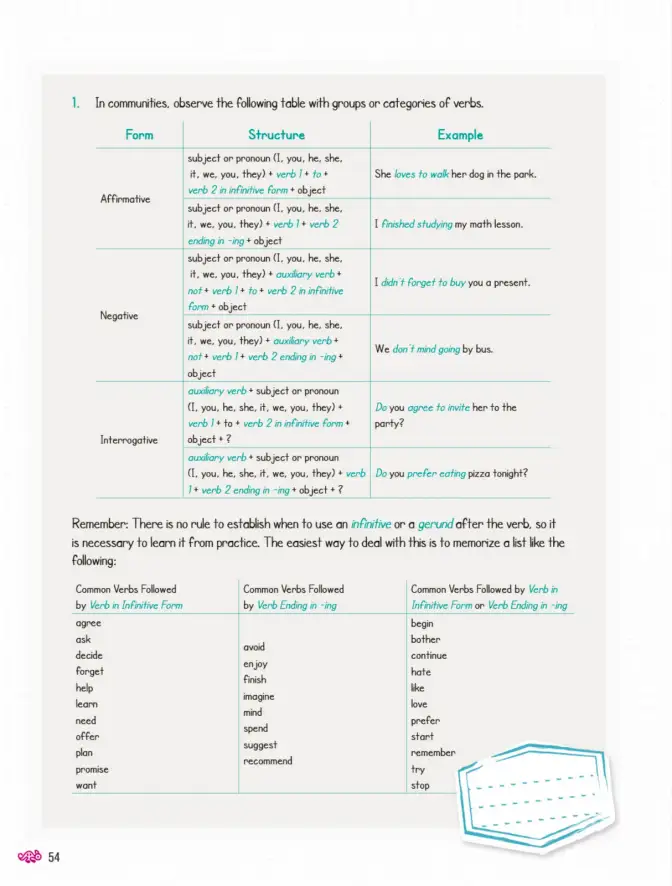
  1. In communities, observe the following table with groups or categories of verbs.
Form Structure Example
Affirmative subject or pronoun (I, you, he, she, it, we, you, they) + verb 1 + to + verb 2 in infinitive form + object She loves to walk her dog in the park.
Affirmative subject or pronoun (I, you, he, she, it, we, you, they) + verb 1 + verb 2 ending in -ing + object I finished studying my math lesson.
Negative subject or pronoun (I, you, he, she, it, we, you, they) + auxiliary verb + not + verb 1 + to + verb 2 in infinitive form + object I didn't forget to buy you a present.
Negative subject or pronoun (I, you, he, she, it, we, you, they) + auxiliary verb + not + verb 1 + verb 2 ending in -ing + object We don't mind going by bus.
Interrogative auxiliary verb + subject or pronoun (I, you, he, she, it, we, you, they) + verb 1 + to + verb 2 in infinitive form + object + ? Do you agree to invite her to the party?
Interrogative auxiliary verb + subject or pronoun (I, you, he, she, it, we, you, they) + verb 1 + verb 2 ending in -ing + object + ? Do you prefer eating pizza tonight?

Remember: There is no rule to establish when to use an infinitive or a gerund after the verb, so it is necessary to learn it from practice. The easiest way to deal with this is to memorize a list like the following:

Common Verbs Followed by Verb in Infinitive Form Common Verbs Followed by Verb Ending in -ing Common Verbs Followed by Verb in Infinitive Form or Verb Ending in -ing
agree avoid begin
ask enjoy bother
decide finish continue
forget imagine hate
help mind like
learn spend love
need suggest prefer
offer recommend start
plan remember
promise try
want stop

Ejemplos resueltos

She loves to walk her dog in the park.

Sujeto + verbo 1 (loves) + to + verbo 2 en infinitivo (walk) + objeto (her dog).

I finished studying my math lesson.

Sujeto + verbo 1 (finished) + verbo 2 en -ing (studying) + objeto (my math lesson).

I didn't forget to buy you a present.

Sujeto + auxiliar + not (didn't) + verbo 1 (forget) + to + verbo 2 (buy) + objeto.

We don't mind going by bus.

Sujeto + auxiliar + not (don't) + verbo 1 (mind) + verbo 2 en -ing (going) + complemento.

Do you agree to invite her to the party?

Auxiliar (Do) + sujeto (you) + verbo 1 (agree) + to + verbo 2 (invite) + objeto + ?

Do you prefer eating pizza tonight?

Auxiliar (Do) + sujeto (you) + verbo 1 (prefer) + verbo 2 en -ing (eating) + objeto + ?

Tablas (2)

Form Structure Example
Affirmative subject or pronoun + verb 1 + to + verb 2 in infinitive form + object She loves to walk her dog in the park.
Affirmative subject or pronoun + verb 1 + verb 2 ending in -ing + object I finished studying my math lesson.
Negative subject or pronoun + auxiliary verb + not + verb 1 + to + verb 2 in infinitive form + object I didn't forget to buy you a present.
Negative subject or pronoun + auxiliary verb + not + verb 1 + verb 2 ending in -ing + object We don't mind going by bus.
Interrogative auxiliary verb + subject or pronoun + verb 1 + to + verb 2 in infinitive form + object + ? Do you agree to invite her to the party?
Interrogative auxiliary verb + subject or pronoun + verb 1 + verb 2 ending in -ing + object + ? Do you prefer eating pizza tonight?
Common Verbs Followed by Verb in Infinitive Form Common Verbs Followed by Verb Ending in -ing Common Verbs Followed by Verb in Infinitive Form or Verb Ending in -ing
agree avoid begin
ask enjoy bother
decide finish continue
forget imagine hate
help mind like
learn spend love
need suggest prefer
offer recommend start
plan remember
promise try
want stop

Diagrama

graph TD
A[Verb patterns] --> B[Verb + to + infinitive]
A --> C[Verb + verb -ing]
A --> D[Verb + infinitive or -ing]
B --> B1[agree, ask, decide, forget, help, learn, need, offer, plan, promise, want]
C --> C1[avoid, enjoy, finish, imagine, mind, spend, suggest, recommend]
D --> D1[begin, bother, continue, hate, like, love, prefer, start, remember, try, stop]

Glosario (5)

infinitive
Forma verbal base precedida por 'to' (to walk, to buy).
gerund
Forma verbal terminada en -ing que funciona como sustantivo (walking, studying).
auxiliary verb
Verbo que ayuda a formar negaciones y preguntas (do, does, did).
object
Elemento que recibe la acción del verbo (her dog, my math lesson).
verb pattern
Estructura que indica qué forma verbal sigue a un verbo principal.

Preguntas para practicar

¿Por qué es importante memorizar listas de verbos seguidos de infinitivo o gerundio?

Porque en inglés no existe una regla fija que determine cuándo usar infinitivo o gerundio después de un verbo. Memorizar listas permite usar correctamente cada patrón en la práctica oral y escrita.

¿Qué diferencia hay entre 'She loves to walk her dog' y 'I finished studying my math lesson'?

En la primera oración el verbo 'loves' rige infinitivo (to walk); en la segunda, 'finished' rige gerundio (studying). Ambos son correctos según el verbo principal.

Temas y conceptos clave

Verbos seguidos de infinitivoVerbos seguidos de gerundioFormas afirmativa, negativa e interrogativaInfinitive form (to + verb)Gerund (verb + -ing)Auxiliary verbSubject or pronounObject
¿Te fue útil esta página?

Figuras de la página (1)

Recuadro decorativo con líneas punteadas para escribir, con borde azul en forma de etiqueta.
Figura 1 image

Preguntas que la gente también hace

¿Cuándo se usa el infinitivo y cuándo el gerundio después de un verbo en inglés?
Consulta la solución completa arriba o explora el libro entero para temas relacionados.
¿Cómo se forma la negativa con verbos que llevan infinitivo o gerundio?
Consulta la solución completa arriba o explora el libro entero para temas relacionados.
¿Qué verbos en inglés aceptan tanto infinitivo como gerundio?
Consulta la solución completa arriba o explora el libro entero para temas relacionados.
📌 Antes de leer esto
  • • Reconocer sujeto, verbo y objeto en una oración
  • • Conocer los pronombres personales en inglés
  • • Identificar verbos auxiliares do/does/did
  • • Formar el gerundio agregando -ing
Siguiente tema sugerido
Práctica escrita: completar oraciones con infinitivo o gerundio según el verbo principal
📝 Transcripción de la página (texto seleccionable) 2421 caracteres

54

  1. In communities, observe the following table with groups or categories of verbs.
FormStructureExample
Affinmativesubject or pronoun (I, you, he, she, it, we, you, they) + verb 1+ to + venb 2 in infinitive form + objectShe loves to walk her dog in the pank.
subject or pronoun (I, you, he, she, it, we, you, they) + venb 1+ verb 2 ending in-ing + objectI finished studying my math lesson.
Negativesubject or pronoun (I, you, he, she, it, we, you, they)+ auxiliary verb + not+ verb 1+ to + venb 2 in infinitive form+ objectI didn't forget to buy you a present.
subject or pronoun (I, you, he, she, it, we, you, they) + auxiliory venb + not + venb 1+ venb 2 ending in -ing+ objectWe don't mind going by bus.
Interrogativeauxiliary venb + subject or pronoun (I, you, he, she, it, we, you, they)+ venb 1 + to + verb 2 in infinitive form + object+?Do you agree to invite her to the party?
auxiliry venb + subject or pronoun 1+ verb 2 ending in-ing + object +?

Remember: There is no rule to establish when to use an infinitive or a gerund after the verb, so it is necessary to learn it from practice. The easiest way to deal with this is to memorize a list like the following:

Common Verbs Followed by Verb in Infinitive FormCommon Verbs Followed by Venb Ending in -ingCommon Verbs Followed by Venb in Infinitive Form or Verb Ending in -ing
agreebegin
askbother
decideavoidcontinue
forgetenjoyhate
helpfinishlike
learnimaginelove
needmindprefer
offerspendstart
plansuggestremember
promiserecommendtry
src="imgs/img_in_image_box_825_1336_1115_1537.jpg" alt="Image" />
wantstop

![](page=0,bbox=[825, 1336, 1115, 1537])

Ad

Otros libros recomendados

Ver todos →
Ad

Usamos cookies propias y de terceros para personalizar contenido, mostrar publicidad y analizar el tráfico. Las cookies necesarias siempre están activas.