Ejercicio 1
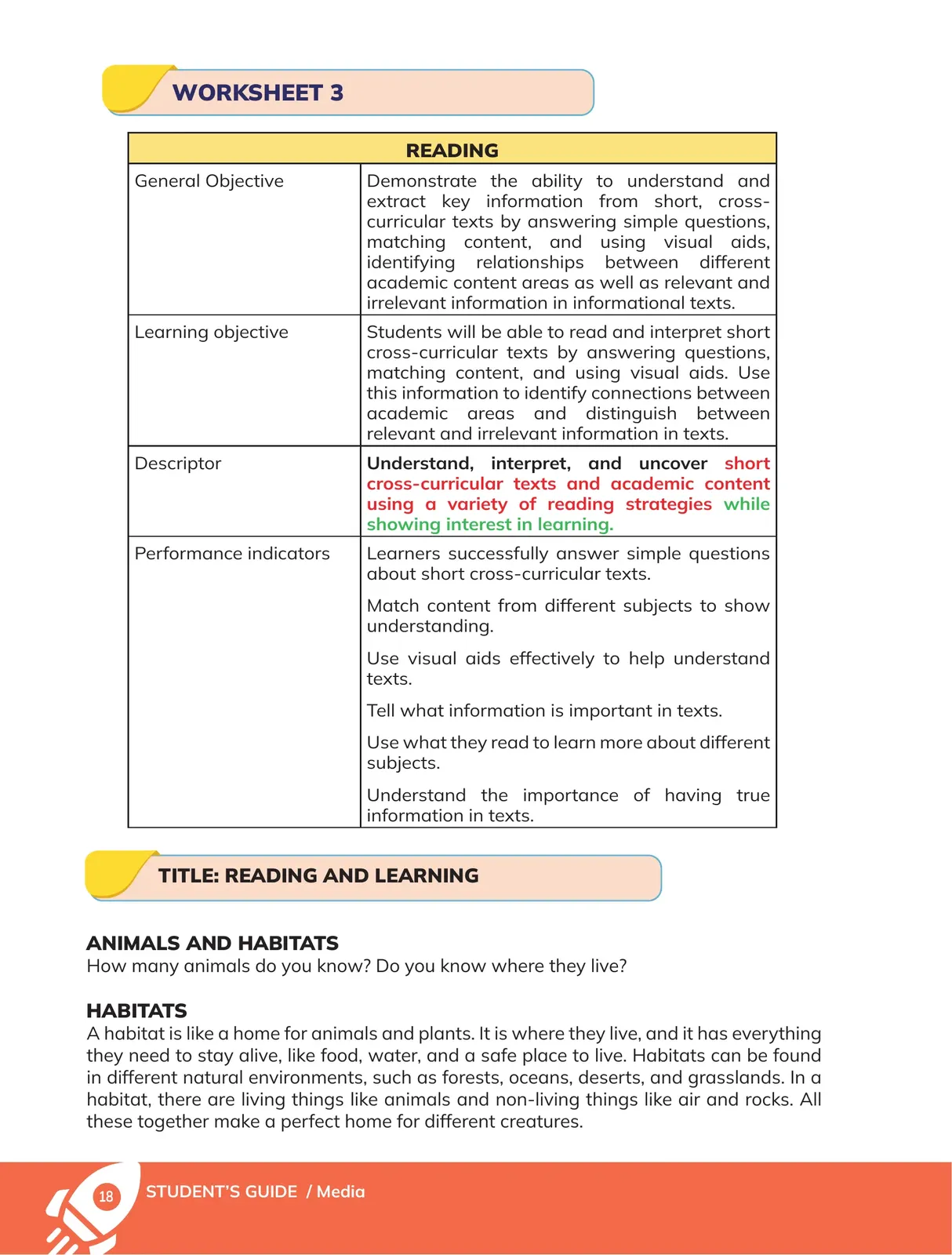
WORKSHEET 3
READING
| Campo | Contenido |
|---|---|
| General Objective | Demonstrate the ability to understand and extract key information from short, cross-curricular texts by answering simple questions, matching content, and using visual aids, identifying relationships between different academic content areas as well as relevant and irrelevant information in informational texts. |
| Learning objective | Students will be able to read and interpret short cross-curricular texts by answering questions, matching content, and using visual aids. Use this information to identify connections between academic areas and distinguish between relevant and irrelevant information in texts. |
| Descriptor | Understand, interpret, and uncover short cross-curricular texts and academic content using a variety of reading strategies while showing interest in learning. |
| Performance indicators | Learners successfully answer simple questions about short cross-curricular texts. |
| Match content from different subjects to show understanding. | |
| Use visual aids effectively to help understand texts. | |
| Tell what information is important in texts. | |
| Use what they read to learn more about different subjects. | |
| Understand the importance of having true information in texts. |
TITLE: READING AND LEARNING
ANIMALS AND HABITATS
How many animals do you know? Do you know where they live?
HABITATS
A habitat is like a home for animals and plants. It is where they live, and it has everything they need to stay alive, like food, water, and a safe place to live. Habitats can be found in different natural environments, such as forests, oceans, deserts, and grasslands. In a habitat, there are living things like animals and non-living things like air and rocks. All these together make a perfect home for different creatures.
STUDENT'S GUIDE / Media — pág. 18