
Worksheet 3 — Reading: Renewable and Non-Renewable Resources
Solución — Página 17
Ingles · 8 EGB · 2024
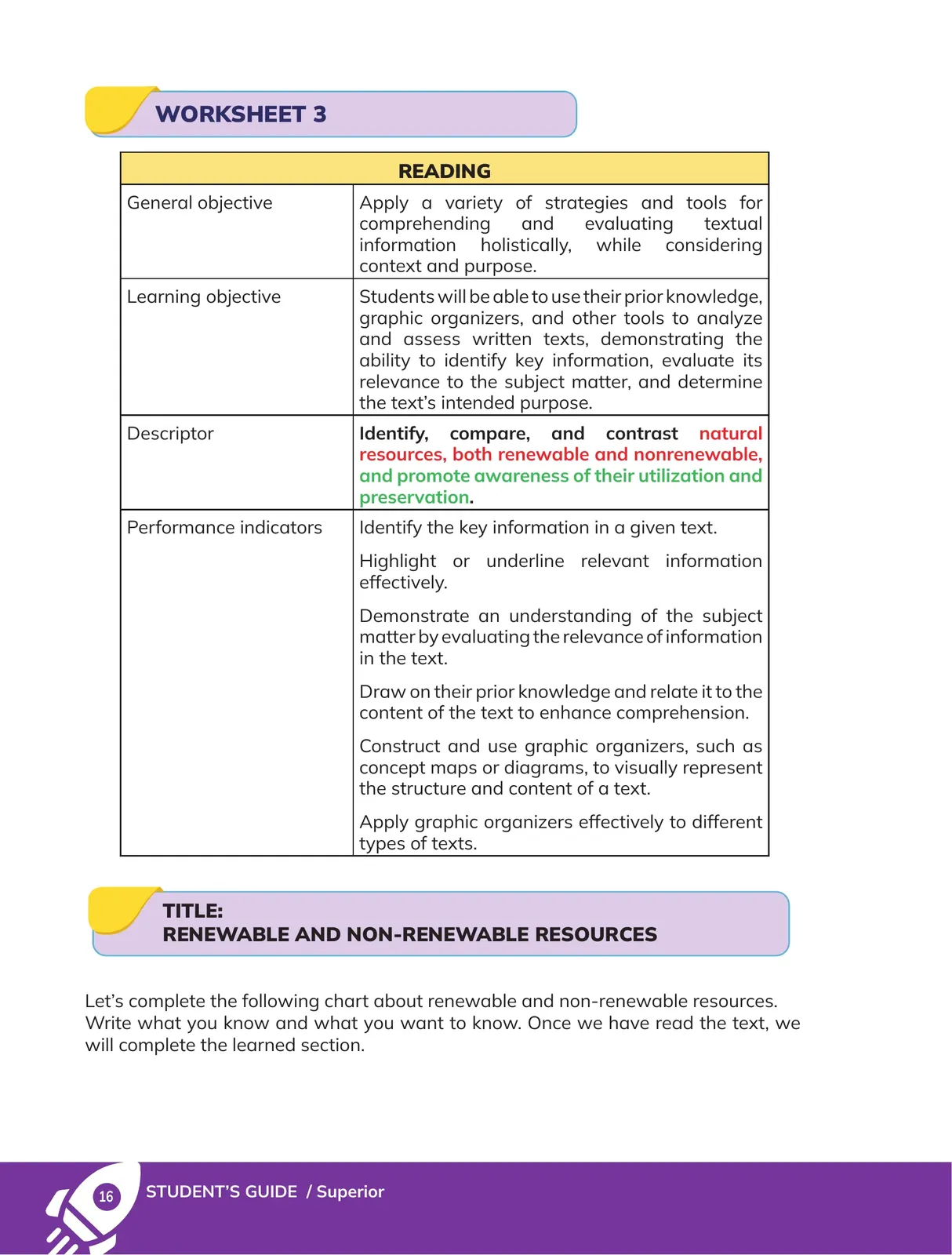
WORKSHEET 3 — Reading
General objective
Apply a variety of strategies and tools for comprehending and evaluating textual information holistically, while considering context and purpose.
Learning objective
Students will be able to use their prior knowledge, graphic organizers, and other tools to analyze and assess written texts, demonstrating the ability to identify key information, evaluate its relevance to the subject matter, and determine the text's intended purpose.
Descriptor
Identify, compare, and contrast natural resources, both renewable and nonrenewable, and promote awareness of their utilization and preservation.
Performance indicators
- Identify the key information in a given text.
- Highlight or underline relevant information effectively.
- Demonstrate an understanding of the subject matter by evaluating the relevance of information in the text.
- Draw on their prior knowledge and relate it to the content of the text to enhance comprehension.
- Construct and use graphic organizers, such as concept maps or diagrams, to visually represent the structure and content of a text.
- Apply graphic organizers effectively to different types of texts.
TITLE: RENEWABLE AND NON-RENEWABLE RESOURCES
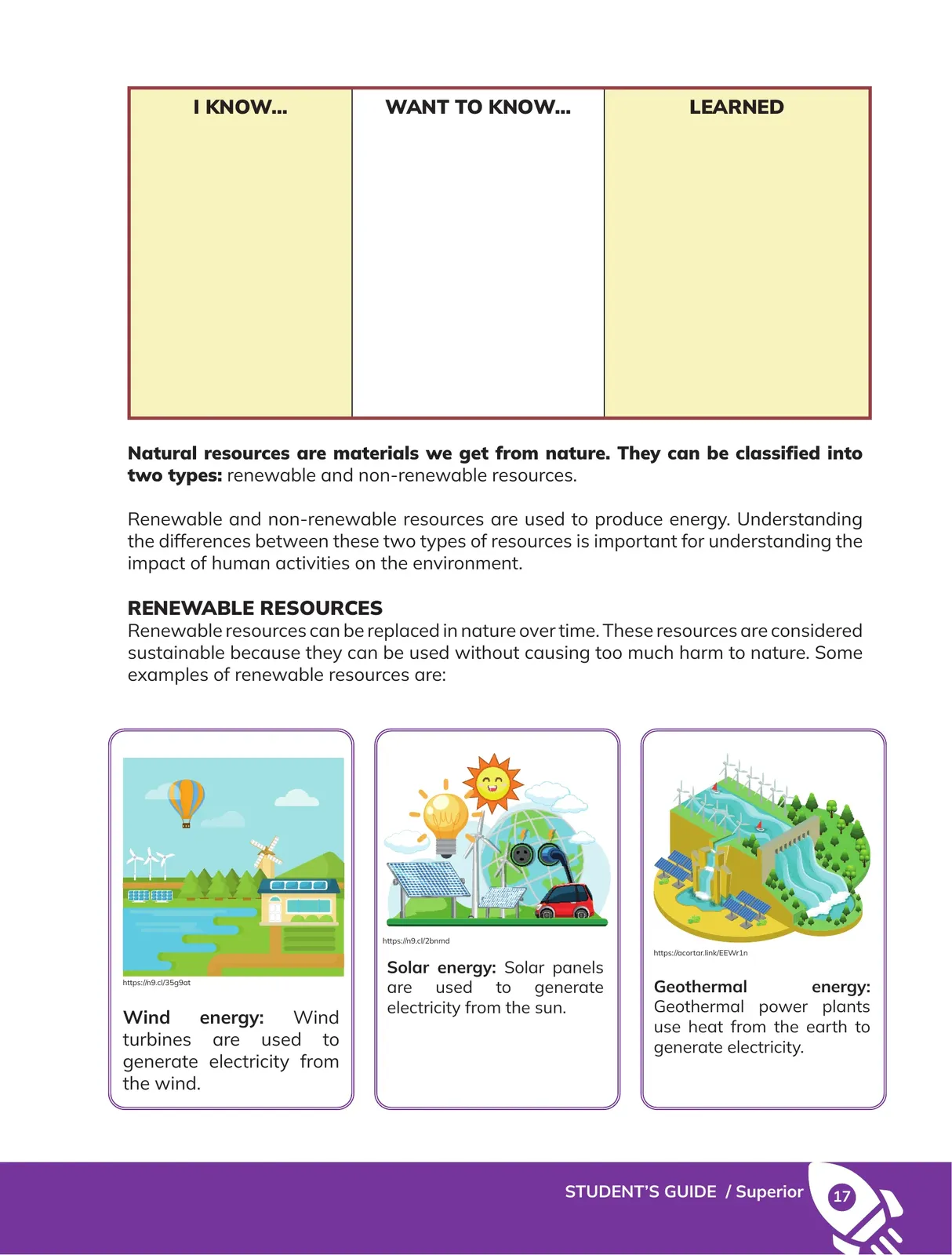
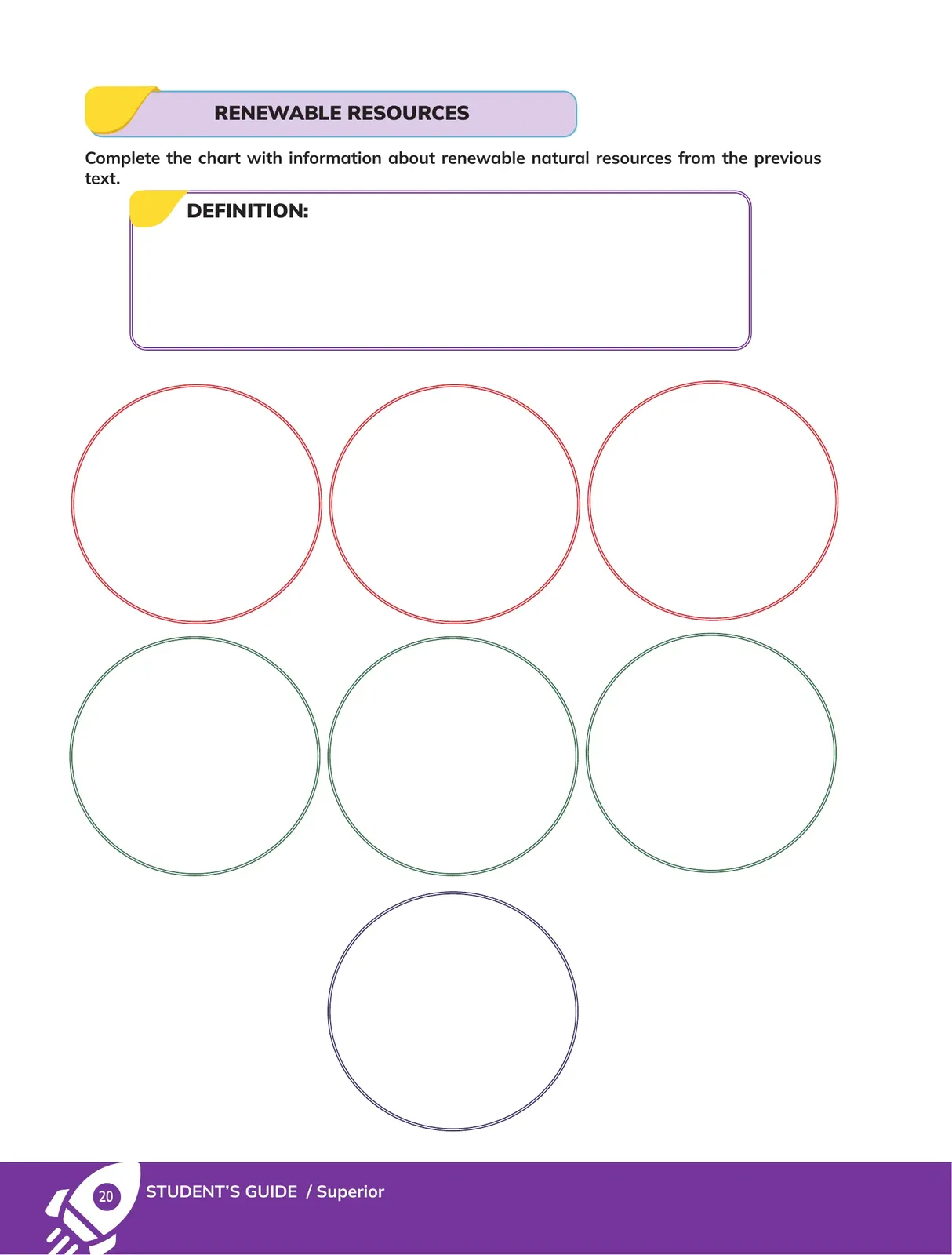
Let's complete the following chart about renewable and non-renewable resources. Write what you know and what you want to know. Once we have read the text, we will complete the learned section.
Diagrama 1
Estructura curricular Worksheet 3.
flowchart TD
  GO[General: estrategias de comprensión lectora] --> LO[Learning: usar conocimientos previos y organizadores gráficos]
  LO --> D[Descriptor: identificar/comparar recursos renovables y no renovables]
  D --> PI[Performance indicators: identificar key info, subrayar, evaluar, usar organizadores]
Tablas
| K — Know | W — Want to know | L — Learned |
|---|---|---|
| (a completar antes de leer) | (a completar antes de leer) | (a completar después de leer) |
Glosario
- renewable resources: Recursos renovables: aquellos que se regeneran a una tasa similar a la de su consumo (sol, viento, agua, biomasa).
- non-renewable resources: Recursos no renovables: aquellos cuya reposición es geológicamente muy lenta (petróleo, gas, carbón, minerales).
- graphic organizer: Organizador gráfico: representación visual de información (mapa conceptual, diagrama de Venn, K-W-L).
- K-W-L chart: Tabla con tres columnas: lo que sé (Know), lo que quiero saber (Want to know) y lo que aprendí (Learned).
Figuras de la página (1)

- • Ver pág. 4: Índice general donde figura la Worksheet 3.
- • Ver pág. 18: Continuación con el texto de lectura sobre recursos renovables y no renovables.
📝 Transcripción de la página (texto seleccionable) 1436 caracteres
__/ WORKSHEET 3 )
General objective Apply a variety of strategies and tools for comprehending «and evaluating textual information holistically, while considering context and purpose.
Learning objective Students will be able to use their prior knowledge, graphic organizers, and other tools to analyze and assess written texts, demonstrating the ability to identify key information, evaluate its relevance to the subject matter, and determine the text's intended purpose.
Descriptor Identify, compare, and contrast natural resources, both renewable and nonrenewable, and promote awareness of their utilization and preservation.
Performance indicators Identify the key information in a given text.
Highlight or underline relevant information effectively.
Demonstrate an understanding of the subject matter by evaluating the relevance of information in the text.
Draw on their prior knowledge and relate it to the content of the text to enhance comprehension.
Construct and use graphic organizers, such as concept maps or diagrams, to visually represent the structure and content of a text.
Apply graphic organizers effectively to different types of texts.
TITLE: RENEWABLE AND NON-RENEWABLE RESOURCES ]
Let’s complete the following chart about renewable and non-renewable resources. Write what you know and what you want to know. Once we have read the text, we will complete the learned section.
(16) STUDENTS GUIDE / Superior
Otros libros recomendados
Estudios Sociales · 2 EGB · 2025
Ministerio de Educación del Ecuador
130 págs.
Ingles · 2 EGB · 2024
Ministerio de Educación del Ecuador
48 págs.
Ciencias Naturales · 2 EGB · 2025
Ministerio de Educación del Ecuador
146 págs.
Lengua Y Literatura · 2 EGB · 2025
Ministerio de Educación del Ecuador
246 págs.
Lengua Y Literatura · 2 EGB · 2024
Ministerio de Educación del Ecuador
70 págs.
Matematica · 6 EGB · 2025
Ministerio de Educación del Ecuador
218 págs.
Estudios Sociales · 6 EGB · 2025
Ministerio de Educación del Ecuador
226 págs.
Ingles · 6 EGB · 2024
Ministerio de Educación del Ecuador
50 págs.