
















Saltar al contenido
MisLibrosTexto
Ad

Speaking: emojis de gusto/disgusto y preguntas sobre jugar y hacer equipo

📄 ejercicios ingles 🎓 secundaria · 1° Secundaria México 🇲🇽 MX 🗣 Español
Página 74
74 de 187
Página 74 de Uérakua anapu uantakua. Projects and Readings  Libro de Educación Secundaria Grado 1°  Ciclo Escolar 2025 - 2026
Anterior Página 74 / 187 Siguiente

Respuesta rápida

Respuestas modelo: Yes, I like playing games with my friends because we laugh a lot; I feel happy when I win because my effort pays off; I feel sad when I lose, but I try to practice more; No, I dislike playing basketball because I can't dribble the ball (ejemplo del libro).

📚 exercise ingles ⭐⭐ Dificultad 2/5 ⏱ 9 min lectura

Solución — Página 74

Uérakua anapu uantakua. Projects and Readings Libro de Educación Secundaria Grado 1° Ciclo Escolar 2025 - 2026

1
Ejercicio 1

Enunciado (traducido): Individualmente, en una hoja crea un emoji tuyo con la cara que harías si te gustara algo y otro emoji con la cara que harías si no te gustara algo. Recorta cada emoji.

Respuesta orientativa: Emoji de gusto: carita sonriente con ojos brillantes (me gusta). Emoji de disgusto: carita con cejas fruncidas y boca hacia abajo (no me gusta).

a
Parte 1.a

Preguntas al compañero (traducidas)

En parejas, pregunta a tu compañero sobre cosas que puede gustarle o no. Preguntas del libro:

  1. Do you like playing games with your friends? (¿Te gusta jugar juegos con tus amigos?)
  2. Do you like being part of a team? (¿Te gusta ser parte de un equipo?)
  3. Do you like playing new games? (¿Te gusta jugar juegos nuevos?)
  4. Do you like following rules while playing games? (¿Te gusta seguir las reglas al jugar?)
  5. How do you feel when you win a game? (¿Cómo te sientes cuando ganas un juego?)
  6. How do you feel when you lose a game? (¿Cómo te sientes cuando pierdes un juego?)
  7. Do you like playing games outside? (¿Te gusta jugar juegos afuera?)
b
Parte 1.b

Respuestas con emoji y oración completa

Regla (traducida): cada vez que tu compañero pregunte, muestra el emoji que corresponda y explica con una oración completa por qué te gusta o no esa situación.

Ejemplo del libro:

  • A: Do you like to play basketball? (¿Te gusta jugar basquetbol?)
  • B: (Muestra una carita triste.) No, I dislike playing basketball because I can't dribble the ball. (No, no me gusta jugar basquetbol porque no sé botar el balón.)

Respuestas de ejemplo para las siete preguntas:

  1. (Emoji feliz) Yes, I like playing games with my friends because we laugh a lot. (Sí, me gusta jugar con mis amigos porque nos reímos mucho.)
  2. (Emoji feliz) Yes, I like being part of a team because we help each other. (Sí, me gusta ser parte de un equipo porque nos ayudamos.)
  3. (Emoji feliz) Yes, I like playing new games because I learn new rules. (Sí, me gustan los juegos nuevos porque aprendo reglas nuevas.)
  4. (Emoji feliz) Yes, I like following the rules because the game is fair for everyone. (Sí, me gusta seguir las reglas porque así el juego es justo para todos.)
  5. (Emoji feliz) I feel happy when I win because my effort pays off. (Me siento feliz cuando gano porque mi esfuerzo vale la pena.)
  6. (Emoji neutral/triste) I feel sad when I lose, but I try to practice more. (Me siento triste cuando pierdo, pero intento practicar más.)
  7. (Emoji feliz) Yes, I like playing outside because I enjoy fresh air and running. (Sí, me gusta jugar afuera porque disfruto el aire libre y correr.)

2
Ejercicio 2

Enunciado (traducido): En asamblea, por turnos, hagan a sus compañeros algunas de las preguntas que hicieron en parejas.

a
Parte 2.a

Levantar el emoji y comparar

Respuesta orientativa: Cuando alguien pregunta, todos levantan su emoji de gusto o disgusto; después cada quien mira alrededor y cuenta, por ejemplo: «Six classmates like playing new games and two don't» (Seis compañeros les gustan los juegos nuevos y dos no). Así se compara al grupo.

b
Parte 2.b

Compartir las razones

Respuesta orientativa: Por turnos, cada estudiante explica su razón: «I like being part of a team because we support each other» o «I dislike losing because I feel frustrated, but I know I can improve». Se escucha con respeto cada explicación.

Respuesta

Se describió la elaboración de los emojis, se formularon las siete preguntas del libro y se respondieron con emoji y oración completa, siguiendo el modelo del ejemplo (B: No, I dislike playing basketball because I can't dribble the ball), más las respuestas orientativas de la asamblea.

Contenido de la página

Speaking

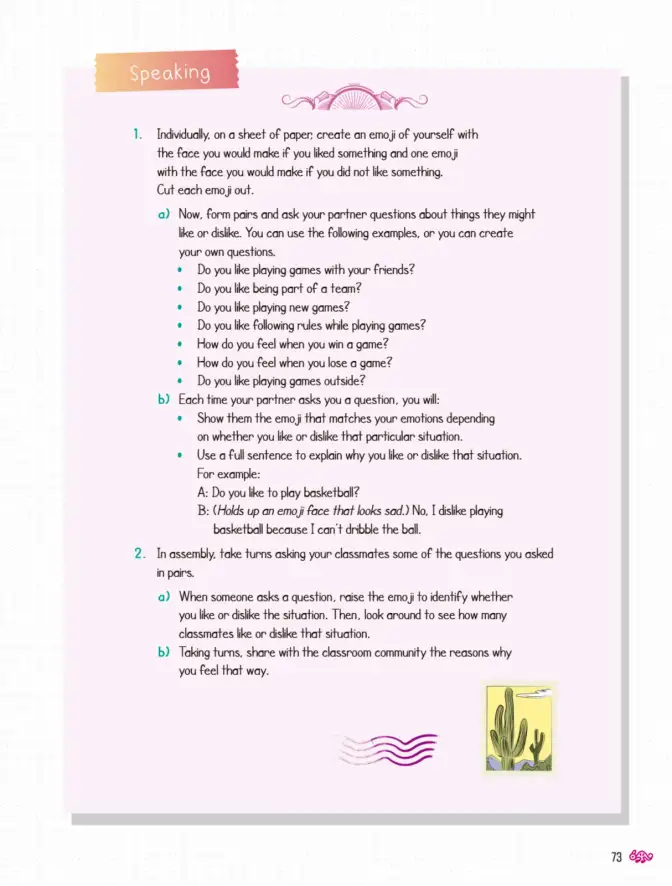
  1. Individually, on a sheet of paper: create an emoji of yourself with the face you would make if you liked something and one emoji with the face you would make if you did not like something. Cut each emoji out.
  • a) Now, form pairs and ask your partner questions about things they might like or dislike. You can use the following examples, or you can create your own questions:
    • Do you like playing games with your friends?
    • Do you like being part of a team?
    • Do you like playing new games?
    • Do you like following rules while playing games?
    • How do you feel when you win a game?
    • How do you feel when you lose a game?
    • Do you like playing games outside?
  • b) Each time your partner asks you a question, you will:
    • Show them the emoji that matches your emotions depending on whether you like or dislike that particular situation.
    • Use a full sentence to explain why you like or dislike that situation. For example:
      • A: Do you like to play basketball?
      • B: (Holds up an emoji face that looks sad.) No, I dislike playing basketball because I can't dribble the ball.
  1. In assembly, take turns asking your classmates some of the questions you asked in pairs.
  • a) When someone asks a question, raise the emoji to identify whether you like or dislike the situation. Then, look around to see how many classmates like or dislike that situation.
  • b) Taking turns, share with the classroom community the reasons why you feel that way.

(Página impresa del libro: 73. Decoración: estampilla con un cactus y matasellos morado.)

Ejemplos resueltos

Do you like to play basketball?

Respuesta del libro: (Holds up an emoji face that looks sad.) No, I dislike playing basketball because I can't dribble the ball. — Se muestra el emoji triste y se explica con oración completa: No me gusta jugar basquetbol porque no sé botar el balón.

Glosario (5)

dribble the ball
botar o driblar el balón: avanzar golpeándolo con las manos o los pies
being part of a team
ser parte de un equipo: pertenecer a un grupo que juega junto
following rules
seguir las reglas: respetar las normas del juego
win a game
ganar un juego: obtener el mejor resultado en la competición
lose a game
perder un juego: no ganar la partida o el partido

Temas y conceptos clave

Speaking: emojis de gusto y disgustoPreguntas en parejas sobre juegos y equiposDinámica de asamblea con emojis y razonesDo you like + -ing? (¿Te gusta...?)How do you feel when...? (¿Cómo te sientes cuando...?)I like/dislike... because... (me gusta/no me gusta... porque...)win a game (ganar un juego)lose a game (perder un juego)follow the rules (seguir las reglas)
¿Te fue útil esta página?

Figuras de la página (3)

Estampilla con la ilustración de dos cactus en paisaje amarillo
Figura 1 image
Matasellos con líneas onduladas en morado
Figura 2 image
Figura 3 de Uérakua anapu uantakua. Projects and Readings  Libro de Educación Secundaria Grado 1°  Ciclo Escolar 2025 - 2026
Figura 3 image

Preguntas que la gente también hace

¿Cómo responder preguntas con do you like en inglés?
Consulta la solución completa arriba o explora el libro entero para temas relacionados.
¿Cómo expresar gustos y disgustos con razones?
Consulta la solución completa arriba o explora el libro entero para temas relacionados.
¿Qué preguntas hacer sobre juegos y deportes en inglés?
Consulta la solución completa arriba o explora el libro entero para temas relacionados.
📌 Antes de leer esto
  • • Preguntas con do you like y how do you feel
  • • Verbos de gusto: like, dislike, love
  • • Vocabulario de juegos y deportes
Siguiente tema sugerido
Continuación del proyecto de juegos: creación de preguntas propias y encuesta grupal
📝 Transcripción de la página (texto seleccionable) 1559 caracteres

Speaking

  1. Individually, on a sheet of paper; create an emoji of yourself with the face you would make if you liked something and one emoji with the face you would make if you did not like something.Cut each emoji out.

a) Now, form pairs and ask your partner questions about things they might like or dislike. You can use the follwing examples, or you can create your own questions.

Do you like playing games with your friends?

0Do you like being part of a team?

Do you like playing new games?

Do you like following rules while playing games?

How do you feel when you win a game?

How do you feel when you lose a game?

Do you like playing games outside?

b) Each time your partner asks you a question, you will:

0Show them the emoji that matches your emotions depending on whether you like or dislike that particular situation.

0Use a full sentence to explain why you like or dislike that situation.For example:

A: Do you like to play basketball?

B:(Holds up an emoji face that looks sad.) No, I dislike playing basketball because I can't dribble the ball

  1. In assembly, take turns asking your classmates some of the questions you asked in pairs.

a) When someone asks a question, raise the emoji to identify whether you like or dislike the situation. Then, look around to see how many classmates like or dislike that situation.

b)Taking turns, share with the classroom community the reasons why you feel that way.

![](page=0,bbox=[504, 149, 773, 198])

![](page=0,bbox=[597, 1322, 788, 1382])

![](page=0,bbox=[876, 1233, 996, 1391])

738

Ad

Otros libros recomendados

Ver todos →
Ad

Usamos cookies propias y de terceros para personalizar contenido, mostrar publicidad y analizar el tráfico. Las cookies necesarias siempre están activas.