It is important to understand the hardships people face when they cannot communicate in their mother language or when they cannot establish communication with their peers. The causes may be some of the following:
Cause 1. Young people do not know that there may be other languages or necessary linguistic systems to communicate with classmates who speak a different language or need a special system to help them communicate (such as Braille or sign language).
Cause 2. Young people are not interested in learning other languages to talk with classmates who use a different language or linguistic system.
Cause 3. The inability to identify other languages as opportunities for communication in artistic expressions, to open a dialogue with cultural diversity or inclusion for people who use other linguistic systems.
Vocabulary
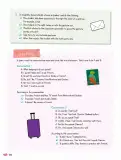
- In communities, do the following activity:
a) Think about five countries, pneferably one per continent, and wnite them on a piece of paper.b) On a separate papen; write the official language of each country, and order the countries from the largest to the smallest.
c)Exchange the paper with another community, and ask them to wnite their information in subparagraphs a and b on the same paper: After 10 minutes, compare your answers with those of the other community. If thene were any differences, find out the correct answers.Then, check them with the whole class.
C
26
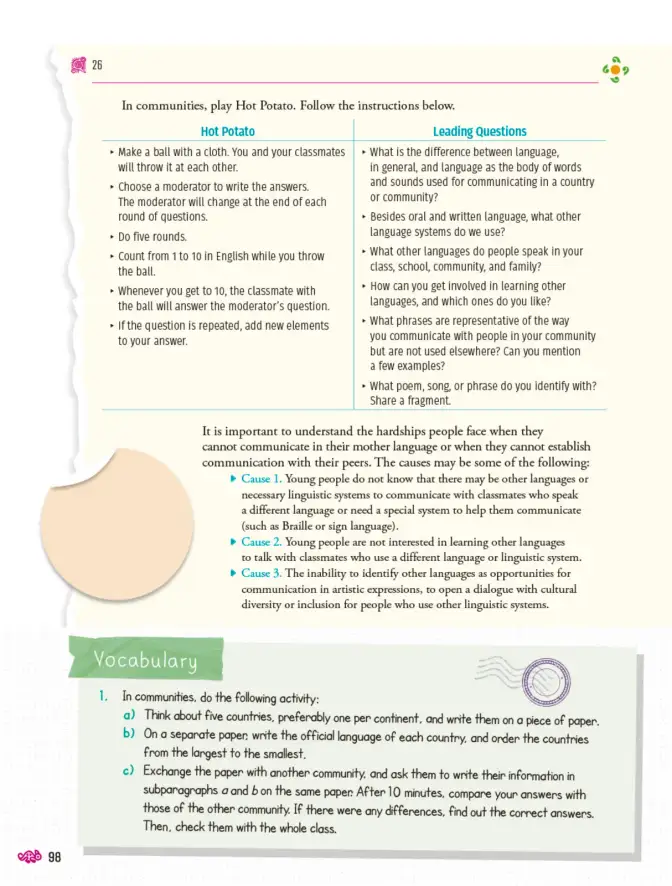
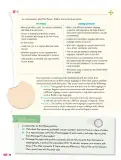
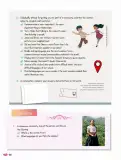
In communities, play Hot Potato. Follow the instructions below.
| Hot Potato | Leading Questions |
| Make a ball with a cloth. You and your classmates will throw it at each other. Choose a moderator to write the answers. | What is the difference between language, in general, and language as the body of words and sounds used for communicating in a country |
| The moderator will change at the end of each round of questions. | or community? Besides oral and written language, what other language systems do we use? |
| ,Do five rounds. Count from 1 to 10 in English while you throw the ball. | What other languages do people speak in your class, school, community, and family? |
| Whenever you get to 10, the classmate with the ball will answer the moderator's question. , If the question is repeated, add new elements | How can you get involved in learning other languages, and which ones do you like? What phrases are representative of the way |
| to your answer. | you communicate with people in your community but are not used elsewhere? Can you mention a few examples? • What poem, song, or phrase do you identify with? Share a fragment. |


98