Automatons The Ancestors of Robots
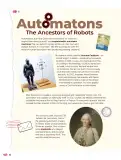
Automatons, from the Greek word automatos, or"mechanic engine that moves by itself," are programmable automatic machines that can perform certain actions on their own and replace humans in some tasks. The first automatons were the result of human fascination with producing amazing creations.
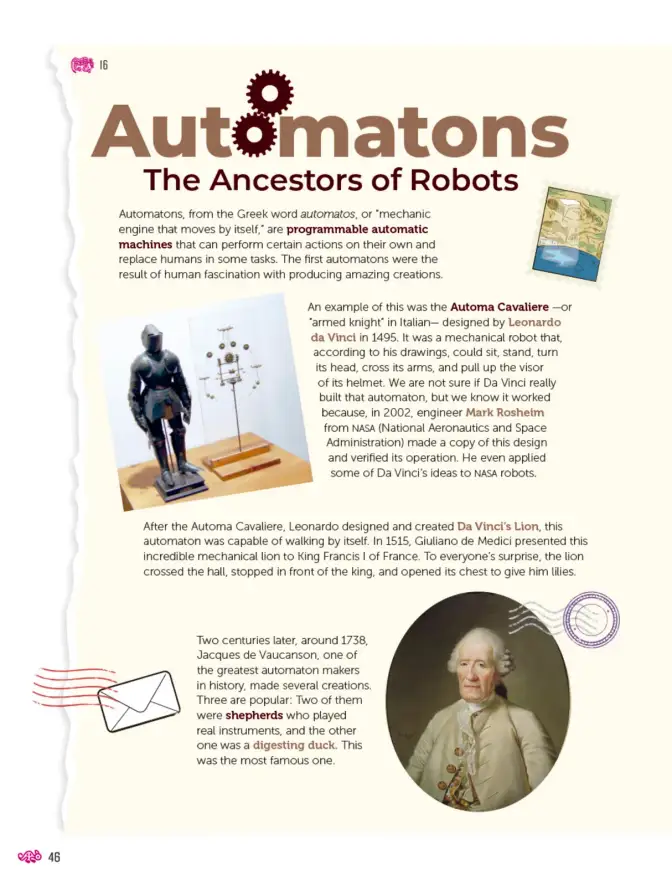
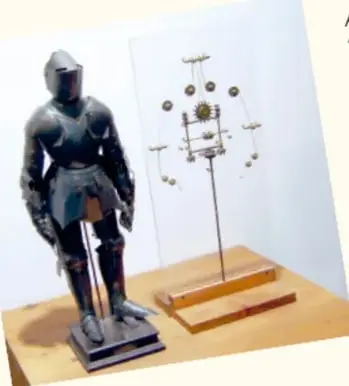
da Vinci in 1495.It was a mechanical robot that,according to his drawings, could sit, stand, turn its head, cross its arms, and pull up the visor of its helmet. We are not sure if Da Vinci really built that automaton, but we know it worked because, in 2002, engineer Mark Rosheim from NAsA (National Aeronautics and Space Administration) made a copy of this design and verified its operation. He even applied some of Da Vinci's ideas to NASA robots.
After the Automa Cavaliere, Leonardo designed and created Da Vinci's Lion, this automaton was capable of walking by itself. In 1515, Giuliano de Medici presented this incredible mechanical lion to King Francis I of France. To everyone's surprise, the lion crossed the hall, stopped in front of the king, and opened its chest to give him lilies.
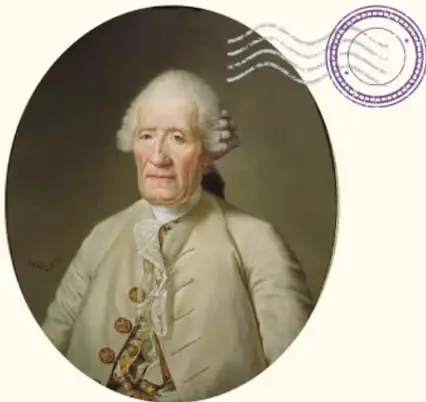
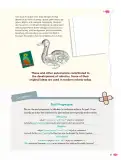
Two centuries later, around 1738,Jacques de Vaucanson, one of the greatest automaton makers in history.made several creations.Three are popular: Two of them were shepherds who played real instruments, and the other one was a digesting duck. This was the most famous one.
C 16


46