

















Will, Going To y condicionales cero y primero
Respuesta rápida
a) will pollute the soil and water; b) will have clean water for the future; c) will harm plants, animals and people; d) will reduce pollution; e) should call a plumber; f) will help the planet breathe; g) will damage the environment; h) will spread awareness; i) will have more water for everyone; j) will improve the air quality.
Solución — Página 92
Uérakua anapu uantakua. Projects and Readings. Libro de Educación Secundaria Grado 2° Ciclo Escolar 2025 - 2026
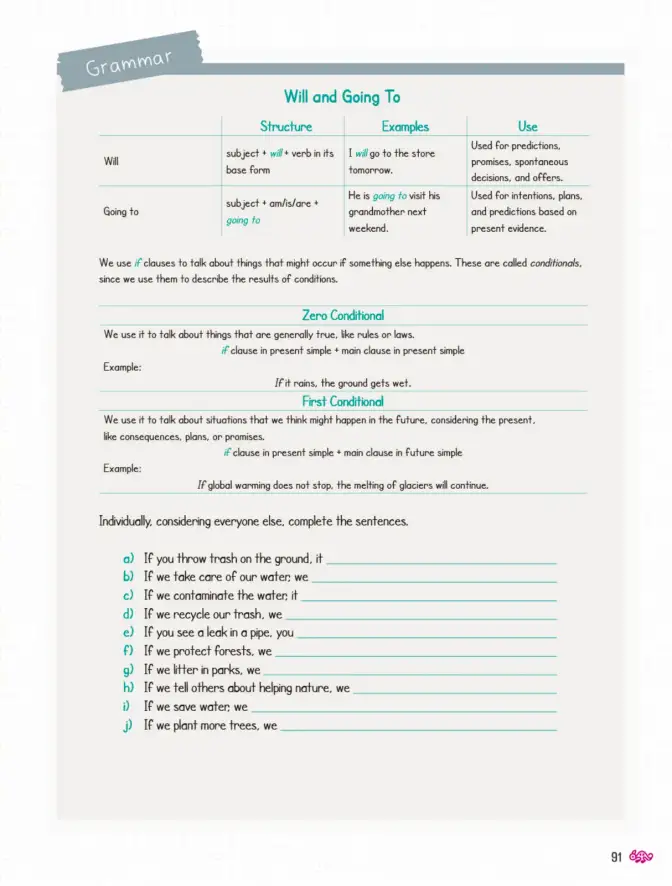
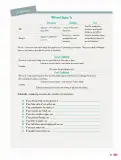
Grammar: Will and Going To
Will se usa para predicciones, promesas, decisiones espontáneas y ofrecimientos: I will go to the store tomorrow.
Going to se usa para intenciones, planes y predicciones basadas en evidencia presente: He is going to visit his grandmother next weekend.
Zero Conditional
Se usa para verdades generales, reglas o leyes.
\text{if clause (present simple)} + \text{main clause (present simple)}
Ejemplo: If it rains, the ground gets wet.
First Conditional
Se usa para situaciones que podrían ocurrir en el futuro, considerando el presente.
\text{if clause (present simple)} + \text{main clause (future simple)}
Ejemplo: If global warming does not stop, the melting of glaciers will continue.
Ejercicio: Complete the sentences
a
If you throw trash on the ground, it will pollute the soil and water.
Respuesta: If you throw trash on the ground, it will pollute the soil and water.
b
If we take care of our water, we will have clean water for the future.
Respuesta: If we take care of our water, we will have clean water for the future.
c
If we contaminate the water, it will harm plants, animals and people.
Respuesta: If we contaminate the water, it will harm plants, animals and people.
d
If we recycle our trash, we will reduce pollution.
Respuesta: If we recycle our trash, we will reduce pollution.
e
If you see a leak in a pipe, you should call a plumber.
Respuesta: If you see a leak in a pipe, you should call a plumber.
f
If we protect forests, we will help the planet breathe.
Respuesta: If we protect forests, we will help the planet breathe.
g
If we litter in parks, we will damage the environment.
Respuesta: If we litter in parks, we will damage the environment.
h
If we tell others about helping nature, we will spread awareness.
Respuesta: If we tell others about helping nature, we will spread awareness.
i
If we save water, we will have more water for everyone.
Respuesta: If we save water, we will have more water for everyone.
j
If we plant more trees, we will improve the air quality.
Respuesta: If we plant more trees, we will improve the air quality.
Contenido de la página
Grammar
Will and Going To
| Structure | Examples | Use | |
|---|---|---|---|
| Will | subject + will + verb in its base form | I will go to the store tomorrow. | Used for predictions, promises, spontaneous decisions, and offers. |
| Going to | subject + am/is/are + going to | He is going to visit his grandmother next weekend. | Used for intentions, plans, and predictions based on present evidence. |
We use if clauses to talk about things that might occur if something else happens. These are called conditionals, since we use them to describe the results of conditions.
Zero Conditional
We use it to talk about things that are generally true, like rules or laws.
if clause in present simple + main clause in present simple
Example: If it rains, the ground gets wet.
First Conditional
We use it to talk about situations that we think might happen in the future, considering the present, like consequences, plans, or promises.
if clause in present simple + main clause in future simple
Example: If global warming does not stop, the melting of glaciers will continue.
Activity
Individually, considering everyone else, complete the sentences.
a) If you throw trash on the ground, it ______________________________________
b) If we take care of our water, we ______________________________________
c) If we contaminate the water, it ______________________________________
d) If we recycle our trash, we ______________________________________
e) If you see a leak in a pipe, you ______________________________________
f) If we protect forests, we ______________________________________
g) If we litter in parks, we ______________________________________
h) If we tell others about helping nature, we ______________________________________
i) If we save water, we ______________________________________
j) If we plant more trees, we ______________________________________
Ejemplos resueltos
If it rains, the ground gets wet.
Condicional cero: expresa una verdad general. Ambas cláusulas van en presente simple.
If global warming does not stop, the melting of glaciers will continue.
Primer condicional: la cláusula if va en presente simple y la principal en futuro simple con will.
Tabla
| Structure | Examples | Use | |
|---|---|---|---|
| Will | subject + will + verb in its base form | I will go to the store tomorrow. | Used for predictions, promises, spontaneous decisions, and offers. |
| Going to | subject + am/is/are + going to | He is going to visit his grandmother next weekend. | Used for intentions, plans, and predictions based on present evidence. |
Fórmulas y ecuaciones
\text{if clause (present simple)} + \text{main clause (present simple)}
\text{if clause (present simple)} + \text{main clause (future simple)}
Glosario (7)
- will
- Verbo modal usado para formar el futuro simple y expresar predicciones, promesas o decisiones espontáneas.
- going to
- Perífrasis verbal usada para expresar planes, intenciones o predicciones basadas en evidencia presente.
- conditional
- Estructura oracional que expresa una condición y su resultado.
- if clause
- Oración subordinada que expresa la condición.
- main clause
- Oración principal que expresa el resultado de la condición.
- litter
- Arrojar basura en lugares públicos.
- leak
- Fuga de agua o de otro líquido.
Temas y conceptos clave
Preguntas que la gente también hace
¿Cuál es la diferencia entre will y going to?
¿Cómo se forma el condicional cero en inglés?
¿Cuándo se usa el primer condicional?
- • Presente simple
- • Pronombres personales
- • Vocabulario básico sobre el medio ambiente
📝 Transcripción de la página (texto seleccionable) 1846 caracteres
We use if clauses to talk about things that might occur if something else happens. These are called conditionals,since we use them to describe the results of conditions.
a)If you throw trash on the ground, it
b)If we take care of our water; we
c)If we contaminate the water; it
d If we recycle our trash, we
e If you see a leak in a pipe, you
f)If we protect forests, we
g)If we liHter in parks, we
h)If we tellothers about helping nature, we i)If we save water, we
j) If we plant more trees, we
Grammar
Will and Going To
| Structure | Examples | Use | |
| Will | subject + will+ venb in its base form | I willgo to the store tomorrow. | Used for predictions, promises, spontaneous decisions, and offens. |
| Going to | subject + am/is/ane + going to | He is going to visit his grandmother next weekend. | Used for intentions, plans, and predictions based on present evidence. |
| Zero Conditional |
| We use it to talk about things that ane genenally true, like rules or laws. if clause in present simple + main clause in present simple |
| Example: If it rains, the ground gets wet. |
| First Conditional |
| We use it to talk about situations that we think might happen in the futune, considering the present, |
| like consequences, plans,or promises. |
| if clause in present simple + main clause in futune simple |
| Example: |
| If global warming does not stop, the melting of glaciers wilcontinue. |
Individuall, considering everyone else, complete the sentences.
91
Otros libros recomendados
Colección Sk´asolil. Lenguajes. Libro de Educación Secundaria Grado 2° Ciclo Escolar 2025 - 2026
SEP/CONALITEG
323 págs.
Colección Sk´asolil. Saberes y pensamiento científico. Libro de Educación Secundaria Grado 2° Ciclo Escolar 2025 - 2026
SEP/CONALITEG
339 págs.

Colección Sk´asolil. Ética, naturaleza y sociedades. Libro de Educación Secundaria Grado 2° Ciclo Escolar 2025 - 2026
SEP/CONALITEG
355 págs.
Fichas de Matemática 2 · 2024
Larisa Mansilla Fernández y equipo
100 págs.
Comprensión lectora : manual para el docente de segundo grado de Secundaria 2018 · 2018
MINEDU
194 págs.
Comprensión lectora 2 : manual para el docente de segundo grado de Secundaria · 2017
MINEDU
130 págs.
Fichas de aprendizaje de Comunicación 2 · 2024
Carmen Patricia Cáceres Villanueva y equipo
100 págs.
Uérakua anapu uantakua. Projects and Readings. Libro de Educación Telesecundaria Grado 3° Ciclo Escolar 2025 - 2026
SEP/CONALITEG
187 págs.