Saltar al contenido
MisLibrosTexto
Ad

From #OOTD to #StreetArtRevolution: reading comprehension

📄 ejercicios ingles 🎓 bachillerato · 3° Secundaria México 🇲🇽 MX 🗣 Español
Página 184
184 de 187
Página 184 de Uérakua anapu uantakua. Projects and Readings.  Libro de Educación Secundaria Grado 3°  Ciclo Escolar 2025 - 2026
Anterior Página 184 / 187 Siguiente

Respuesta rápida

2.a: They disagreed on social media's role in art and had different working styles. 2.b: Their combined skills made the project more complete. 2.c: Collaboration between different perspectives leads to success. 2.d: Yes, it can promote art widely if used responsibly.

📚 exercise ingles ⭐⭐ Dificultad 2/5 ⏱ 10 min lectura

Solución — Página 184

Uérakua anapu uantakua. Projects and Readings. Libro de Educación Secundaria Grado 3° Ciclo Escolar 2025 - 2026

1
Ejercicio 1

In pairs, before reading the following text, discuss the following questions: Have you ever had to work with someone you didn't like at first? How did you fix your differences?

Respuesta orientativa: Yes, I once had to work with a classmate I didn't get along with at first. We fixed our differences by talking about our goals and dividing the tasks according to our strengths. We learned to listen to each other and focus on the project instead of our personal opinions.

2
Ejercicio 2

In communities, discuss and answer in your notebook the following questions:

a
Parte 2.a

What are the initial challenges that Sarah and Ben face when working together on the project?

  1. Sarah wanted to document everything for her social media followers, while Ben preferred to focus on the stories behind the murals.
  2. They argued about the artistic merit of using social media to promote street art.
  3. Sarah saw social media as exposure, but Ben feared it was not authentic.
Respuesta

They disagreed on the role of social media in art and had different working styles, which caused arguments at the beginning.

b
Parte 2.b

How do Sarah and Ben's contrasting perspectives on art contribute to the success of their final project?

  1. Sarah contributed her online platform and social media campaign to amplify the message.
  2. Ben contributed his knowledge of street art and the stories behind the murals.
  3. Together they created a powerful mural about environmental issues and a digital campaign that attracted crowds and generated discussions.
Respuesta

Their different perspectives combined traditional street art with digital promotion, making the project more complete and successful.

c
Parte 2.c

What message does the story send about working with people who have different perspectives?

  1. The story shows that even contrasting perspectives can find common ground.
  2. Collaboration and respect for differences lead to better results.
  3. Working with people who think differently can help you learn and grow.
Respuesta

The story teaches that collaboration between people with different perspectives can produce innovative and successful outcomes.

d
Parte 2.d

Do you think social media can be a valuable tool for promoting art? Explain your answer.

  1. Social media can reach a global audience quickly and at low cost.
  2. It allows artists to share their work, connect with other artists, and receive feedback.
  3. However, it can also commercialize art and distract from its authenticity.

Respuesta orientativa: Yes, social media can be a valuable tool for promoting art because it helps artists reach a wider audience and connect with people who appreciate their work. However, it should be used responsibly to preserve the authenticity of the art.

Contenido de la página

Reading

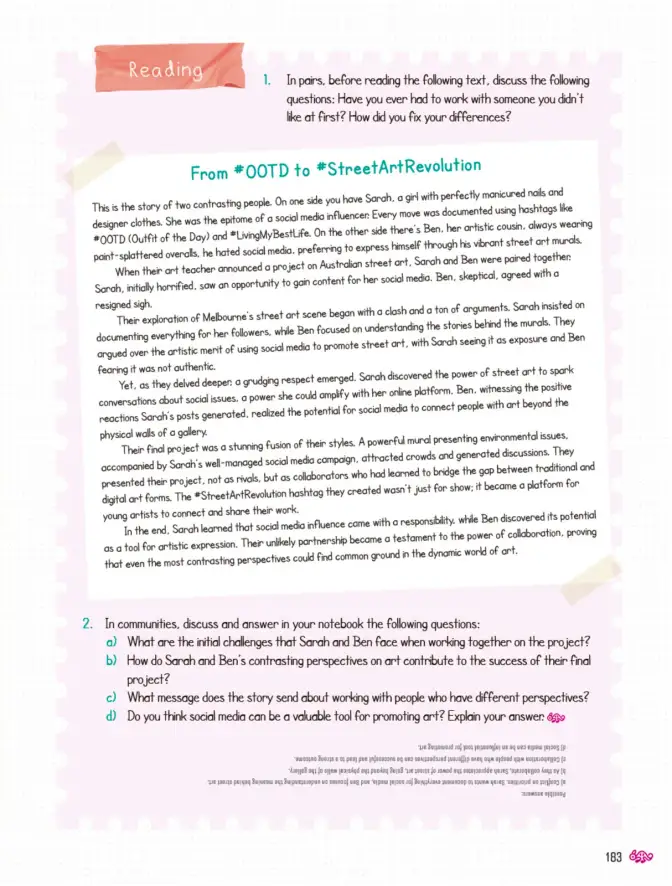
  1. In pairs, before reading the following text, discuss the following questions: Have you ever had to work with someone you didn't like at first? How did you fix your differences?

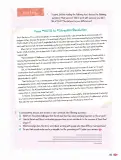
From #OOTD to #StreetArtRevolution

This is the story of two contrasting people. On one side you have Sarah, a girl with perfectly manicured nails and designer clothes. She was the epitome of a social media influencer. Every move was documented using hashtags like #OOTD (Outfit of the Day) and #LivingMyBestLife. On the other side there's Ben, her artistic cousin, always wearing paint-splattered overalls, he hated social media, preferring to express himself through his vibrant street art murals.

When their art teacher announced a project on Australian street art, Sarah and Ben were paired together. Sarah, initially horrified, saw an opportunity to gain content for her social media. Ben, skeptical, agreed with a resigned sigh.

Their exploration of Melbourne's street art scene began with a clash and a ton of arguments. Sarah insisted on documenting everything for her followers, while Ben focused on understanding the stories behind the murals. They argued over the artistic merit of using social media to promote street art, with Sarah seeing it as exposure and Ben fearing it was not authentic.

Yet, as they delved deeper, a grudging respect emerged. Sarah discovered the power of street art to spark conversations about social issues, a power she could amplify with her online platform. Ben, witnessing the positive reactions Sarah's posts generated, realized the potential for social media to connect people with art beyond the physical walls of a gallery.

Their final project was a stunning fusion of their styles. A powerful mural presenting environmental issues, accompanied by Sarah's well-managed social media campaign, attracted crowds and generated discussions. They presented their project, not as rivals, but as collaborators who had learned to bridge the gap between traditional and digital art forms. The #StreetArtRevolution hashtag they created wasn't just for show; it became a platform for young artists to connect and share their work.

In the end, Sarah learned that social media influence came with a responsibility, while Ben discovered its potential as a tool for artistic expression. Their unlikely partnership became a testament to the power of collaboration, proving that even the most contrasting perspectives could find common ground in the dynamic world of art.

  1. In communities, discuss and answer in your notebook the following questions:

a) What are the initial challenges that Sarah and Ben face when working together on the project? b) How do Sarah and Ben's contrasting perspectives on art contribute to the success of their final project? c) What message does the story send about working with people who have different perspectives? d) Do you think social media can be a valuable tool for promoting art? Explain your answer.

Glosario (6)

OOTD
Outfit of the Day, hashtag used to share daily outfits on social media
street art
visual art created in public locations, often unsanctioned
mural
a painting or other work of art executed directly on a wall
influencer
a person with the ability to influence potential buyers of a product or service by promoting it on social media
collaboration
the action of working with someone to produce or create something
hashtag
a word or phrase preceded by a hash sign (#), used on social media to identify messages on a specific topic

Preguntas para practicar

Have you ever had to work with someone you didn't like at first? How did you fix your differences?

Yes, I once had to work with a classmate I didn't get along with at first. We fixed our differences by talking about our goals and dividing the tasks according to our strengths. We learned to listen to each other and focus on the project instead of our personal opinions.

What are the initial challenges that Sarah and Ben face when working together on the project?

They disagreed on the role of social media in art and had different working styles, which caused arguments at the beginning.

How do Sarah and Ben's contrasting perspectives on art contribute to the success of their final project?

Their different perspectives combined traditional street art with digital promotion, making the project more complete and successful.

What message does the story send about working with people who have different perspectives?

The story teaches that collaboration between people with different perspectives can produce innovative and successful outcomes.

Do you think social media can be a valuable tool for promoting art? Explain your answer.

Yes, social media can be a valuable tool for promoting art because it helps artists reach a wider audience and connect with people who appreciate their work. However, it should be used responsibly to preserve the authenticity of the art.

Temas y conceptos clave

Lectura comprensiva en inglésColaboración y trabajo en equipoArte callejero y redes socialesStreet artSocial media influencerCollaborationContrasting perspectivesHashtag campaign
¿Te fue útil esta página?

Preguntas que la gente también hace

¿Cómo pueden las redes sociales ayudar a los artistas callejeros?
Consulta la solución completa arriba o explora el libro entero para temas relacionados.
¿Qué hacer cuando trabajas con alguien que piensa diferente a ti?
Consulta la solución completa arriba o explora el libro entero para temas relacionados.
¿Cuál es el mensaje principal del texto From #OOTD to #StreetArtRevolution?
Consulta la solución completa arriba o explora el libro entero para temas relacionados.
📌 Antes de leer esto
  • • Vocabulario básico en inglés sobre arte y redes sociales
  • • Comprensión de textos narrativos en inglés
  • • Habilidad para identificar ideas principales y detalles
Siguiente tema sugerido
Writing: creating a social media campaign for a cause
📝 Transcripción de la página (texto seleccionable) 2538 caracteres

Reading

  1. In pairs, before reading the following text, discuss the following questions: Have you ever had to work with someone you didn't like at first? How did you fix your differences?

From#OOTD to #StreetArtRevolution

This is the story of two contrasting people. On one side you have Sarah, a ginl with perfectly manicured nails and designer clothes. She was the epitome of a social media influencer Every move was documented using hashtags like #OOTD (Outfit of the Day) and #LivingMyBestLife. On the other side there's Ben, her artistic cousin, always wearing -splattered overalls, he hated social medid, prereriig To cxptot antSanah and Ben were pained together

When the ant teacher announceprjeon Ausirld sile cdi senticgaree wit resigned sigh.ae gdteueneSea nsse

resigned sigh.documenting everything for her followers, while Ben focused on understanding the stories behind the murals.They argued over the artistic merit of using social media to promote street art, with Sarah seeing it as exposure and Ben fegring it was not authentic.cawaneat eeoeeeee

conversations about social issues, a power she could amplify with her online platform. Ben, witnessing the positive reactions Sarah's posts generated, realized the potential for social media to connect people with art beyond the physical walls of a gallery.ca wallsofogallo eeeeneeyonenta ssue

accompanied by Sarah's well-managed social media campaign, attracted crowds and generated discussions. They presented their project, not as rivals, but as collaborators who had learned to bridge the gap between traditional and digital art forms.The#StreetArtRevolution hashtag they created wasn't just for show; it became a platform for youngantists tocoectand share theinwonk.aartiststoconnecandsharethe woriBendscovered ispotenti

as a tool for artistic expression. Their unlikely partnership became a testament to the power of collaboration, proving that even the most contrasting perspectives could find common ground in the dynamic world of art.

  1. In communities, discuss and answer in your notebook the following questions:

a) What are the initial challenges that Sarah and Ben face when working together on the pro ject?b) How do Sarah and Ben's contrasting perspectives on ant contribute to the success of their final project?

c)What message does the story send about working with people who have different perspectives?d) Do you think social media can be a valuable tool for promoting art? Explain your answer: &s

d u e es a a aa a a SIBE

183

Ad

Otros libros recomendados

Ver todos →
Ad

Usamos cookies propias y de terceros para personalizar contenido, mostrar publicidad y analizar el tráfico. Las cookies necesarias siempre están activas.