















Saltar al contenido
MisLibrosTexto
Ad

Why Is a Language Lost? - Indigenous Languages and Their Preservation

📄 ejercicios ingles 🎓 bachillerato · 3° Secundaria México 🇲🇽 MX 🗣 Español
Página 63
63 de 187
Página 63 de Uérakua anapu uantakua. Projects and Readings.  Libro de Educación Secundaria Grado 3°  Ciclo Escolar 2025 - 2026
Anterior Página 63 / 187 Siguiente

Respuesta rápida

1.a) Investigación sobre desplazamiento histórico y discriminación. 1.b) Causas: discriminación, migración, castellanización. 1.c) Club de conversación, carteles bilingües, radio comunitaria. 1.d) Parteras, mitos y fiestas en lengua materna. 2. Casa de cultura, escuela bilingüe, radio comunitaria.

📚 exercise ingles ⭐⭐ Dificultad 2/5 ⏱ 8 min lectura

Solución — Página 63

Uérakua anapu uantakua. Projects and Readings. Libro de Educación Secundaria Grado 3° Ciclo Escolar 2025 - 2026

1
Ejercicio 1

In assembly, read the following text: "Why Is a Language Lost?"

a
Parte 1.a

In communities, and with the help of your teacher, research in different media —books from the community library, magazines, or the internet— the historical and cultural journey of Indigenous languages and the adversities that have hindered their preservation and transmission.

Respuesta orientativa:

Las lenguas indígenas de México han sufrido un desplazamiento histórico desde la Conquista y la Colonia, cuando se impuso el español como lengua de prestigio y de administración. Durante los siglos XIX y XX, las políticas de castellanización en la escuela y la discriminación social provocaron que muchas familias dejaran de transmitir su lengua materna a los hijos. Factores como la migración a las ciudades, el racismo lingüístico y la falta de materiales educativos en lenguas originarias aceleraron su pérdida. Actualmente, el INALI reconoce 68 lenguas indígenas con 364 variantes, muchas en riesgo de desaparición.

b
Parte 1.b

Write what you found out.

Respuesta orientativa:

Hallazgos principales: (1) la discriminación es la causa principal de la pérdida; (2) la migración y la búsqueda de mejores oportunidades económicas llevan a los padres a no transmitir la lengua; (3) la escuela ha sido históricamente un espacio de castellanización forzada; (4) existen actualmente programas de revitalización como la educación intercultural bilingüe y el Instituto Nacional de Lenguas Indígenas (INALI).

c
Parte 1.c

On the board, write and propose actions to promote using an Indigenous language in your community.

Respuesta orientativa:

Acciones propuestas: (1) crear un club de conversación en lengua indígena en la escuela; (2) elaborar carteles bilingües para los espacios públicos; (3) invitar a hablantes mayores a compartir cuentos y leyendas; (4) producir un podcast o radio comunitaria en lengua originaria; (5) incluir la lengua indígena en los anuncios y asambleas comunitarias; (6) organizar un festival cultural con danzas, música y poesía en lengua materna.

d
Parte 1.d

Consider the social practices and customs that prevail in your community. Think, for example, of its stories, myths, and traditions —such as the work of midwives— passed down and enjoyed in their cherished native tongue.

Respuesta orientativa:

En muchas comunidades, las parteras transmiten conocimientos sobre el embarazo, el parto y el cuidado del recién nacido en su lengua materna, junto con rezos y rituales. Los mitos fundacionales, los cuentos de animales y las leyendas sobre cerros, ríos y cuevas se narran en la lengua originaria y contienen una cosmovisión que se pierde al traducirse. Las fiestas patronales, las mayordomías y las danzas tradicionales también conservan cantos y discursos rituales en lengua indígena que refuerzan la identidad comunitaria.

2
Ejercicio 2

Ask your family members or neighbors to tell you about the community's sites or institutions that have helped them to preserve its linguistic legacy and identify the practices used to achieve this.

Respuesta orientativa:

Instituciones y sitios que preservan el legado lingüístico: la casa de cultura comunitaria, la escuela bilingüe, la radio comunitaria, la biblioteca local, el mercado tradicional y la iglesia. Prácticas identificadas: transmitir cuentos y consejos de abuelos a nietos, usar la lengua en asambleas ejidales, cantar en lengua originaria en fiestas, elaborar artesanías nombrando cada objeto en la lengua, y enseñar a los niños los nombres de plantas, animales y lugares en la lengua materna.

Contenido de la página

Approach

  1. In assembly, read the following text:

Why Is a Language Lost?

Each language has its worldview, which implies a particular way of understanding and being in the world. Mothers and fathers pass down their mother tongues from early childhood when raising their children and in other social settings such as the community and school.

Despite its importance, Indigenous languages have faced adversities that have endangered their conservation and permanence for centuries. Discrimination against speaking a language other than the national language is one of the leading causes of the loss of an Indigenous language. Seeking better social and economic opportunities, mothers and fathers choose not to pass it down to their daughters and sons.

a) In communities, and with the help of your teacher, research in different media —books from the community library, magazines, or the internet— the historical and cultural journey of Indigenous languages and the adversities that have hindered their preservation and transmission.

b) Write what you found out.

c) On the board, write and propose actions to promote using an Indigenous language in your community.

d) Consider the social practices and customs that prevail in your community. Think, for example, of its stories, myths, and traditions —such as the work of midwives— passed down and enjoyed in their cherished native tongue.

  1. Ask your family members or neighbors to tell you about the community's sites or institutions that have helped them to preserve its linguistic legacy and identify the practices used to achieve this.

Tabla

Causa Descripción Ejemplo
Discriminación Rechazo a quien habla una lengua distinta a la nacional Burla en la escuela por hablar náhuatl
Migración Desplazamiento a ciudades donde se usa solo el español Familias que dejan de hablar mixteco
Oportunidades económicas Padres priorizan el español para el éxito laboral No enseñan la lengua a los hijos
Castellanización escolar Escuela que impone el español Prohibición de hablar lengua indígena en clase

Diagrama

mindmap
  root((Why Is a Language Lost?))
    Causas
      Discriminación
      Migración
      Búsqueda de oportunidades
      Castellanización escolar
    Consecuencias
      Pérdida intergeneracional
      Pérdida de cosmovisión
      Desaparición de saberes
    Acciones de preservación
      Educación bilingüe
      Radio comunitaria
      Transmisión oral
      Festivales culturales

Glosario (7)

worldview
cosmovisión; forma particular de entender y estar en el mundo
mother tongue
lengua materna; primera lengua que se aprende en la infancia
Indigenous languages
lenguas indígenas; idiomas originarios de un pueblo
adversities
adversidades; dificultades o problemas que obstaculizan algo
linguistic legacy
legado lingüístico; herencia cultural expresada en la lengua
midwives
parteras; mujeres que ayudan en los partos
pass down
transmitir de una generación a otra

Preguntas para practicar

Why is a language lost according to the text?

Because of discrimination against speaking a language other than the national language, and because parents seeking better social and economic opportunities choose not to pass it down to their children.

What does it mean that each language has its worldview?

It means that each language implies a particular way of understanding and being in the world, so losing a language means losing a unique way of interpreting reality.

What actions can you propose to promote an Indigenous language in your community?

Creating conversation clubs, bilingual signs, community radio programs, cultural festivals, and using the language in public assemblies.

Temas y conceptos clave

Pérdida de lenguas indígenasTransmisión intergeneracional de la lenguaDiscriminación lingüísticaPreservación del patrimonio lingüísticoworldview (cosmovisión)mother tongue (lengua materna)Indigenous languages (lenguas indígenas)linguistic legacy (legado lingüístico)adversities (adversidades)preservation and transmission (preservación y transmisión)

Fuentes y referencias

  • Instituto Nacional de Lenguas Indígenas (INALI)
  • UNESCO Atlas of the World's Languages in Danger
  • Biblioteca comunitaria local
¿Te fue útil esta página?

Figuras de la página (4)

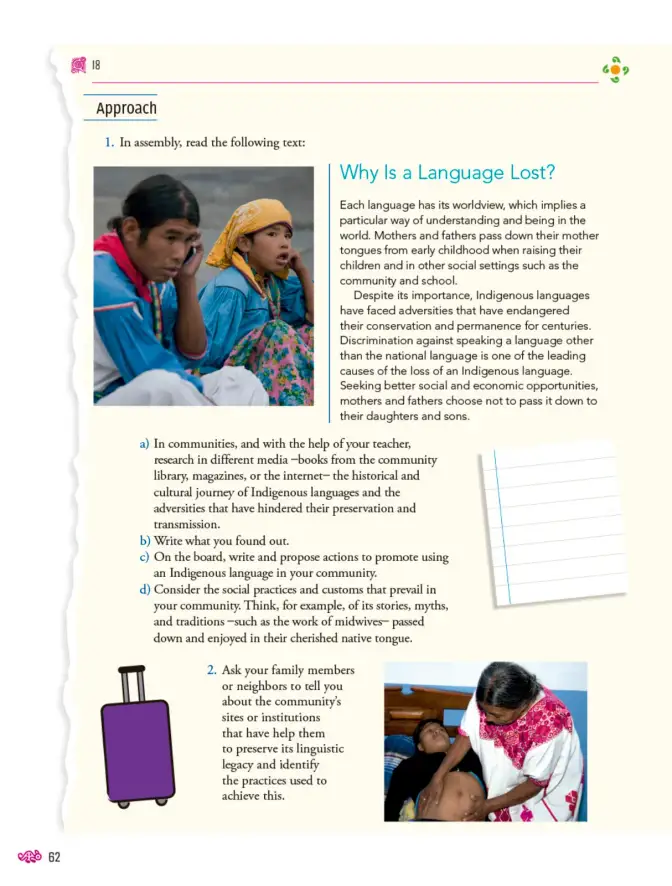
Fotografía de un hombre y una mujer indígenas con vestimenta tradicional; el hombre habla por teléfono celular y la mujer viste blusa azul y pañoleta amarilla.
Figura 1 image
Fotografía de una partera tradicional atendiendo a una mujer embarazada acostada; la partera viste blusa blanca con bordados rojos.
Figura 2 image
Ilustración de una hoja de cuaderno con líneas para escribir.
Figura 3 image
Ilustración de una maleta morada con ruedas.
Figura 4 image

Preguntas que la gente también hace

¿Por qué se pierden las lenguas indígenas en México?
Consulta la solución completa arriba o explora el libro entero para temas relacionados.
¿Cuántas lenguas indígenas existen en México y cuántas están en riesgo?
Consulta la solución completa arriba o explora el libro entero para temas relacionados.
¿Qué acciones puedo hacer para promover el uso de una lengua indígena en mi comunidad?
Consulta la solución completa arriba o explora el libro entero para temas relacionados.
📌 Antes de leer esto
  • • Comprensión lectora en inglés nivel B1
  • • Conocimiento básico sobre pueblos indígenas de México
  • • Vocabulario sobre cultura y comunidad
Siguiente tema sugerido
Indigenous Languages in Mexico: Current Status and Revitalization Programs
📝 Transcripción de la página (texto seleccionable) 1771 caracteres

Approach

  1. In assembly, read the following text:

Why Is a Language Lost?

Each language has its worldview, which implies a particular way of understanding and being in the world. Mothers and fathers pass down their mother tongues from early childhood when raising their children and in other social settings such as the community and school.

Despite its importance, Indigenous languages have faced adversities that have endangered their conservation and permanence for centuries.Discrimination against speaking a language other than the national language is one of the leading causes of the loss of an Indigenous language.Seeking better social and economic opportunities,mothers and fathers choose not to pass it down to their daughters and sons.

a) In communities, and with the help of your teacher,research in different media —books from the community library, magazines, or the internet- the historical and cultural journey of Indigenous languages and the adversities that have hindered their preservation and transmission.

b) Write what you found out.

c) On the board, write and propose actions to promote using an Indigenous language in your community.

d) Consider the social practices and customs that prevail in your community. Think, for example, of its stories, myths,and traditions —such as the work of midwives- passed down and enjoyed in their cherished native tongue.

  1. Ask your family members or neighbors to tell you about the community's sites or institutions that have help them to preserve its linguistic legacy and identify the practices used to achieve this.

18

,

![](page=0,bbox=[167, 299, 565, 731])

![](page=0,bbox=[691, 1191, 1059, 1482])

![](page=0,bbox=[858, 805, 1129, 1098])

![](page=0,bbox=[181, 1196, 318, 1459])

中

62

Ad

Otros libros recomendados

Ver todos →
Ad

Usamos cookies propias y de terceros para personalizar contenido, mostrar publicidad y analizar el tráfico. Las cookies necesarias siempre están activas.