















Saltar al contenido
MisLibrosTexto
Ad

Identity Handbook: Scrapbook or Brochure Project

📄 ejercicios ingles 🎓 otro · 1° TELESECUNDARIA México 🇲🇽 MX 🗣 Español
Página 106
106 de 187
Página 106 de Uérakua anapu uantakua. Projects and Readings.  Libro de Educación Telesecundaria Grado 1°  Ciclo Escolar 2025 - 2026
Anterior Página 106 / 187 Siguiente

Respuesta rápida

Se elige scrapbook o folleto, se recopilan expresiones literarias de la comunidad, se traducen, se ilustran y se evalúan las estrategias con las preguntas de exploración.

📚 exercise ingles ⭐⭐ Dificultad 2/5 ⏱ 8 min lectura

Solución — Página 106

Uérakua anapu uantakua. Projects and Readings. Libro de Educación Telesecundaria Grado 1° Ciclo Escolar 2025 - 2026

1
Ejercicio 1

Enunciado: In assembly, and with the help of your teacher, choose the appropriate sequence of activities to create your Identity Handbook (Option 1: Scrapbook or Option 2: Brochure).

  1. Revisar las dos opciones del cuadro: Option 1. Scrap book y Option 2. Brochure.
  2. Identificar los pasos comunes: elegir frases o expresiones literarias de la comunidad, buscar fuentes orales o documentales, compilar la información de cada integrante, traducirla o adaptarla a otro sistema lingüístico, ilustrar con fotografías, dibujos o recortes.
  3. Decidir el formato final: si se elige el scrapbook, se hace en hojas tamaño carta y se guarda en una carpeta con portada y hoja informativa; si se elige el folleto, se siguen los tres primeros pasos de la Opción 1 y se coloca la información en formato de folleto fácil de leer y llevar, con tres páginas en blanco al final.
  4. Incluir en la portada los nombres de los miembros de la comunidad de aula y colaboradores, mencionando quién ayudó con la traducción o adaptación.
Respuesta

Se elige una de las dos opciones y se sigue la secuencia de pasos indicada, integrando expresiones literarias de la comunidad, traducción, ilustraciones y créditos en la portada.


2
Ejercicio 2

Enunciado: Once you start the project, review that the strategies are working perfectly. If they aren't, you will have to modify them. Get together in a community and write the following questions on a sheet of paper:

a) Which activities have worked as expected? b) Which activities were not accomplished or are incomplete? Why? c) Can you use any other action or activity to meet the objectives?

a
Parte 2.a
  1. Revisar el plan de trabajo del proyecto.
  2. Identificar las actividades que se completaron según lo previsto (por ejemplo, la recolección de frases, la traducción, la ilustración).
  3. Anotar en una hoja las que sí funcionaron.
Respuesta

Las actividades que funcionaron fueron la búsqueda de expresiones literarias y la recopilación de información, porque se contó con fuentes orales y documentales accesibles.

b
Parte 2.b
  1. Revisar las actividades pendientes.
  2. Detectar causas: falta de tiempo, dificultad para traducir, poca colaboración, materiales insuficientes.
  3. Escribir las razones.
Respuesta

No se completaron la traducción y la ilustración final porque algunos integrantes no entregaron su parte a tiempo y no se encontró un traductor disponible.

c
Parte 2.c
  1. Proponer acciones alternativas: pedir ayuda a un compañero bilingüe, usar un diccionario, dividir tareas, establecer fechas límite.
  2. Evaluar si esas acciones ayudan a cumplir los objetivos.
  3. Anotarlas.
Respuesta

Sí, se puede pedir apoyo a un hablante de la lengua originaria de la comunidad, usar recursos digitales de traducción y reorganizar el cronograma para cumplir con el folleto.

3
Ejercicio 3

Enunciado: Exchange your projects and answer the questions. Be respectful of other opinions and express your points of view on how the projects can be improved.

  1. Intercambiar el proyecto con otro equipo.
  2. Leer las preguntas de exploración respondidas por los compañeros.
  3. Dar retroalimentación respetuosa: señalar fortalezas y sugerir mejoras en contenido, traducción, presentación visual y claridad.
  4. Expresar el punto de vista propio sobre cómo mejorar el proyecto.
Respuesta

Se intercambian los proyectos, se responden las preguntas con respeto y se proponen mejoras como ampliar la información, revisar la traducción y mejorar la portada.

Contenido de la página

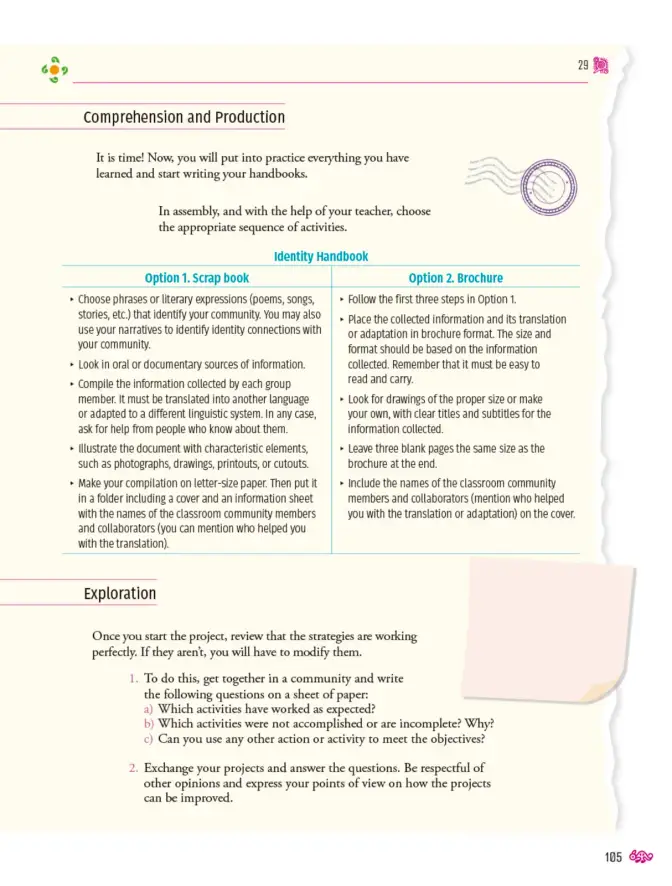
Comprehension and Production

It is time! Now, you will put into practice everything you have learned and start writing your handbooks.

In assembly, and with the help of your teacher, choose the appropriate sequence of activities.

Identity Handbook

Option 1. Scrap book Option 2. Brochure
Choose phrases or literary expressions (poems, songs, stories, etc.) that identify your community. You may also use your narratives to identify identity connections with your community. Follow the first three steps in Option 1.
Look in oral or documentary sources of information. Place the collected information and its translation or adaptation in brochure format. The size and format should be based on the information collected. Remember that it must be easy to read and carry.
Compile the information collected by each group member. It must be translated into another language or adapted to a different linguistic system. In any case, ask for help from people who know about them. Look for drawings of the proper size or make your own, with clear titles and subtitles for the information collected.
Illustrate the document with characteristic elements, such as photographs, drawings, printouts, or cutouts. Leave three blank pages the same size as the brochure at the end.
Make your compilation on letter-size paper. Then put it in a folder including a cover and an information sheet with the names of the classroom community members and collaborators (you can mention who helped you with the translation). Include the names of the classroom community members and collaborators (mention who helped you with the translation or adaptation) on the cover.

Exploration

Once you start the project, review that the strategies are working perfectly. If they aren't, you will have to modify them.

  1. To do this, get together in a community and write the following questions on a sheet of paper: a) Which activities have worked as expected? b) Which activities were not accomplished or are incomplete? Why? c) Can you use any other action or activity to meet the objectives?

  2. Exchange your projects and answer the questions. Be respectful of other opinions and express your points of view on how the projects can be improved.

Tabla

Option 1. Scrap book Option 2. Brochure
Choose phrases or literary expressions (poems, songs, stories, etc.) that identify your community. You may also use your narratives to identify identity connections with your community. Follow the first three steps in Option 1.
Look in oral or documentary sources of information. Place the collected information and its translation or adaptation in brochure format. The size and format should be based on the information collected. Remember that it must be easy to read and carry.
Compile the information collected by each group member. It must be translated into another language or adapted to a different linguistic system. In any case, ask for help from people who know about them. Look for drawings of the proper size or make your own, with clear titles and subtitles for the information collected.
Illustrate the document with characteristic elements, such as photographs, drawings, printouts, or cutouts. Leave three blank pages the same size as the brochure at the end.
Make your compilation on letter-size paper. Then put it in a folder including a cover and an information sheet with the names of the classroom community members and collaborators (you can mention who helped you with the translation). Include the names of the classroom community members and collaborators (mention who helped you with the translation or adaptation) on the cover.

Glosario (6)

handbook
manual o cuaderno que reúne información sobre un tema
scrapbook
álbum o libro de recortes donde se pegan fotografías, dibujos y textos
brochure
folleto informativo, fácil de leer y llevar
literary expressions
expresiones literarias como poemas, canciones o cuentos
compile
recopilar o reunir información de varias fuentes
assembly
reunión del grupo completo para tomar decisiones

Preguntas para practicar

Which activities have worked as expected?

Las actividades que funcionaron fueron la búsqueda de expresiones literarias y la recopilación de información, porque se contó con fuentes orales y documentales accesibles.

Which activities were not accomplished or are incomplete? Why?

No se completaron la traducción y la ilustración final porque algunos integrantes no entregaron su parte a tiempo y no se encontró un traductor disponible.

Can you use any other action or activity to meet the objectives?

Sí, se puede pedir apoyo a un hablante de la lengua originaria de la comunidad, usar recursos digitales de traducción y reorganizar el cronograma para cumplir con el folleto.

Temas y conceptos clave

Identity HandbookScrapbookBrochureExploration and evaluationIdentityCommunityLiterary expressionsTranslationProject evaluation
¿Te fue útil esta página?

Figuras de la página (2)

Sello postal con líneas de movimiento, decorativo.
Figura 1 image
Nota adhesiva rosa con esquina doblada, decorativa.
Figura 2 image

Preguntas que la gente también hace

¿Qué es un Identity Handbook y cómo se elabora?
Consulta la solución completa arriba o explora el libro entero para temas relacionados.
¿Cómo puedo traducir expresiones literarias de mi comunidad al inglés?
Consulta la solución completa arriba o explora el libro entero para temas relacionados.
¿Qué preguntas debo responder para evaluar mi proyecto escolar?
Consulta la solución completa arriba o explora el libro entero para temas relacionados.
📌 Antes de leer esto
  • • Vocabulario básico en inglés sobre identidad y comunidad
  • • Conocimiento de expresiones literarias de la comunidad
  • • Habilidades básicas de investigación y trabajo en equipo
Siguiente tema sugerido
Presentación oral del Identity Handbook
📝 Transcripción de la página (texto seleccionable) 2500 caracteres

Comprehension and Production

It is time! Now, you will put into practice everything you have learned and start writing your handbooks.

In assembly, and with the help of your teacher, choose the appropriate sequence of activities.

Exploration

Once you start the project, review that the strategies are working perfectly. If they aren't, you will have to modify them.

  1. To do this, get together in a community and write the following questions on a sheet of paper:a) Which activities have worked as expected? b) Which activities were not accomplished or are incomplete? Why? c) Can you use any other action or activity to meet the objectives?

  2. Exchange your projects and answer the questions. Be respectful of other opinions and express your points of view on how the projects can be improved.

29

![](page=0,bbox=[838, 279, 1042, 388])

Identity Handbook

Identity Handbook Option 1. Scrap bookOption 2. Brochure
Choose phrases or literary expressions (poems, songs, stories, etc.) that identify your community. You may also use your narratives to identify identity connections with your community. Look in oral or documentary sources of information.Follow the first three steps in Option 1. Place the collected information and its translation or adaptation in brochure format. The size and format should be based on the information
Compile the information collected by each group member. It must be translated into another languagecollected. Remember that it must be easy to read and carry. Look for drawings of the proper size or make
or adapted to a diferent linguistic system. In any case, ask for help from people who know about them. Illustrate the document with characteristic elements,your own, with clear titles and subtitles for the information collected. Leave three blank pages the same size as the
such as photographs, drawings, printouts, or cutouts. Make your compilation on letter-size paper. Then put it in a folder including a cover and an information sheet with the names of the classroom community members and collaborators (you can mention who helped you with the translation).brochure at the end. Include the names of the classroom community members and collaborators (mention who helped you with the translation or adaptation) on the cover.

![](page=0,bbox=[834, 1018, 1150, 1274])

105

8

Ad

Otros libros recomendados

Ver todos →
Ad

Usamos cookies propias y de terceros para personalizar contenido, mostrar publicidad y analizar el tráfico. Las cookies necesarias siempre están activas.