Saltar al contenido
MisLibrosTexto
Ad

That's the Question! – Shaping Personal Identity

📄 ejercicios ingles 🎓 otro · 1° TELESECUNDARIA México 🇲🇽 MX 🗣 Español
Página 22
22 de 187
Página 22 de Uérakua anapu uantakua. Projects and Readings.  Libro de Educación Telesecundaria Grado 1°  Ciclo Escolar 2025 - 2026
Anterior Página 22 / 187 Siguiente

Respuesta rápida

2.d) Vocabulario escolar: classes, sports, library, science, math, English, art, music, friends, teachers. 3.a) Sí, la familia transmite valores y costumbres. 3.b) Sí, los amigos influyen en gustos y expresiones. 3.c) Distingo mis gustos por lo que siento al hacerlo, no por lo que hace el grupo.

📚 exercise ingles ⭐⭐ Dificultad 2/5 ⏱ 8 min lectura

Solución — Página 22

Uérakua anapu uantakua. Projects and Readings. Libro de Educación Telesecundaria Grado 1° Ciclo Escolar 2025 - 2026

2
Ejercicio 2

d

Draw one last circle and, inside it, write words related to your school community: which activities are carried out at school, what you like the most doing there, your favorite subjects, etc.

Respuesta orientativa: En el cuarto círculo se escriben palabras en inglés relacionadas con la comunidad escolar. Ejemplo de vocabulario: classes, homework, sports, library, science, math, English, art, music, friends, teachers, break time, soccer, reading, experiments. Estas palabras describen actividades escolares, gustos y asignaturas favoritas.

3
Ejercicio 3

Consider the descriptions you wrote in the circles and answer the following questions in your notebook.

a
Parte 3.a

Does your family influence the way you are?

Respuesta orientativa: Yes, my family influences the way I am because I learn values, customs, and habits from them. For example, I learned to be respectful and responsible from my parents. They also influence my tastes in food, music, and celebrations.

b
Parte 3.b

Do your friends influence your life?

Respuesta orientativa: Yes, friends influence my life because we share interests, activities, and ways of speaking. Sometimes I adopt their expressions or hobbies, but I also keep my own ideas. Good friends help me feel accepted and supported.

c
Parte 3.c

How do you distinguish between what you like/dislike and what they like/dislike?

Respuesta orientativa: I distinguish my own likes and dislikes by thinking about how I feel when I do an activity. If I enjoy it and feel comfortable, it is my own preference. If I only do it to belong to the group, then it is not really mine. I can respect my friends' tastes without copying them.

4
Ejercicio 4

In community, share your answers.

Respuesta orientativa: Se comparten las respuestas en plenaria. Cada estudiante explica brevemente cómo su familia y amigos influyen en su identidad y cómo diferencia sus propios gustos de los del grupo. Se practica la escucha activa y el respeto por las opiniones de los demás.

Let's Get Into It! – Ejercicio 1

In community, hang around the classroom the sheets of paper with the four circles. Look at them and carefully read the words your classmates wrote about themselves, their family, their friends, and their school community.

Respuesta orientativa: Se colocan en las paredes del aula las hojas con los cuatro círculos elaborados previamente. Los estudiantes caminan, leen en silencio las palabras de sus compañeros y toman nota mental de las ideas que más les llaman la atención sobre la identidad de los demás.

Let's Get Into It! – Ejercicio 2

Write in your notebook a few sentences based on the information you read, then take turns sharing them with the community.

a
Parte 4.a

Pedro likes to ride his bike.

Respuesta orientativa: Esta oración usa el verbo like en tercera persona singular (likes) seguido de infinitivo con to: ride his bike. Estructura: sujeto + likes + to + verbo + complemento.

b
Parte 4.b

Sofia is very good at mathematics.

Respuesta orientativa: Esta oración usa el verbo to be (is) + very good at + sustantivo o área de conocimiento (mathematics). Sirve para describir habilidades.

c
Parte 4.c

Sam's mom is a secretary.

Respuesta orientativa: Esta oración usa el posesivo sajón (Sam's) para indicar pertenencia y el verbo to be (is) + artículo indefinido a + profesión (secretary).

That's the Question! – Reflexión

Shaping your personal identity requires self-knowledge and recognition that you are a unique and unrepeatable person...

Respuesta orientativa: La identidad personal se construye al reconocer lo que nos hace únicos y diferentes de los demás. Aunque queremos pertenecer a un grupo y a veces copiamos modas o costumbres, es posible formar parte de él sin abandonar nuestra forma de ser y pensar. Para lograrlo, se necesita autoconocimiento, respeto a las diferencias y comunicación asertiva en las relaciones.

Contenido de la página

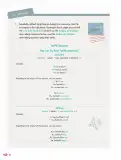
d) Draw one last circle and, inside it, write words related to your school community: which activities are carried out at school, what you like the most doing there, your favorite subjects, etc. Write words that have to do with it.

  1. Consider the descriptions you wrote in the circles and answer the following questions in your notebook:

a) Does your family influence the way you are?

b) Do your friends influence your life?

c) How do you distinguish between what you like/dislike and what they like/dislike?

  1. In community, share your answers.

Let's Get Into It!

  1. In community, hang around the classroom the sheets of paper with the four circles. Look at them and carefully read the words your classmates wrote about themselves, their family, their friends, and their school community.

  2. Write in your notebook a few sentences based on the information you read, then take turns sharing them with the community. Take a look at these examples:

a) Pedro likes to ride his bike.

b) Sofia is very good at mathematics.

c) Sam's mom is a secretary.

INQUIRY DESIGN AND DEVELOPMENT

That's the Question!

Shaping your personal identity requires self-knowledge and recognition that you are a unique and unrepeatable person by identifying what makes you different from others. However, it is difficult to accept our own differences because we want to be part of a specific group of people. Therefore, we copy what others do: wearing certain clothing styles, dyeing our hair in different colors, etc.

All the above is fine, as it shapes our collective identity. But... How can we be part of a group without abandoning our way of being and thinking? How can we acknowledge personal differences that influence our personality? How can we establish good and respectful relationships?

Ejemplos resueltos

Pedro likes to ride his bike.

Estructura: sujeto (Pedro) + verbo like en tercera persona (likes) + to + verbo base (ride) + complemento (his bike). Se usa para expresar gustos.

Sofia is very good at mathematics.

Estructura: sujeto (Sofia) + verbo to be (is) + very good at + área (mathematics). Se usa para describir habilidades.

Sam's mom is a secretary.

Estructura: posesivo sajón (Sam's) + sustantivo (mom) + verbo to be (is) + artículo (a) + profesión (secretary). Se usa para indicar pertenencia y ocupación.

Glosario (8)

self-knowledge
conocimiento de uno mismo
unrepeatable
irrepetible, único
identity
identidad
influence
influir, influencia
belong
pertenecer
acknowledge
reconocer, aceptar
respectful
respetuoso
community
comunidad

Preguntas para practicar

How can we be part of a group without abandoning our way of being and thinking?

Podemos pertenecer a un grupo manteniendo nuestras convicciones, expresando nuestras ideas con respeto y eligiendo qué costumbres adoptar sin dejar de ser nosotros mismos.

How can we acknowledge personal differences that influence our personality?

Reconociendo que cada persona tiene experiencias, gustos y formas de pensar distintas, y valorando esas diferencias como parte de la riqueza del grupo.

How can we establish good and respectful relationships?

Practicando la escucha activa, la empatía, la comunicación asertiva y el respeto por los límites y opiniones de los demás.

Temas y conceptos clave

Identidad personalInfluencia de la familia y los amigosPertenencia a un grupoAutoconocimientoDescripción de gustos y habilidades en inglésidentidad personalinfluencia socialpertenenciadiferencias individualesrelaciones respetuosasautoconocimiento
¿Te fue útil esta página?

Figuras de la página (3)

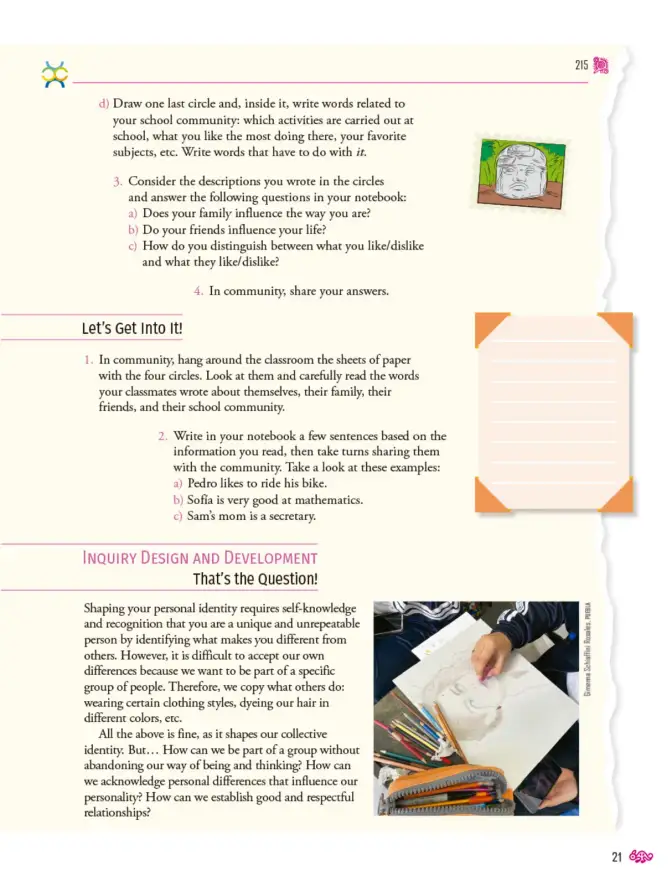
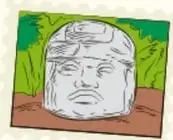
Ilustración de una cabeza tallada en piedra estilo prehispánico sobre fondo verde.
Figura 1 image
Hoja de papel color durazno con esquinas naranjas y líneas para escribir.
Figura 2 image
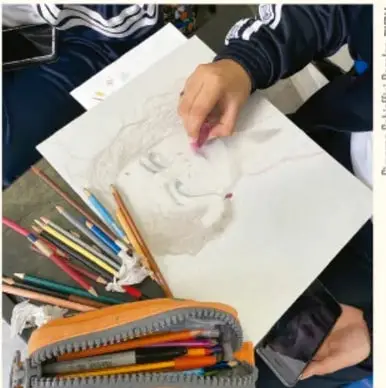
Fotografía de una mano dibujando un rostro a lápiz sobre papel, con colores y una lapicera sobre la mesa.
Figura 3 image

Preguntas que la gente también hace

¿Cómo influye la familia en la identidad personal?
Consulta la solución completa arriba o explora el libro entero para temas relacionados.
¿Cómo puedo pertenecer a un grupo sin dejar de ser yo mismo?
Consulta la solución completa arriba o explora el libro entero para temas relacionados.
¿Cómo se describen los gustos y habilidades en inglés?
Consulta la solución completa arriba o explora el libro entero para temas relacionados.
📌 Antes de leer esto
  • • Vocabulario básico en inglés sobre familia, amigos y escuela
  • • Uso del verbo to be y del verbo like en presente simple
  • • Identificación de adjetivos posesivos y posesivo sajón
Siguiente tema sugerido
Inquiry Design and Development: reconocer diferencias personales y establecer relaciones respetuosas
📝 Transcripción de la página (texto seleccionable) 1925 caracteres

d) Draw one last circle and, inside it, write words related to your school community: which activities are carried out at school, what you like the most doing there, your favorite subjects, etc. Write words that have to do with it.

  1. Consider the descriptions you wrote in the circles and answer the following questions in your notebook:a) Does your family influence the way you are?b) Do your friends influence your life? c) How do you distinguish between what you like/dislike and what they like/dislike?

4. In community, share your answers.

Let's Get Into It!

  1. In community, hang around the classroom the sheets of paper with the four circles. Look at them and carefully read the words your classmates wrote about themselves, their family, their friends, and their school community.

  2. Write in your notebook a few sentences based on the information you read, then take turns sharing them with the community. Take a look at these examples:a) Pedro likes to ride his bike.

b) Sofia is very good at mathematics.

c) Sam's mom is a secretary.

INQUIRY DESIGN AND DEVELOPMENT That's the Question!

Shaping your personal identity requires self-knowledge and recognition that you are a unique and unrepeatable person by identifying what makes you different from others. However, it is difficult to accept our own differences because we want to be part of a specific group of people. Therefore, we copy what others do:wearing certain clothing styles, dyeing our hair in different colors, etc.

All the above is fine, as it shapes our collective identity. But... How can we be part of a group without abandoning our way of being and thinking? How can we acknowledge personal differences that infl uence our personality? How can we establish good and respectful relationships?

8

215

![](page=0,bbox=[852, 240, 1025, 380])

![](page=0,bbox=[854, 559, 1149, 931])

![](page=0,bbox=[673, 1082, 1059, 1470])

21

乐
Ad

Otros libros recomendados

Ver todos →
Ad

Usamos cookies propias y de terceros para personalizar contenido, mostrar publicidad y analizar el tráfico. Las cookies necesarias siempre están activas.