















Saltar al contenido
MisLibrosTexto
Ad

Time Expressions: Completing Sentences About Sports and History

📄 ejercicios ingles 🎓 otro · 1° TELESECUNDARIA México 🇲🇽 MX 🗣 Español
Página 95
95 de 187
Página 95 de Uérakua anapu uantakua. Projects and Readings.  Libro de Educación Telesecundaria Grado 1°  Ciclo Escolar 2025 - 2026
Anterior Página 95 / 187 Siguiente

Respuesta rápida

1.a last; 1.b right now / later; 1.c today; 1.d next; 1.e ago / right now; 2.a ago; 2.b last; 2.c next; 2.d later; 2.e nowadays; 2.f tomorrow

📚 exercise ingles ⭐⭐ Dificultad 2/5 ⏱ 5 min lectura

Solución — Página 95

Uérakua anapu uantakua. Projects and Readings. Libro de Educación Telesecundaria Grado 1° Ciclo Escolar 2025 - 2026

1
Ejercicio 1

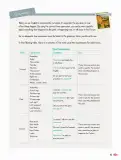
Individually, complete the sentences with the correct time expression from the table above.

a
Parte 1.a

______ month, my family and I played baseball with our neighbors. It was fun.

  1. La oración está en pasado simple ("played") y se refiere a un mes ya transcurrido.
  2. La expresión que indica pasado reciente es last.
Respuesta

Last

b
Parte 1.b

What are you doing? Well, ______ I'm finishing my homework, so I can go out to play football ______ in the afternoon.

  1. La primera acción ocurre en el momento de hablar: se usa right now.
  2. La segunda indica un momento posterior dentro del mismo día: later.
Respuesta

right now / later

c
Parte 1.c

I'm not feeling very well ______. I think I've got the flu and I won't be able to play in the basketball tournament.

  1. El malestar ocurre en el presente inmediato.
  2. La expresión adecuada es today.
Respuesta

today

d
Parte 1.d

Are you going to see our school's volleyball team match ______ Saturday? I'm sure it will be exciting!

  1. "Saturday" sin preposición necesita un determinante que indique el próximo sábado.
  2. Se usa next.
Respuesta

next

e
Parte 1.e

Hey! What happened? A minute ______ you were very happy, but ______ you look terrible!

  1. "A minute" + expresión de pasado inmediato: ago.
  2. Contraste con el presente: right now.
Respuesta

ago / right now

2
Ejercicio 2

In pairs, complete the sentences with the correct time expression in parentheses.

a
Parte 2.a

Many centuries ______ (later/next/ago), the ball game had a religious meaning for some Mesoamerican societies.

  1. "Many centuries" indica tiempo transcurrido desde el pasado.
  2. Con períodos de tiempo se usa ago.
Respuesta

ago

b
Parte 2.b

______ (next/last/ago) Monday we set up an exhibition on the history of balls at school. It was so much fun!

  1. El verbo "set up" está en pasado.
  2. Se necesita una expresión de pasado: last.
Respuesta

last

c
Parte 2.c

We will present another project about Indigenous communities in Mexico ______ (next/later/nowadays) month. It's going to be great!

  1. "Will present" indica futuro.
  2. Con "month" se usa next.
Respuesta

next

d
Parte 2.d

In my classroom, everybody was excited about the gallery we will open ______ (ago/last/later) this week.

  1. "Will open" indica futuro dentro de la misma semana.
  2. La expresión adecuada es later.
Respuesta

later

e
Parte 2.e

My dad says that ______ (later/ago/nowadays) classes are very different from those in his school days.

  1. Se compara el presente con el pasado.
  2. La expresión para el presente actual es nowadays.
Respuesta

nowadays

f
Parte 2.f

______ (tomorrow/next/this), my class will visit a factory to learn about machines and materials used in the manufacture of balls.

  1. "Will visit" indica futuro.
  2. Con "my class" como sujeto y sin artículo, se usa tomorrow.
Respuesta

tomorrow

Contenido de la página

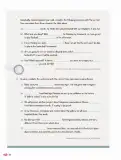
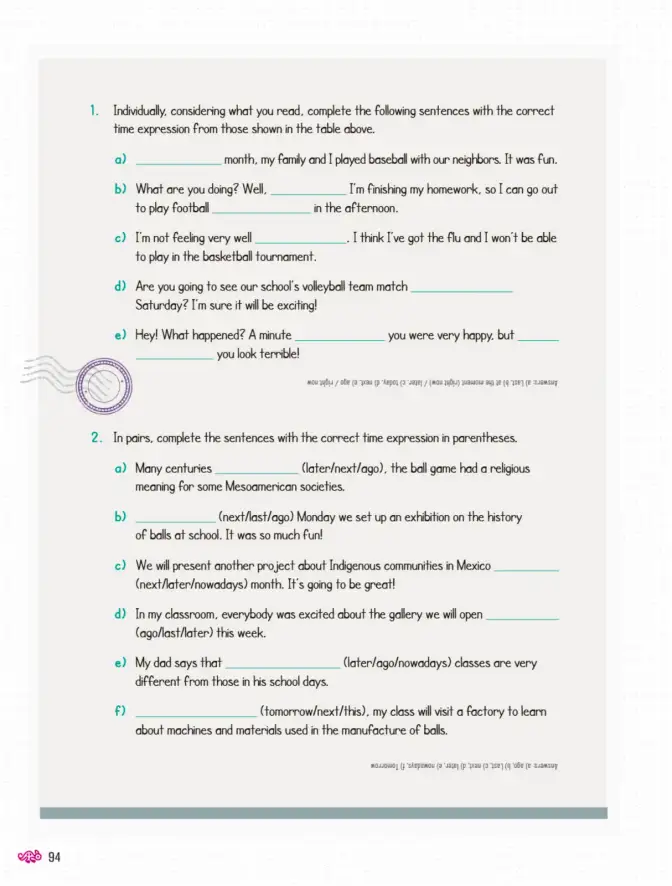
  1. Individually, considering what you read, complete the following sentences with the correct time expression from those shown in the table above.

a) ______ month, my family and I played baseball with our neighbors. It was fun.

b) What are you doing? Well, ______ I'm finishing my homework, so I can go out to play football ______ in the afternoon.

c) I'm not feeling very well ______. I think I've got the flu and I won't be able to play in the basketball tournament.

d) Are you going to see our school's volleyball team match ______ Saturday? I'm sure it will be exciting!

e) Hey! What happened? A minute ______ you were very happy, but ______ you look terrible!

Answers: a) last, b) right now / later, c) today, d) next, e) ago / right now

  1. In pairs, complete the sentences with the correct time expression in parentheses.

a) Many centuries ______ (later/next/ago), the ball game had a religious meaning for some Mesoamerican societies.

b) ______ (next/last/ago) Monday we set up an exhibition on the history of balls at school. It was so much fun!

c) We will present another project about Indigenous communities in Mexico ______ (next/later/nowadays) month. It's going to be great!

d) In my classroom, everybody was excited about the gallery we will open ______ (ago/last/later) this week.

e) My dad says that ______ (later/ago/nowadays) classes are very different from those in his school days.

f) ______ (tomorrow/next/this), my class will visit a factory to learn about machines and materials used in the manufacture of balls.

Answers: a) ago, b) last, c) next, d) later, e) nowadays, f) tomorrow

Glosario (8)

last
último/a; se usa con períodos de tiempo para indicar el más reciente en el pasado
next
próximo/a; indica el siguiente período de tiempo en el futuro
ago
hace; se coloca después de un período de tiempo para indicar cuánto tiempo ha pasado
later
más tarde; indica un momento posterior al actual
nowadays
hoy en día; se usa para hablar del presente en contraste con el pasado
tomorrow
mañana; el día siguiente al actual
right now
ahora mismo; en este preciso momento
today
hoy; el día actual

Temas y conceptos clave

Expresiones de tiempoDeportes y actividades escolaresHistoria de las pelotas en Mesoaméricalastnextagolaternowadaystomorrowthisright nowtoday
¿Te fue útil esta página?

Figuras de la página (1)

Sello circular con diseño de líneas curvas, similar a una marca de agua decorativa.
Figura 1 image

Preguntas que la gente también hace

¿Cuándo se usa 'ago' y cuándo 'later' en inglés?
Consulta la solución completa arriba o explora el libro entero para temas relacionados.
¿Cómo se usan 'last' y 'next' con días de la semana?
Consulta la solución completa arriba o explora el libro entero para temas relacionados.
¿Cuál es la diferencia entre 'nowadays' y 'right now'?
Consulta la solución completa arriba o explora el libro entero para temas relacionados.
📌 Antes de leer esto
  • • Reconocer el pasado simple de verbos regulares e irregulares
  • • Identificar el futuro con 'will' y 'going to'
  • • Vocabulario básico de deportes y actividades escolares
Siguiente tema sugerido
Uso de conectores de secuencia y expresiones de frecuencia en inglés
📝 Transcripción de la página (texto seleccionable) 1436 caracteres
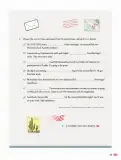
  1. Individually, considering what you read, complete the following sentences with the correct time expression from those shown in the table above.

a)month, my family and I played baseball with our neighbors. It was fun.

b) What are you doing? Well,I'm finishing my homework, so I can go out to play football in the afternoon.

c)I'm not feeling very well .I think I've got the flu and I won't be able to play in the basketball tournament.

d) Are you going to see our school's volleyball team match Saturday? I'm sure it will be exciting!

e)Hey! What happened? A minute you were very happy, but you look terrible!

  1. In pairs, complete the sentences with the correct time expression in parentheses.

a) Many centuries (later/next/ago), the ball game had a religious meaning for some Mesoamerican societies.

b)(next/last/ago) Monday we set up an exhibition on the history of balls at school. It was so much fun!

c)We willpresent another project about Indigenous communities in Mexico (next/later/nowadays) month. It's going to be great!

d) In my classroom, everybody was excited about the gallery we willopen (ago/last/later) this week.

e)My dad says that (later/ago/nowadays) classes are very different from those in his school days.

f)(tomorrow/next/this), my class will isit a factory to learn about machines and materials used in the manufacture of balls.

![](page=0,bbox=[37, 639, 239, 747])

mo spou aae) a ()(e e sy

94

Ad

Otros libros recomendados

Ver todos →
Ad

Usamos cookies propias y de terceros para personalizar contenido, mostrar publicidad y analizar el tráfico. Las cookies necesarias siempre están activas.