

















Mexican Revolution: Listening and Grammar (Past Tenses)
Respuesta rápida
Listening: 1 railroads, 2 wealth concentrated, 3 Díaz defeated, 4 Zapata/Orozco/Villa complain, 5 Huerta dictatorship, 6 Huerta vs Carranza/Obregón, 7 Carranza hated, 8 Villa/Zapata rebel, 9 Orozco/Villa lead north, 10 Constitution 1917, 11 peasants get land, 12 Obregón president.
Solución — Página 155
Uérakua anapu uantakua. Projects and Readings. Libro de Educación Telesecundaria Grado 2° Ciclo Escolar 2025 - 2026
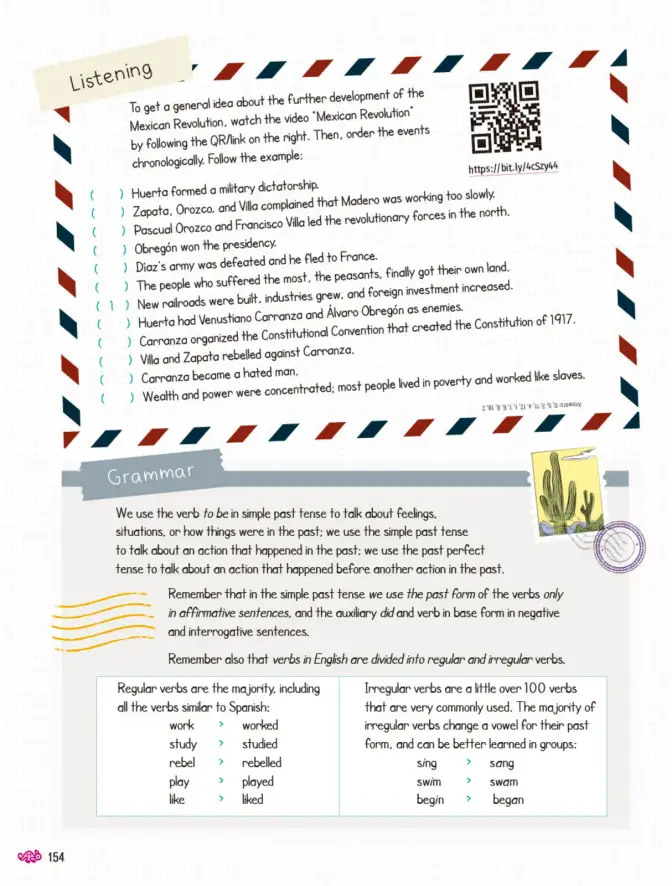
Listening: Order the events chronologically
Enunciado (ES): Para tener una idea general del desarrollo posterior de la Revolución Mexicana, mira el video "Mexican Revolution" siguiendo el enlace QR de la derecha. Luego ordena los eventos cronológicamente. Sigue el ejemplo.
Enunciado (EN): To get a general idea about the further development of the Mexican Revolution, watch the video "Mexican Revolution" by following the QR/link on the right. Then, order the events chronologically. Follow the example.
El evento (1) ya está dado: New railroads were built, industries grew, and foreign investment increased. Corresponde al Porfiriato (antes de 1910).
- Wealth and power were concentrated; most people lived in poverty and worked like slaves. (Porfiriato, ~1900)
- Díaz's army was defeated and he fled to France. (1911)
- Zapata, Orozco, and Villa complained that Madero was working too slowly. (1911-1912)
- Huerta formed a military dictatorship. (1913)
- Huerta had Venustiano Carranza and Álvaro Obregón as enemies. (1913)
- Carranza became a hated man. (1913-1914)
- Villa and Zapata rebelled against Carranza. (1914)
- Pascual Orozco and Francisco Villa led the revolutionary forces in the north. (1914)
- Carranza organized the Constitutional Convention that created the Constitution of 1917. (1916-1917)
- The people who suffered the most, the peasants, finally got their own land. (1917-1920)
- Obregón won the presidency. (1920)
Respuesta (orden final): ( 1 ) New railroads were built, industries grew, and foreign investment increased. ( 2 ) Wealth and power were concentrated; most people lived in poverty and worked like slaves. ( 3 ) Díaz's army was defeated and he fled to France. ( 4 ) Zapata, Orozco, and Villa complained that Madero was working too slowly. ( 5 ) Huerta formed a military dictatorship. ( 6 ) Huerta had Venustiano Carranza and Álvaro Obregón as enemies. ( 7 ) Carranza became a hated man. ( 8 ) Villa and Zapata rebelled against Carranza. ( 9 ) Pascual Orozco and Francisco Villa led the revolutionary forces in the north. ( 10 ) Carranza organized the Constitutional Convention that created the Constitution of 1917. ( 11 ) The people who suffered the most, the peasants, finally got their own land. ( 12 ) Obregón won the presidency.
Grammar
Enunciado (ES): Usamos el verbo to be en pasado simple para hablar de sentimientos, situaciones o cómo eran las cosas en el pasado; usamos el pasado simple para hablar de una acción que ocurrió en el pasado; usamos el pasado perfecto para hablar de una acción que ocurrió antes de otra acción en el pasado.
Enunciado (EN): We use the verb to be in simple past tense to talk about feelings, situations, or how things were in the past; we use the simple past tense to talk about an action that happened in the past; we use the past perfect tense to talk about an action that happened before another action in the past.
Recuerda: En pasado simple usamos la forma pasada del verbo solo en oraciones afirmativas; en negativas e interrogativas usamos el auxiliar did + verbo en forma base.
Recuerda también: Los verbos en inglés se dividen en regulares e irregulares.
Regular verbs (verbos regulares)
Son la mayoría, incluyendo todos los verbos similares al español:
| Base form | Past form |
|---|---|
| work | worked |
| study | studied |
| rebel | rebelled |
| play | played |
| like | liked |
Irregular verbs (verbos irregulares)
Son un poco más de 100 verbos de uso muy común. La mayoría cambia una vocal en su forma pasada y se aprenden mejor en grupos:
| Base form | Past form |
|---|---|
| sing | sang |
| swim | swam |
| begin | began |
Respuesta orientativa: Los verbos regulares forman el pasado agregando -ed (work → worked). Los irregulares no siguen esa regla y cambian de forma (sing → sang, swim → swam, begin → began).
Contenido de la página
Listening
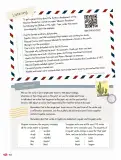
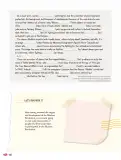
To get a general idea about the further development of the Mexican Revolution, watch the video "Mexican Revolution" by following the QR/link on the right. Then, order the events chronologically. Follow the example:
( ) Huerta formed a military dictatorship. ( ) Zapata, Orozco, and Villa complained that Madero was working too slowly. ( ) Pascual Orozco and Francisco Villa led the revolutionary forces in the north. ( ) Obregón won the presidency. ( ) Díaz's army was defeated and he fled to France. ( ) The people who suffered the most, the peasants, finally got their own land. ( 1 ) New railroads were built, industries grew, and foreign investment increased. ( ) Huerta had Venustiano Carranza and Álvaro Obregón as enemies. ( ) Carranza organized the Constitutional Convention that created the Constitution of 1917. ( ) Villa and Zapata rebelled against Carranza. ( ) Carranza became a hated man. ( ) Wealth and power were concentrated; most people lived in poverty and worked like slaves.
Grammar
We use the verb to be in simple past tense to talk about feelings, situations, or how things were in the past; we use the simple past tense to talk about an action that happened in the past; we use the past perfect tense to talk about an action that happened before another action in the past.
Remember that in the simple past tense we use the past form of the verbs only in affirmative sentences, and the auxiliary did and verb in base form in negative and interrogative sentences.
Remember also that verbs in English are divided into regular and irregular verbs.
Regular verbs
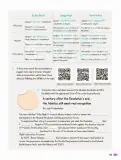
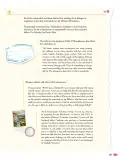
Regular verbs are the majority, including all the verbs similar to Spanish:
| Base | Past |
|---|---|
| work | worked |
| study | studied |
| rebel | rebelled |
| play | played |
| like | liked |
Irregular verbs
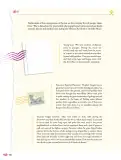
Irregular verbs are a little over 100 verbs that are very commonly used. The majority of irregular verbs change a vowel for their past form, and can be better learned in groups:
| Base | Past |
|---|---|
| sing | sang |
| swim | swam |
| begin | began |
Ejemplos resueltos
Order the events chronologically. Follow the example: ( 1 ) New railroads were built, industries grew, and foreign investment increased.
El evento 1 corresponde al Porfiriato. Después: concentración de riqueza, derrota de Díaz, quejas contra Madero, dictadura de Huerta, enemistad con Carranza y Obregón, Carranza odiado, rebelión de Villa y Zapata, fuerzas del norte, Constitución de 1917, reparto de tierras y presidencia de Obregón.
Tabla
| Base form | Past form | Type |
|---|---|---|
| work | worked | regular |
| study | studied | regular |
| rebel | rebelled | regular |
| play | played | regular |
| like | liked | regular |
| sing | sang | irregular |
| swim | swam | irregular |
| begin | began | irregular |
Diagrama
timeline
    title Mexican Revolution Timeline
    1900 : Porfiriato, railroads, foreign investment
    1910 : Wealth concentrated, poverty
    1911 : Díaz defeated, flees to France
    1912 : Zapata, Orozco, Villa complain about Madero
    1913 : Huerta dictatorship
    1914 : Villa and Zapata rebel against Carranza
    1917 : Constitution of 1917
    1920 : Obregón wins presidency
Glosario (5)
- chronologically
- en orden cronológico, según el orden en que ocurrieron los hechos
- dictatorship
- dictadura, gobierno en el que una sola persona concentra todo el poder
- peasants
- campesinos, personas que trabajan la tierra
- past perfect
- tiempo verbal que indica una acción ocurrida antes de otra acción pasada
- auxiliary did
- auxiliar que se usa para formar negativas e interrogativas en pasado simple
Preguntas para practicar
Why is it important to order historical events chronologically?
Ordenar los eventos cronológicamente permite comprender las causas y consecuencias de los hechos históricos, identificar relaciones de causa-efecto y construir una narrativa coherente de la Revolución Mexicana.
Temas y conceptos clave
Fuentes y referencias
- https://bit.ly/4cSzy44
Figuras de la página (3)



Preguntas que la gente también hace
¿Cómo se ordenan cronológicamente los eventos de la Revolución Mexicana en inglés?
¿Cuál es la diferencia entre past simple y past perfect en inglés?
¿Cómo se forman los verbos regulares e irregulares en pasado en inglés?
- • Verbo to be en presente y pasado
- • Vocabulario básico de historia
- • Reconocer verbos en inglés
📝 Transcripción de la página (texto seleccionable) 1666 caracteres
Listening
e Mexican Revolution, watch the video"Mexican Revolution"by following the QR/link on the right. Then, order the events chronologically. Follow the example:
)Huerta formed a military dictatorship.)Zapata,Orozco,and Villa coplaine d henevolutionary forces n thenonth.
Obregonwon iepdoe
)The people who suffered the most, the peusd foreian investment increased Diazsarmy was defeate an neTe
New railroaas were bunC annanza and Alvaro Obregón as enemies.
Huenta had Venustiano Carranzaand Aaro Orethat created h
Villa and Zapata rebelld against Caranza.
)Cse
22
Grammar
We use the verb to be in simple past tense to talk about feelings,situations, or how things were in the past; we use the simple past tense to talk about an action that happened in the past; we use the past perfect tense to talk about an action that happened before another action in the past.
Remember that in the simple past tense we use the past form of the verbs only in affinmative sentences, and the auxiliary did and verb in base form in negative and interrogative sentences.
Remember also that verbs in English are divided into regular and iregular verbs.
Regular verbs are the majority, including all the verbs similar to Spanish:
work >worked study >studied rebel V rebelled play -played like V liked
Irregular verbs are a litle over 100 verbs that are very commonly used. The majority of irregular verbs change a vowel for their past form, and can be better learned in groups:
sing >sang swim V swam began


154
Otros libros recomendados
Colección Sk´asolil. Lenguajes. Libro de Educación Telesecundaria Grado 2° Ciclo Escolar 2025 - 2026
SEP/CONALITEG
323 págs.
Colección Sk´asolil. Saberes y pensamiento científico. Libro de Educación Telesecundaria Grado 2° Ciclo Escolar 2025 - 2026
SEP/CONALITEG
339 págs.
Colección Sk´asolil. Ética, naturaleza y sociedades. Libro de Educación Telesecundaria Grado 2° Ciclo Escolar 2025 - 2026
SEP/CONALITEG
355 págs.
Uérakua anapu uantakua. Projects and Readings. Libro de Educación Telesecundaria Grado 3° Ciclo Escolar 2025 - 2026
SEP/CONALITEG
187 págs.
Colección Sk´asolil. De lo humano y lo comunitario. Libro de Educación Telesecundaria Grado 2° Ciclo Escolar 2025 - 2026
SEP/CONALITEG
259 págs.
Colección Sk´asolil. Nuestro libro de Proyectos. Tomo II. Libro de Educación Telesecundaria Grado 2° Ciclo Escolar 2025 - 2026
SEP/CONALITEG
259 págs.
Colección Sk´asolil. Nuestro libro de Proyectos. Tomo I. Libro de Educación Telesecundaria Grado 2° Ciclo Escolar 2025 - 2026
SEP/CONALITEG
291 págs.
Colección Sk´asolil. Nuestro libro de Proyectos. Tomo III. Libro de Educación Telesecundaria Grado 2° Ciclo Escolar 2025 - 2026
SEP/CONALITEG
291 págs.