

















Present Simple and Present Progressive Tense
Respuesta rápida
Present Simple: rutinas, hechos y sentimientos (do/does). Present Progressive: acciones en curso (am/is/are + -ing).
Solución — Página 23
Uérakua anapu uantakua. Projects and Readings. Libro de Educación Telesecundaria Grado 2° Ciclo Escolar 2025 - 2026
Present Simple Tense
Se usa para acciones habituales, hechos y sentimientos.
- Affirmative: sujeto + verbo (+ -s/-es en 3.ª persona) + objeto.
- They like fruit. / She likes popcorn.
- Negative: sujeto + do not (don't) / does not (doesn't) + verbo + objeto.
- They don't like fruit. / She doesn't like popcorn.
- Interrogative: Do/Does + sujeto + verbo + objeto + ?
- Do they like fruit? Yes, they do. / Does she like popcorn? No, she doesn't.
Respuesta: El presente simple describe rutinas, hechos y sentimientos; en 3.ª persona singular el verbo lleva -s/-es y se usa does/doesn't.
Present Progressive Tense
Se usa para acciones que ocurren ahora.
- Affirmative: sujeto + am/is/are + verbo(-ing) + objeto.
- I am studying. / You are writing a letter.
- Negative: sujeto + am not / are not (aren't) / is not (isn't) + verbo(-ing) + objeto.
- I am not studying. / You are not writing a letter.
- Interrogative: Am/Are/Is + sujeto + verbo(-ing) + objeto + ?
- Am I studying? / Are you writing a letter? Yes, you are. No, you are not.
Respuesta: El presente progresivo describe acciones en curso; se forma con am/is/are + verbo en -ing.
Cuadro comparativo
| Tiempo | Uso | Auxiliar | Ejemplo |
|---|---|---|---|
| Present Simple | Rutinas, hechos, sentimientos | do / does | She works at a factory. |
| Present Progressive | Acciones que ocurren ahora | am / is / are | She is working now. |
Contenido de la página
Grammar
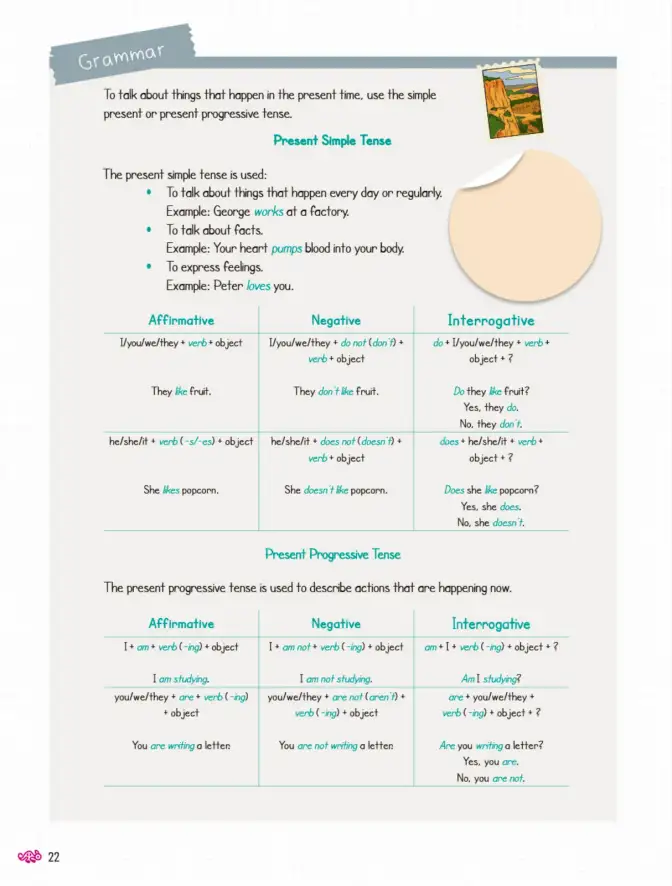
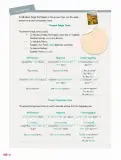
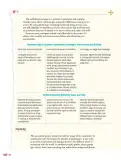
To talk about things that happen in the present time, use the simple present or present progressive tense.
Present Simple Tense
The present simple tense is used:
- To talk about things that happen every day or regularly. Example: George works at a factory.
- To talk about facts. Example: Your heart pumps blood into your body.
- To express feelings. Example: Peter loves you.
| Affirmative | Negative | Interrogative |
|---|---|---|
| I/you/we/they + verb + object | I/you/we/they + do not (don't) + verb + object | do + I/you/we/they + verb + object + ? |
| They like fruit. | They don't like fruit. | Do they like fruit? Yes, they do. No, they don't. |
| he/she/it + verb (-s/-es) + object | he/she/it + does not (doesn't) + verb + object | does + he/she/it + verb + object + ? |
| She likes popcorn. | She doesn't like popcorn. | Does she like popcorn? Yes, she does. No, she doesn't. |
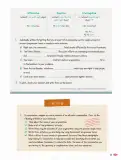
Present Progressive Tense
The present progressive tense is used to describe actions that are happening now.
| Affirmative | Negative | Interrogative |
|---|---|---|
| I + am + verb (-ing) + object | I + am not + verb (-ing) + object | am + I + verb (-ing) + object + ? |
| I am studying. | I am not studying. | Am I studying? |
| you/we/they + are + verb (-ing) + object | you/we/they + are not (aren't) + verb (-ing) + object | are + you/we/they + verb (-ing) + object + ? |
| You are writing a letter. | You are not writing a letter. | Are you writing a letter? Yes, you are. No, you are not. |
Ejemplos resueltos
George ___ at a factory. (work)
Tercera persona singular → se agrega -s: George works at a factory.
Your heart ___ blood into your body. (pump)
Hecho general, 3.ª persona singular → pumps.
Peter ___ you. (love)
Sentimiento, 3.ª persona singular → loves.
They ___ fruit. (negative)
They + don't + like → They don't like fruit.
She ___ popcorn. (interrogative)
Does + she + like → Does she like popcorn? Yes, she does.
I ___ studying. (affirmative)
I + am + verb(-ing) → I am studying.
You ___ writing a letter. (negative)
You + are not + writing → You are not writing a letter.
Tablas (2)
| Affirmative | Negative | Interrogative |
|---|---|---|
| I/you/we/they + verb + object | I/you/we/they + do not (don't) + verb + object | do + I/you/we/they + verb + object + ? |
| They like fruit. | They don't like fruit. | Do they like fruit? Yes, they do. No, they don't. |
| he/she/it + verb (-s/-es) + object | he/she/it + does not (doesn't) + verb + object | does + he/she/it + verb + object + ? |
| She likes popcorn. | She doesn't like popcorn. | Does she like popcorn? Yes, she does. No, she doesn't. |
| Affirmative | Negative | Interrogative |
|---|---|---|
| I + am + verb (-ing) + object | I + am not + verb (-ing) + object | am + I + verb (-ing) + object + ? |
| I am studying. | I am not studying. | Am I studying? |
| you/we/they + are + verb (-ing) + object | you/we/they + are not (aren't) + verb (-ing) + object | are + you/we/they + verb (-ing) + object + ? |
| You are writing a letter. | You are not writing a letter. | Are you writing a letter? Yes, you are. No, you are not. |
Diagrama
mindmap
  root((Present Tenses))
    Present Simple
      Rutinas
      Hechos
      Sentimientos
      do/does
    Present Progressive
      Acciones ahora
      am/is/are
      verbo -ing
Fórmulas y ecuaciones
Sujeto + verbo (+ -s/-es) + objeto
Sujeto + do/does + not + verbo + objeto
Do/Does + sujeto + verbo + objeto + ?
Sujeto + am/is/are + verbo(-ing) + objeto
Glosario (6)
- simple present
- Tiempo verbal para rutinas, hechos y sentimientos.
- present progressive
- Tiempo verbal para acciones que ocurren en el momento.
- affirmative
- Forma oracional que afirma algo.
- negative
- Forma oracional que niega algo usando not.
- interrogative
- Forma oracional que formula preguntas.
- verb (-ing)
- Verbo con terminación -ing usado en presente progresivo.
Preguntas para practicar
¿Cuál es la diferencia principal entre el presente simple y el presente progresivo?
El presente simple se usa para rutinas, hechos y sentimientos, mientras que el presente progresivo describe acciones que están ocurriendo en el momento de hablar. El primero usa do/does como auxiliar y el segundo am/is/are + verbo en -ing.
¿Por qué en tercera persona singular se agrega -s o -es al verbo?
Es una regla de concordancia del inglés: con he, she, it el verbo principal lleva -s o -es en presente simple, y en negativo e interrogativo se usa does/doesn't en lugar de do/don't.
Temas y conceptos clave
Figuras de la página (1)

Preguntas que la gente también hace
¿Cuándo se usa el presente simple y cuándo el presente progresivo?
¿Cómo se forma la tercera persona singular en presente simple?
¿Cuál es la diferencia entre do y does en las preguntas?
- • Reconocer pronombres personales en inglés
- • Conocer el verbo to be (am/is/are)
- • Identificar verbos en infinitivo
📝 Transcripción de la página (texto seleccionable) 1745 caracteres
To talk about things that happen in the present time, use the simple present or present progressive tense.
Present Simple Tense
The present simple tense is used:
Example: Peter loves you.
•To talk about things that happen every day or regularly.Example: George works at a factory.
●To talk about facts.
Example: Your heart pumps blood into your body.
®To express feelings.
Grammar

| Affirmative | Negative | Interrogative do + I/you/we/they + verb + object+? |
| I/you/we/they + venb+ object | Ilyou/we/they + do not (don'f) + venb + object | |
| They like fruit. | They don't like fruit. | Do they like fruit? Yes, they do. |
| he/she/it + venb(-s/-es) + object | he/shelit + does not(doesn't) + venb + object She doesn't lke popcorn. | does + he/shelit + venb + object+? |
| She likespopcorn. | Does she like popcorn? Yes, she does. | No, she doesn't. |
Present Progressive Tense
The present progressive tense is used to describe actions that are happening now.
| Affirmative | Negative | Interrogative |
| I+am+ venb(-ing) + object I am studying. | I + am not+ venb(-ing) + object I am not studying. | am+I + verb(-ing)+ object +? AmI studying? |
| you/we/they + ane + venb(-ing) + object You are writinga letten | you/we/they + are not (aren't) + venb(-ing)+ object You ane not writing a letten | are + you/we/they + venb(-ing)+ object+ ? Ane you wniting a letten? Yes, you are. No, you ane not. |
22
Otros libros recomendados

Colección Sk´asolil. Lenguajes. Libro de Educación Telesecundaria Grado 2° Ciclo Escolar 2025 - 2026
SEP/CONALITEG
323 págs.

Colección Sk´asolil. Saberes y pensamiento científico. Libro de Educación Telesecundaria Grado 2° Ciclo Escolar 2025 - 2026
SEP/CONALITEG
339 págs.

Colección Sk´asolil. Ética, naturaleza y sociedades. Libro de Educación Telesecundaria Grado 2° Ciclo Escolar 2025 - 2026
SEP/CONALITEG
355 págs.
Uérakua anapu uantakua. Projects and Readings. Libro de Educación Telesecundaria Grado 3° Ciclo Escolar 2025 - 2026
SEP/CONALITEG
187 págs.

Colección Sk´asolil. De lo humano y lo comunitario. Libro de Educación Telesecundaria Grado 2° Ciclo Escolar 2025 - 2026
SEP/CONALITEG
259 págs.

Colección Sk´asolil. Nuestro libro de Proyectos. Tomo II. Libro de Educación Telesecundaria Grado 2° Ciclo Escolar 2025 - 2026
SEP/CONALITEG
259 págs.

Colección Sk´asolil. Nuestro libro de Proyectos. Tomo I. Libro de Educación Telesecundaria Grado 2° Ciclo Escolar 2025 - 2026
SEP/CONALITEG
291 págs.

Colección Sk´asolil. Nuestro libro de Proyectos. Tomo III. Libro de Educación Telesecundaria Grado 2° Ciclo Escolar 2025 - 2026
SEP/CONALITEG
291 págs.