
















Saltar al contenido
MisLibrosTexto
Ad

Present Simple vs. Present Progressive: Community and Altruistic Organizations

📄 ejercicios ingles 🎓 otro · 2° TELESECUNDARIA México 🇲🇽 MX 🗣 Español
Página 24
24 de 171
Página 24 de Uérakua anapu uantakua. Projects and Readings.  Libro de Educación Telesecundaria Grado 2°  Ciclo Escolar 2025 - 2026
Anterior Página 24 / 171 Siguiente

Respuesta rápida

1.a) is helping; 1.b) focuses / promotes; 1.c) matters / tries; 1.d) are working; 1.e) join.

📚 exercise ingles ⭐⭐ Dificultad 2/5 ⏱ 10 min lectura

Solución — Página 24

Uérakua anapu uantakua. Projects and Readings. Libro de Educación Telesecundaria Grado 2° Ciclo Escolar 2025 - 2026

1
Ejercicio 1

Completa cada oración con el presente simple o el presente progresivo del verbo entre paréntesis.

a
Parte 1.a

Enunciado: Right now, the community ______ (help) people affected by the recent hurricane.

  1. La expresión Right now indica una acción que ocurre en este momento, por lo que se usa el presente progresivo.
  2. Estructura: sujeto + is/are + verbo en -ing. El sujeto the community es singular, así que se usa is.
  3. Verbo help → helping.
Respuesta

is helping

b
Parte 1.b

Enunciado: The United Nations ______ (focus) its efforts on maintaining international peace and ______ (promote) friendly relations between nations.

  1. La primera parte describe una función permanente de la ONU, por lo que se usa el presente simple. El sujeto The United Nations se trata como singular: focuses.
  2. La segunda parte también es una función habitual, por lo que se usa el presente simple. El sujeto The United Nations (singular) → promotes.
Respuesta

focuses; promotes

c
Parte 1.c

Enunciado: Your voice ______ (matter) and our organization ______ (try) to find solutions to your problems.

  1. Ambas oraciones expresan hechos generales, por lo que se usa el presente simple.
  2. Sujeto Your voice (singular) → matters.
  3. Sujeto our organization (singular) → tries (la y cambia a i y se añade -es).
Respuesta

matters; tries

d
Parte 1.d

Enunciado: Since the earthquake, volunteers ______ (work) day and night to help people in need.

  1. La palabra Since indica una acción que comenzó en el pasado y continúa, por lo que se usa el presente perfecto progresivo o el presente progresivo. En este contexto, el presente progresivo expresa la acción continua: are working.
  2. Sujeto volunteers (plural) → are + working.
Respuesta

are working

e
Parte 1.e

Enunciado: Each year, more women ______ (join) protests against violence.

  1. Each year indica una acción habitual que se repite cada año, por lo que se usa el presente simple.
  2. Sujeto more women (plural) → join (sin -s).
Respuesta

join

2
Ejercicio 2

En parejas, revisen sus respuestas y escríbanlas en el pizarrón.

Respuesta orientativa: Se sugiere que los estudiantes comparen sus respuestas, justifiquen el uso de cada tiempo verbal y escriban las oraciones completas en el pizarrón para su revisión grupal.

Writing

a
Parte 2.a

Enunciado: Think about the name of your organization.

Respuesta orientativa: Helping Hands Community (Manos Amigas).

b
Parte 2.b

Enunciado: Make a list of the problems it attends.

Respuesta orientativa:

  • Lack of food and clean water.
  • Homelessness after natural disasters.
  • Lack of medical assistance.
  • Educational support for children.
c
Parte 2.c

Enunciado: Write three regular activities of your organization using the present simple tense.

Respuesta orientativa:

  1. We distribute food to families in need.
  2. Our volunteers teach children how to read and write.
  3. The organization provides medical care in rural communities.
d
Parte 2.d

Enunciado: Write three activities you are doing now using the present progressive tense.

Respuesta orientativa:

  1. We are collecting donations for the hurricane victims.
  2. Volunteers are building temporary shelters.
  3. I am organizing a fundraising event.
e
Parte 2.e

Enunciado: Write a letter to your country's government asking for cooperation.

Respuesta orientativa:

[Date]

To the Ministry of Social Development:

We are writing on behalf of Helping Hands Community to request your cooperation in supporting people affected by recent disasters. Our organization is currently distributing food, providing medical assistance, and offering educational support to children in vulnerable communities.

We believe that with your support, we can reach more families and improve their quality of life. We are willing to work together to create a better future for everyone.

Sincerely,

[Your Name] President of Helping Hands Community

Contenido de la página

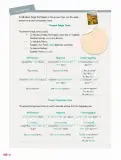
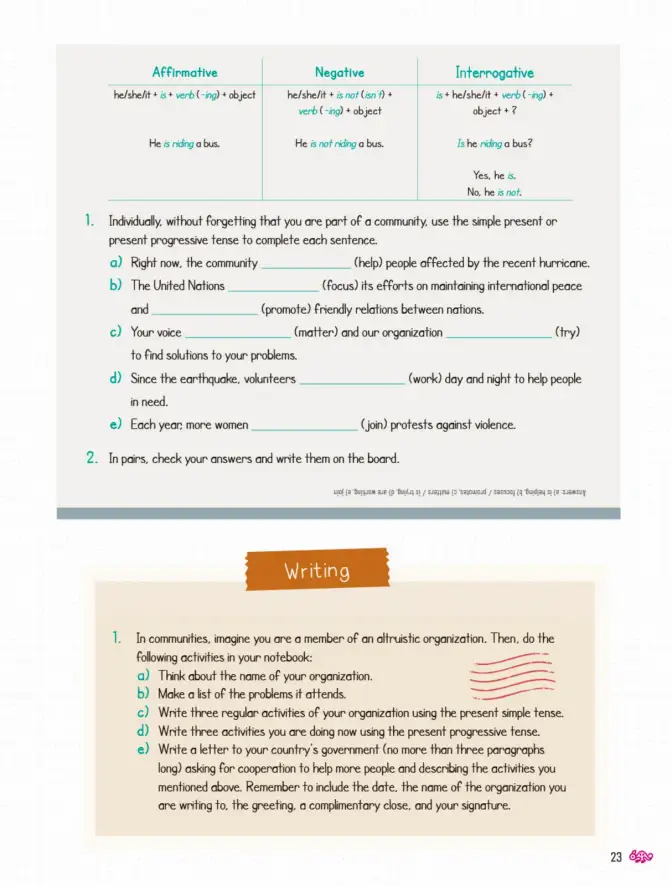
Grammar: Present Simple vs. Present Progressive

Affirmative Negative Interrogative
he/she/it + is + verb(-ing) + object he/she/it + is not (isn't) + verb(-ing) + object is + he/she/it + verb(-ing) + object + ?
He is riding a bus. He is not riding a bus. Is he riding a bus?
Yes, he is. / No, he is not.

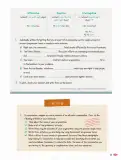
1. Individually, without forgetting that you are part of a community, use the simple present or present progressive tense to complete each sentence.

a) Right now, the community ______ (help) people affected by the recent hurricane.

b) The United Nations ______ (focus) its efforts on maintaining international peace and ______ (promote) friendly relations between nations.

c) Your voice ______ (matter) and our organization ______ (try) to find solutions to your problems.

d) Since the earthquake, volunteers ______ (work) day and night to help people in need.

e) Each year, more women ______ (join) protests against violence.

2. In pairs, check your answers and write them on the board.

Writing

1. In communities, imagine you are a member of an altruistic organization. Then, do the following activities in your notebook:

a) Think about the name of your organization.

b) Make a list of the problems it attends.

c) Write three regular activities of your organization using the present simple tense.

d) Write three activities you are doing now using the present progressive tense.

e) Write a letter to your country's government (no more than three paragraphs long) asking for cooperation to help more people and describing the activities you mentioned above. Remember to include the date, the name of the organization you are writing to, the greeting, a complimentary close, and your signature.

Ejemplos resueltos

He is riding a bus.

Estructura afirmativa del presente progresivo: sujeto + is + verbo(-ing) + objeto.

Tabla

Affirmative Negative Interrogative
he/she/it + is + verb(-ing) + object he/she/it + is not (isn't) + verb(-ing) + object is + he/she/it + verb(-ing) + object + ?
He is riding a bus. He is not riding a bus. Is he riding a bus?
Yes, he is. / No, he is not.

Glosario (8)

community
comunidad
hurricane
huracán
United Nations
Naciones Unidas
earthquake
terremoto
volunteers
voluntarios
altruistic
altruista
cooperation
cooperación
complimentary close
despedida cordial

Preguntas para practicar

Why is it important to use the present progressive in sentences with 'right now'?

Because 'right now' indicates an action happening at the moment of speaking, which is the main use of the present progressive.

Temas y conceptos clave

Presente simplePresente progresivoEscritura de cartas formalesOrganizaciones altruistasAffirmative, negative and interrogative structuresPresent simple for routines and general truthsPresent progressive for actions happening nowFormal letter writing
¿Te fue útil esta página?

Figuras de la página (1)

Número de página 23 con un adorno decorativo.
Figura 1 image

Preguntas que la gente también hace

¿Cuándo se usa el presente simple y cuándo el presente progresivo en inglés?
Consulta la solución completa arriba o explora el libro entero para temas relacionados.
¿Cómo se forma el presente progresivo en inglés?
Consulta la solución completa arriba o explora el libro entero para temas relacionados.
¿Cómo escribir una carta formal en inglés para solicitar cooperación?
Consulta la solución completa arriba o explora el libro entero para temas relacionados.
📌 Antes de leer esto
  • • Conocer la conjugación básica del presente simple en inglés
  • • Identificar sujetos singulares y plurales
  • • Reconocer verbos en inglés
Siguiente tema sugerido
Presente perfecto y pasado simple en contextos comunitarios
📝 Transcripción de la página (texto seleccionable) 1883 caracteres

1.Individually, without forgetting that you are part of a community, use the simple present or present progressive tense to complete each sentence.

a) Right now, the community (help) people affected by the recent hurricane.

b) The United Nations (focus) its efforts on maintaining international peace and (promote) friendly relations between nations.

c) Your voice (matter) and our organization (try)to find solutions to your problems.

d) Since the earthquake, volunteers (work) day and night to help people in need.

e)Each year; more women (join) protests against violence.

  1. In pairs, check your answers and write them on the board.

d/ s d

Writing

  1. In communities, imagine you are a member of an altruistic organization. Then, do the following activities in your notebook:

a) Think about the name of your organization.

b)Make a list of the problems it attends.

c)Write three regular activities of your organization using the present simple tense.

d)Write three activities you are doing now using the present progressive tense.

e Write a letter to your country's government (no more than three paragraphs long) asking for cooperation to help more people and describing the activities you mentioned above. Remember to include the date, the name of the organization you are writing to, the greeting, a complimentary close, and your signature.

AffirmativeNegativeInterrogative
h e/s h e/i t+i s+v e n b(-i n g)+o b j e c the/shelit + is not (isn't) + verb(-ing) + objectobject+? i s+h e/s h e/i t+v e r b(-i n g)
He is niding a bus.He is not niding a bus.Is he niding a bus?
Yes, he is. No, he is not.

![](page=0,bbox=[845, 1178, 1004, 1263])

23

Ad

Otros libros recomendados

Ver todos →
Ad

Usamos cookies propias y de terceros para personalizar contenido, mostrar publicidad y analizar el tráfico. Las cookies necesarias siempre están activas.