















Saltar al contenido
MisLibrosTexto
Ad

Quantifiers: Countable and Uncountable Nouns

📄 teoria ingles 🎓 otro · 2° TELESECUNDARIA México 🇲🇽 MX 🗣 Español
Página 73
73 de 171
Página 73 de Uérakua anapu uantakua. Projects and Readings.  Libro de Educación Telesecundaria Grado 2°  Ciclo Escolar 2025 - 2026
Anterior Página 73 / 171 Siguiente

Respuesta rápida

3.a) some 3.b) a lot of

📚 theory ingles ⭐⭐ Dificultad 2/5 ⏱ 8 min lectura

Solución — Página 73

Uérakua anapu uantakua. Projects and Readings. Libro de Educación Telesecundaria Grado 2° Ciclo Escolar 2025 - 2026

2
Ejercicio 2

Pay attention to your teacher's explanation about the use of quantifiers. Discuss with a partner the information and exchange some examples. Clarify with the teacher any doubts you may have.

Respuesta orientativa:

  1. El docente explica que los cuantificadores indican cantidad y que su elección depende de si el sustantivo es contable (countable) o incontable (uncountable).
  2. Con un compañero, se comparan ejemplos: some books (contable, afirmativa), some advice (incontable, afirmativa), any markers (contable, negativa/interrogativa), much water (incontable, negativa/interrogativa), many friends (contable, negativa/interrogativa), a few dollars (contable), a little salt (incontable), a lot of teachers (contable), a lot of money (incontable).
  3. Se aclaran dudas con el profesor, por ejemplo: some también puede usarse en preguntas cuando se ofrece algo (Would you like some coffee?), y much puede aparecer en afirmativas en registro formal (There is much to learn).

Respuesta orientativa: se espera que el estudiante participe en la discusión y produzca ejemplos propios con cada cuantificador.


3
Ejercicio 3

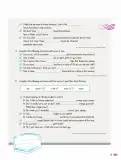
Individually, but keeping in mind that you are part of a community, complete the following sentences with the correct quantifier.

a
Parte 3.a

I'd like to have ______ (many / some / a few) more information before I make a decision.

  1. Information es un sustantivo incontable, por lo que no puede usarse many (solo contables) ni a few (solo contables).
  2. Some se usa con sustantivos incontables en oraciones afirmativas.
  3. La oración es afirmativa y expresa deseo de obtener una cantidad adicional de información.
Respuesta

some

b
Parte 3.b

The place was full, so ______ (some / a little / a lot of) people heard what she told him.

  1. People es un sustantivo contable en plural.
  2. A little solo se usa con incontables, por lo que se descarta.
  3. Some es posible gramaticalmente, pero el contexto "the place was full" indica una gran cantidad, no una cantidad indefinida pequeña.
  4. A lot of expresa gran cantidad y funciona con sustantivos contables en plural.
Respuesta

a lot of

Contenido de la página

Quantifiers

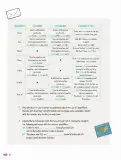
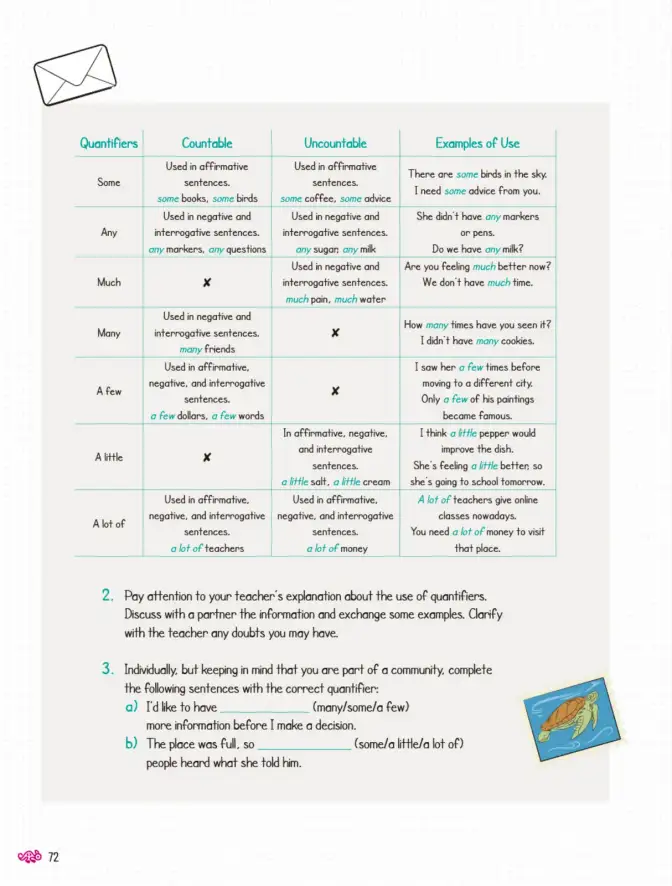
Quantifiers Countable Uncountable Examples of Use
Some Used in affirmative sentences. some books, some birds Used in affirmative sentences. some coffee, some advice There are some birds in the sky. I need some advice from you.
Any Used in negative and interrogative sentences. any markers, any questions Used in negative and interrogative sentences. any sugar, any milk She didn't have any markers or pens. Do we have any milk?
Much ✗ Used in negative and interrogative sentences. much pain, much water Are you feeling much better now? We don't have much time.
Many Used in negative and interrogative sentences. many friends ✗ How many times have you seen it? I didn't have many cookies.
A few Used in affirmative, negative, and interrogative sentences. a few dollars, a few words ✗ I saw her a few times before moving to a different city. Only a few of his paintings became famous.
A little ✗ In affirmative, negative, and interrogative sentences. a little salt, a little cream I think a little pepper would improve the dish. She's feeling a little better, so she's going to school tomorrow.
A lot of Used in affirmative, negative, and interrogative sentences. a lot of teachers Used in affirmative, negative, and interrogative sentences. a lot of money A lot of teachers give online classes nowadays. You need a lot of money to visit that place.

Activities

  1. Pay attention to your teacher's explanation about the use of quantifiers. Discuss with a partner the information and exchange some examples. Clarify with the teacher any doubts you may have.

  2. Individually, but keeping in mind that you are part of a community, complete the following sentences with the correct quantifier:

a) I'd like to have ______ (many/some/a few) more information before I make a decision.

b) The place was full, so ______ (some/a little/a lot of) people heard what she told him.

Ejemplos resueltos

There are ______ birds in the sky. (some / any / much)

Birds es contable plural y la oración es afirmativa, por lo que se usa some.

Respuesta: There are some birds in the sky.

We don't have ______ time. (many / much / a few)

Time es incontable y la oración es negativa, por lo que se usa much.

Respuesta: We don't have much time.

Tabla

Quantifiers Countable Uncountable Examples of Use
Some Used in affirmative sentences. some books, some birds Used in affirmative sentences. some coffee, some advice There are some birds in the sky. I need some advice from you.
Any Used in negative and interrogative sentences. any markers, any questions Used in negative and interrogative sentences. any sugar, any milk She didn't have any markers or pens. Do we have any milk?
Much ✗ Used in negative and interrogative sentences. much pain, much water Are you feeling much better now? We don't have much time.
Many Used in negative and interrogative sentences. many friends ✗ How many times have you seen it? I didn't have many cookies.
A few Used in affirmative, negative, and interrogative sentences. a few dollars, a few words ✗ I saw her a few times before moving to a different city. Only a few of his paintings became famous.
A little ✗ In affirmative, negative, and interrogative sentences. a little salt, a little cream I think a little pepper would improve the dish. She's feeling a little better, so she's going to school tomorrow.
A lot of Used in affirmative, negative, and interrogative sentences. a lot of teachers Used in affirmative, negative, and interrogative sentences. a lot of money A lot of teachers give online classes nowadays. You need a lot of money to visit that place.

Glosario (6)

Quantifier
Palabra que indica cantidad o grado, como some, any, much, many, a few, a little, a lot of.
Countable noun
Sustantivo que se puede contar y tiene forma plural, por ejemplo book/books, friend/friends.
Uncountable noun
Sustantivo que no se cuenta fácilmente y no tiene plural habitual, por ejemplo advice, water, money.
Affirmative sentence
Oración que afirma o declara algo.
Negative sentence
Oración que niega algo, generalmente con not.
Interrogative sentence
Oración que formula una pregunta.

Preguntas para practicar

Pay attention to your teacher's explanation about the use of quantifiers. Discuss with a partner the information and exchange some examples. Clarify with the teacher any doubts you may have.

El estudiante debe escuchar la explicación, comentar con un compañero ejemplos como *some books*, *any milk*, *much time*, *many friends*, *a few dollars*, *a little salt* y *a lot of people*, y preguntar al docente las dudas que tenga.

Temas y conceptos clave

Cuantificadores en inglésSustantivos contables e incontablesQuantifiersCountable nounsUncountable nounsAffirmative sentencesNegative sentencesInterrogative sentences
¿Te fue útil esta página?

Figuras de la página (2)

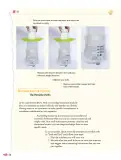
Ilustración de un sobre de carta abierto.
Figura 1 image
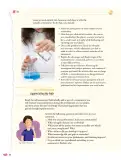
Ilustración de una tortuga marina nadando.
Figura 2 image

Preguntas que la gente también hace

¿Cuándo se usa some y cuándo any en inglés?
Consulta la solución completa arriba o explora el libro entero para temas relacionados.
¿Cuál es la diferencia entre much y many?
Consulta la solución completa arriba o explora el libro entero para temas relacionados.
¿Cómo se usan a few y a little con sustantivos contables e incontables?
Consulta la solución completa arriba o explora el libro entero para temas relacionados.
📌 Antes de leer esto
  • • Reconocer sustantivos contables e incontables
  • • Formar oraciones afirmativas, negativas e interrogativas en presente simple
  • • Conocer el plural de los sustantivos
Siguiente tema sugerido
Uso de how much y how many en preguntas
📝 Transcripción de la página (texto seleccionable) 2281 caracteres
  1. Pay attention to your teacher's explanation about the use of quantifiers.Discuss with a partner the information and exchange some examples. Clarify with the teacher any doubts you may have.

  2. Individually but keeping in mind that you are part of a community, complete the following sentences with the correct quantifier:

a) I'd like to have (many/some/a few)more information before I make a decision.

b)The place was full, so (some/a liHe/a lot of)people heard what she told him.

![](page=0,bbox=[58, 76, 211, 190])

QuantifiersCountableUncountableExamples of Use
SomeUsed in affirmative sentences. some books, some bindsUsed in affirmative sentences. some coffee, some adviceThere are some binds in the sky. I need some advice from you.
AnyUsed in negative and interrogative sentences. any markers, any questionsUsed in negative and interrogative sentences. any sugar; any milkShe didn't have any mankens or pens. Do we have any milk?
MuchXUsed in negative and interrogative sentences. much pain, much waterAre you feeling much better now? We don't have much time.
ManyUsed in negative and interrogative sentences. many friendsXHow many times have you seen it? I didn't have many cookies.
A fewUsed in affirmative, negative, and interrogative sentences. a few dollrs, a few worndsXI saw her a few times before moving to a diffenent city. Onlya few of his paintings became famous.
A litHleXIn affirmative, negative, and interrogative sentences. a liHle salt,a litle creamI think a litHle pepper would improve the dish. She's feeling a litHle betten, so she's going to school tomorrow.
A lot ofUsed in affinmative, negative, and interrogative sentences. a lot of teachersUsed in affirmative, negative, and intenrogative sentences. a lot ofmoneyA lot of teachers give online classes nowadays. You needa lot ofmoney to visit that place.

![](page=0,bbox=[942, 1218, 1124, 1376])

72

Ad

Otros libros recomendados

Ver todos →
Ad

Usamos cookies propias y de terceros para personalizar contenido, mostrar publicidad y analizar el tráfico. Las cookies necesarias siempre están activas.