Saltar al contenido
MisLibrosTexto
Ad

Sharing and Assessing What We Learned: managing physical, recreational and sports activities

📄 ejercicios educacion-fisica 🎓 otro · 3° TELESECUNDARIA México 🇲🇽 MX 🗣 Español
Página 154
154 de 187
Página 154 de Uérakua anapu uantakua. Projects and Readings.  Libro de Educación Telesecundaria Grado 3°  Ciclo Escolar 2025 - 2026
Anterior Página 154 / 187 Siguiente

Respuesta rápida

Antes: espacios seguros y consensos. Durante: participación, normas, evaluación y eslogan. Después: asamblea con preguntas a-d y acta de acuerdos en el cuaderno.

📚 exercise educacion-fisica ⭐⭐ Dificultad 2/5 ⏱ 8 min lectura

Solución — Página 154

Uérakua anapu uantakua. Projects and Readings. Libro de Educación Telesecundaria Grado 3° Ciclo Escolar 2025 - 2026

6
Ejercicio 6

Prepare external communication directed to other educational agents, family members, friends, and neighbors based on evidence and other significant inputs. Recreational, physical and sports activities must be presented in the educational community within the daily workday.

  1. Identificar los agentes externos: familias, vecinos, autoridades locales y organizaciones comunitarias.
  2. Reunir evidencias del diagnóstico: encuestas, registros de actividad física y datos sobre sedentarismo.
  3. Elaborar mensajes breves (carteles, boletines, redes) con lenguaje claro y datos concretos.
  4. Presentar las actividades recreativas y deportivas dentro de la jornada escolar, en un horario fijo y visible.

Respuesta orientativa: Se comunica a la comunidad educativa mediante carteles y boletines con evidencias del diagnóstico, y las actividades se presentan dentro de la jornada diaria en un espacio y horario establecidos.

7
Ejercicio 7

Invite specialists from other areas to give short conferences or share activation or physical exercise routines.

  1. Identificar especialistas disponibles: médicos, nutriólogos, entrenadores, psicólogos.
  2. Acordar con ellos charlas breves de 10 a 15 minutos o rutinas de activación.
  3. Calendarizar las intervenciones dentro del horario escolar.
  4. Registrar la participación y evaluar el impacto con una breve encuesta.

Respuesta orientativa: Se invita a especialistas en salud, nutrición y deporte para dar charlas cortas o dirigir rutinas de activación, coordinando fechas y registrando la asistencia para evaluar su impacto.

8
Ejercicio 8

Determine actions that favor everyone's participation, especially if there are students with disabilities, special educational needs, or learning barriers.

  1. Detectar barreras físicas, comunicativas y actitudinales.
  2. Adaptar reglas, materiales y espacios (rampas, balones sonoros, señas).
  3. Formar equipos heterogéneos y asignar roles rotativos.
  4. Evaluar la participación de todo el grupo y ajustar las actividades.

Respuesta orientativa: Se eliminan barreras adaptando materiales, reglas y espacios, y se promueve la participación de todos con roles rotativos y apoyos específicos según cada necesidad.

Ad
1
Ejercicio 1

Below are some recommendations for managing and implementing physical, recreational, and sports activities in the project.

1
Ejercicio 1

Before

  1. Promover el intercambio de experiencias entre comunidades para retroalimentar y planear.
  2. Elegir y gestionar espacios seguros y construir materiales que incentiven la participación.
  3. Lograr consensos sobre la participación y promover actitudes y valores durante la socialización.

Respuesta orientativa: Antes del proyecto se dialoga con otras comunidades, se eligen espacios seguros, se elaboran materiales y se acuerdan normas de convivencia y participación.

1
Ejercicio 1

During

  1. Fomentar la participación de la comunidad escolar explicando la intención del proyecto y el problema planteado.
  2. Vigilar el cumplimiento responsable y respetuoso de las normas establecidas.
  3. Evaluar el grado de aprobación del contenido diseñando alternativas para estilos de vida activos y saludables, analizando conductas de riesgo y sedentarismo.
  4. Diseñar un eslogan para difundir el proyecto y evaluar su relevancia.

Respuesta orientativa: Durante el proyecto se motiva la participación, se supervisan las normas, se evalúa el contenido con alternativas saludables y se crea un eslogan que difunde la propuesta.

Ad
1
Ejercicio 1

After

  1. Reunir retroalimentación en asamblea respondiendo las preguntas a), b), c) y d).
  2. Sistematizar las respuestas y compararlas con los objetivos iniciales.

Respuesta orientativa: Después del proyecto se realiza una asamblea donde se responden las preguntas sobre actividades, espacios, colaboración y participación de la comunidad, y se comparan los resultados con lo planeado.

2
Ejercicio 2

Finally, write in your notebooks the assembly agreements reached by the community regarding how to design physical, recreational, and sports activities that promote healthy living habits for the school and social community members.

  1. Registrar fecha, participantes y acuerdos de la asamblea.
  2. Redactar cada acuerdo con responsable, acción y plazo.
  3. Incluir acciones para la escuela y para la comunidad.
  4. Firmar el acta y dar seguimiento en la siguiente sesión.

Respuesta orientativa: En el cuaderno se escribe un acta con los acuerdos de la asamblea: actividades a realizar, responsables, fechas y acciones para promover hábitos saludables en la escuela y la comunidad.

Contenido de la página

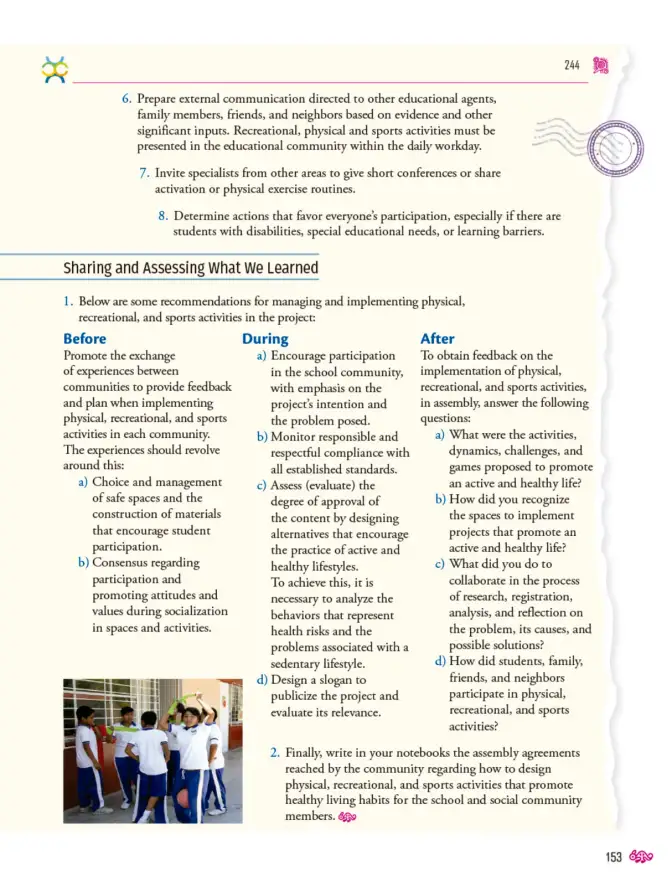
  1. Prepare external communication directed to other educational agents, family members, friends, and neighbors based on evidence and other significant inputs. Recreational, physical and sports activities must be presented in the educational community within the daily workday.

  2. Invite specialists from other areas to give short conferences or share activation or physical exercise routines.

  3. Determine actions that favor everyone's participation, especially if there are students with disabilities, special educational needs, or learning barriers.

Sharing and Assessing What We Learned

  1. Below are some recommendations for managing and implementing physical, recreational, and sports activities in the project:

Before

Promote the exchange of experiences between communities to provide feedback and plan when implementing physical, recreational, and sports activities in each community. The experiences should revolve around this:

a) Choice and management of safe spaces and the construction of materials that encourage student participation.

b) Consensus regarding participation and promoting attitudes and values during socialization in spaces and activities.

During

a) Encourage participation in the school community, with emphasis on the project's intention and the problem posed.

b) Monitor responsible and respectful compliance with all established standards.

c) Assess (evaluate) the degree of approval of the content by designing alternatives that encourage the practice of active and healthy lifestyles. To achieve this, it is necessary to analyze the behaviors that represent health risks and the problems associated with a sedentary lifestyle.

d) Design a slogan to publicize the project and evaluate its relevance.

After

To obtain feedback on the implementation of physical, recreational, and sports activities, in assembly, answer the following questions:

a) What were the activities, dynamics, challenges, and games proposed to promote an active and healthy life?

b) How did you recognize the spaces to implement projects that promote an active and healthy life?

c) What did you do to collaborate in the process of research, registration, analysis, and reflection on the problem, its causes, and possible solutions?

d) How did students, family, friends, and neighbors participate in physical, recreational, and sports activities?

  1. Finally, write in your notebooks the assembly agreements reached by the community regarding how to design physical, recreational, and sports activities that promote healthy living habits for the school and social community members.

Tabla

Etapa Acciones clave Producto
Antes Intercambio de experiencias, espacios seguros, consensos Plan de actividades y materiales
Durante Participación, normas, evaluación, eslogan Actividades ejecutadas y eslogan
Después Asamblea, preguntas a-d, acuerdos Acta de acuerdos en el cuaderno

Diagrama

flowchart LR
A[Antes] --> A1[Intercambio de experiencias]
A --> A2[Espacios seguros y materiales]
A --> A3[Consensos y valores]
B[Durante] --> B1[Participación escolar]
B --> B2[Normas y supervisión]
B --> B3[Evaluación y eslogan]
C[Después] --> C1[Asamblea de retroalimentación]
C --> C2[Preguntas a-d]
C --> C3[Acta de acuerdos]

Glosario (5)

External communication
Comunicación dirigida a personas fuera del aula: familias, vecinos y agentes educativos.
Sedentary lifestyle
Estilo de vida con poca o nula actividad física.
Slogan
Frase breve y llamativa que difunde el proyecto.
Assembly
Reunión de la comunidad escolar para tomar acuerdos.
Learning barriers
Obstáculos que dificultan el aprendizaje o la participación.

Preguntas para practicar

What were the activities, dynamics, challenges, and games proposed to promote an active and healthy life?

Se propusieron juegos cooperativos, retos motores, circuitos de activación y dinámicas de integración que fomentan el movimiento diario y la convivencia saludable.

How did you recognize the spaces to implement projects that promote an active and healthy life?

Se identificaron patios, canchas, parques y áreas comunes seguras, considerando accesibilidad, iluminación y disponibilidad de materiales para la actividad física.

What did you do to collaborate in the process of research, registration, analysis, and reflection on the problem, its causes, and possible solutions?

Se aplicaron encuestas, se registraron datos en tablas, se analizaron causas del sedentarismo y se propusieron soluciones como rutinas diarias y campañas de difusión.

How did students, family, friends, and neighbors participate in physical, recreational, and sports activities?

Participaron en jornadas abiertas, torneos recreativos y caminatas, apoyando la organización y asistiendo a las actividades convocadas por la escuela.

Temas y conceptos clave

Gestión de actividades físicas, recreativas y deportivasComunicación con agentes educativosParticipación inclusivaEvaluación y retroalimentación en asambleaAntes, durante y después del proyectoEspacios segurosConsenso y valoresEslogan del proyectoSedentarismo y conductas de riesgoAcuerdos de asamblea
¿Te fue útil esta página?

Preguntas que la gente también hace

¿Cómo se organiza un proyecto de activación física en la escuela?
Consulta la solución completa arriba o explora el libro entero para temas relacionados.
¿Qué acuerdos se toman en una asamblea escolar sobre hábitos saludables?
Consulta la solución completa arriba o explora el libro entero para temas relacionados.
¿Cómo incluir a estudiantes con discapacidad en actividades deportivas?
Consulta la solución completa arriba o explora el libro entero para temas relacionados.
📌 Antes de leer esto
  • • Identificar problemas de salud relacionados con el sedentarismo
  • • Conocer técnicas de investigación y registro de datos
  • • Manejar normas de convivencia y trabajo colaborativo
Siguiente tema sugerido
Evaluación final del proyecto y presentación de resultados a la comunidad
📝 Transcripción de la página (texto seleccionable) 2690 caracteres
  1. Prepare external communication directed to other educational agents,family members, friends, and neighbors based on evidence and other significant inputs. Recreational, physical and sports activities must be presented in the educational community within the daily workday.

  2. Invite specialists from other areas to give short conferences or share activation or physical exercise routines.

  3. Determine actions that favor everyone's participation, especially if there are students with disabilities, special educational needs, or learning barriers.

Sharing and Assessing What We Learned

  1. Below are some recommendations for managing and implementing physical,recreational, and sports activities in the project:

Before

Promote the exchange of experiences between communities to provide feedback and plan when implementing physical, recreational, and sports activities in each community.The experiences should revolve around this:a) Choice and management of safe spaces and the construction of materials that encourage student participation. b)Consensus regarding participation and promoting attitudes and values during socialization in spaces and activities.

During

a) Encourage participation in the school community,with emphasis on the project's intention and the problem posed.b) Monitor responsible and respectful compliance with all established standards.c) Assess (evaluate) the degree of approval of the content by designing alternatives that encourage the practice of active and healthy lifestyles. To achieve this, it is necessary to analyze the behaviors that represent health risks and the problems associated with a sedentary lifestyle.d) Design a slogan to publicize the project and evaluate its relevance.

After

To obtain feedback on the implementation of physical,recreational, and sports activities,in assembly, answer the following questions:a) What were the activities, dynamics, challenges, and games proposed to promote an active and healthy life?b) How did you recognize the spaces to implement projects that promote an active and healthy life?c)What did you do to collaborate in the process of research, registration, analysis, and reflection on the problem, its causes, and possible solutions?d) How did students, family, friends, and neighbors participate in physical, recreational, and sports activities?

  1. Finally, write in your notebooks the assembly agreements reached by the community regarding how to design physical, recreational, and sports activities that promote healthy living habits for the school and social community members.6

×

244

O

![](page=0,bbox=[958, 206, 1163, 318])

![](page=0,bbox=[113, 1221, 437, 1485])

153

8

Ad

Otros libros recomendados

Ver todos →
Ad

Usamos cookies propias y de terceros para personalizar contenido, mostrar publicidad y analizar el tráfico. Las cookies necesarias siempre están activas.