Saltar al contenido
MisLibrosTexto
Ad

Daily Routines and Chemical Reactions: Health and Environment

📄 ejercicios quimica 🎓 otro · 3° TELESECUNDARIA México 🇲🇽 MX 🗣 Español
Página 156
156 de 187
Página 156 de Uérakua anapu uantakua. Projects and Readings.  Libro de Educación Telesecundaria Grado 3°  Ciclo Escolar 2025 - 2026
Anterior Página 156 / 187 Siguiente

Respuesta rápida

Ejercicios resueltos: identificación de hábitos dañinos, clasificación de reacciones naturales y humanas, y respuestas sobre definición, causas y tipos de reacciones químicas.

📚 exercise quimica ⭐⭐ Dificultad 2/5 ⏱ 15 min lectura

Solución — Página 156

Uérakua anapu uantakua. Projects and Readings. Libro de Educación Telesecundaria Grado 3° Ciclo Escolar 2025 - 2026

1
Ejercicio 1

In community, read the following text, underline the relevant ideas, and look for the meaning of the words you do not know.

Respuesta orientativa: El texto describe la rutina de una persona de 30 años. Ideas relevantes: desayuno con café, ducha con champú, dos horas de coche al trabajo, almuerzo con hamburguesa doble y refresco, fumar con colegas, dos horas de regreso, TV y luces encendidas, y acampar con fogatas los fines de semana. Palabras clave: routine, robust coffee, shampoo, double hamburger, soda, bonfires.

2
Ejercicio 2

In community, find three activities in the text that damage health and three that harm the environment. Write them in your notebook.

Respuesta
Dañan la salud Dañan el ambiente
Beber café en exceso Conducir dos horas al trabajo (emisiones de \text{CO}_2)
Comer hamburguesa doble y refresco Fumar (contaminación del aire)
Fumar cigarrillos Dejar luces y TV encendidas (consumo de energía)
Conducir dos horas (sedentarismo) Fogatas en la montaña (deforestación y \text{CO}_2)
3
Ejercicio 3

Discuss why you chose those activities.

Respuesta orientativa: Se eligieron porque el consumo excesivo de café, comida rápida y tabaco afecta directamente al organismo, mientras que conducir, fumar, dejar luces encendidas y hacer fogatas liberan contaminantes o consumen recursos, dañando el ambiente.

Ad
4
Ejercicio 4

Based on your knowledge, determine if the activities you read in the text are the result of natural chemical reactions or if human beings produce them.

Respuesta orientativa: La mayoría son reacciones producidas por el ser humano: la combustión de gasolina, el encendido de luces (transformación de energía), fumar y las fogatas. Algunas son naturales: la digestión de los alimentos y la respiración.

5
Ejercicio 5

Answer the following questions:

a
Parte 5.a

How can you identify what chemical reactions happen in the examples you chose?

Respuesta

Se identifican por cambios observables: cambio de color, formación de gases, liberación de calor o luz, y formación de nuevas sustancias. Por ejemplo, al fumar se produce combustión con humo y calor; al conducir se libera \text{CO}_2 y \text{H}_2\text{O}.

b
Parte 5.b

What is the cause of chemical reactions?

Respuesta

Ocurren cuando las sustancias reaccionan al romperse y formarse enlaces químicos, generalmente por colisiones entre partículas con suficiente energía. Factores como temperatura, concentración y catalizadores influyen en su velocidad.

c
Parte 5.c

Why do people say that chemistry is everywhere?

Where We Are Headed

Paso 1

Reflect on what you know about natural chemical reactions and those produced by human beings.

Respuesta orientativa: Las reacciones naturales ocurren sin intervención humana, como la fotosíntesis o la oxidación del hierro. Las producidas por el ser humano son controladas o provocadas, como la combustión en motores o la fabricación de plásticos.

Paso 2

Read the following questions as a guide for your investigation. Use them or write some others.

Respuesta orientativa:

a) ¿Qué es una reacción química? Es un proceso en el que una o más sustancias se transforman en otras con propiedades diferentes.

b) ¿Qué se necesita para que ocurra una reacción química? Colisiones efectivas entre partículas, energía de activación y condiciones adecuadas de temperatura, presión o catalizadores.

c) ¿Qué son las funciones químicas? Son grupos de compuestos con propiedades similares, como óxidos, ácidos, bases y sales.

d) ¿Cómo se clasifican las sustancias? En elementos, compuestos y mezclas (homogéneas y heterogéneas).

e) ¿Qué tipos de reacciones químicas existen? De síntesis, descomposición, sustitución simple, doble sustitución, combustión, ácido-base y redox.

f) ¿Por qué es importante conocer las reacciones químicas en la vida diaria? Para tomar decisiones informadas sobre salud, alimentación, limpieza y cuidado del ambiente.

g) ¿Qué elementos debe incluir una dieta saludable? Carbohidratos, proteínas, grasas saludables, vitaminas, minerales, fibra y agua en proporciones adecuadas.

Respuesta

Porque toda la materia está formada por sustancias que reaccionan constantemente: desde la digestión y la respiración hasta la combustión, la fotosíntesis y la fabricación de materiales. La química explica los cambios en la vida diaria.

Contenido de la página

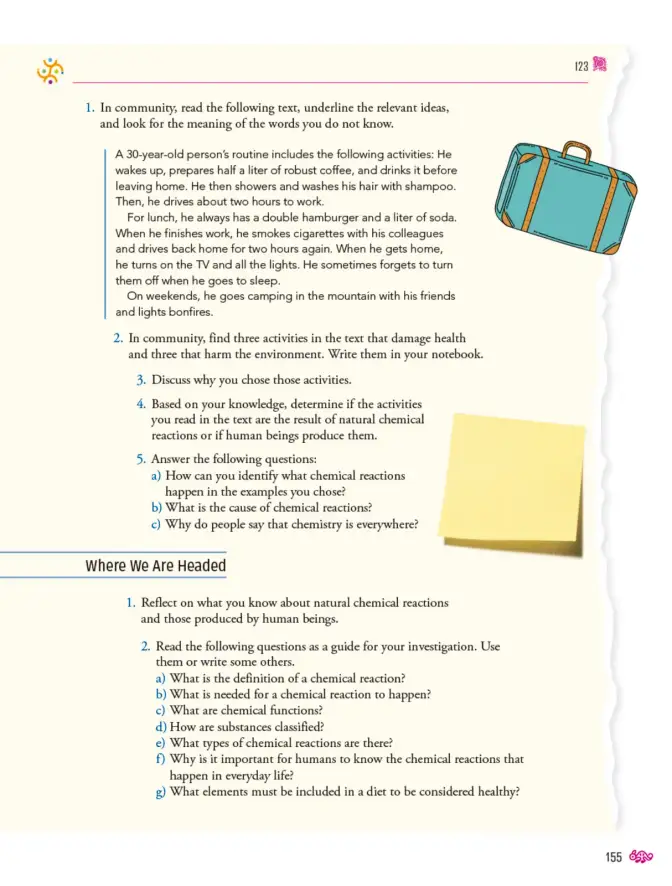
  1. In community, read the following text, underline the relevant ideas, and look for the meaning of the words you do not know.

A 30-year-old person's routine includes the following activities: He wakes up, prepares half a liter of robust coffee, and drinks it before leaving home. He then showers and washes his hair with shampoo. Then, he drives about two hours to work.

For lunch, he always has a double hamburger and a liter of soda. When he finishes work, he smokes cigarettes with his colleagues and drives back home for two hours again. When he gets home, he turns on the TV and all the lights. He sometimes forgets to turn them off when he goes to sleep.

On weekends, he goes camping in the mountain with his friends and lights bonfires.

  1. In community, find three activities in the text that damage health and three that harm the environment. Write them in your notebook.

  2. Discuss why you chose those activities.

  3. Based on your knowledge, determine if the activities you read in the text are the result of natural chemical reactions or if human beings produce them.

  4. Answer the following questions:

a) How can you identify what chemical reactions happen in the examples you chose?

b) What is the cause of chemical reactions?

c) Why do people say that chemistry is everywhere?

Where We Are Headed

  1. Reflect on what you know about natural chemical reactions and those produced by human beings.

  2. Read the following questions as a guide for your investigation. Use them or write some others.

a) What is the definition of a chemical reaction?

b) What is needed for a chemical reaction to happen?

c) What are chemical functions?

d) How are substances classified?

e) What types of chemical reactions are there?

f) Why is it important for humans to know the chemical reactions that happen in everyday life?

g) What elements must be included in a diet to be considered healthy?

Ejemplos resueltos

Clasifica la combustión de gasolina al conducir como reacción natural o humana.

Es una reacción producida por el ser humano, ya que ocurre en motores de vehículos. La ecuación general es: \text{C}_8\text{H}_{18} + \frac{25}{2}\text{O}_2 \rightarrow 8\text{CO}_2 + 9\text{H}_2\text{O}.

Tabla

Dañan la salud Dañan el ambiente
Beber café en exceso Conducir dos horas al trabajo
Comer hamburguesa doble y refresco Fumar cigarrillos
Fumar cigarrillos Dejar luces y TV encendidas
Conducir dos horas (sedentarismo) Fogatas en la montaña

Diagrama

mindmap
  root((Reacciones químicas))
    Naturales
      Fotosíntesis
      Digestión
      Respiración
    Humanas
      Combustión
      Fumar
      Fogatas
      Industria

Fórmulas y ecuaciones

\text{Combustión: combustible} + \text{O}_2 \rightarrow \text{CO}_2 + \text{H}_2\text{O} + \text{energía}

\text{CH}_4 + 2\text{O}_2 \rightarrow \text{CO}_2 + 2\text{H}_2\text{O}

\text{C}_6\text{H}@@MATH_0@@\text{O}_6 + 6\text{O}_2 \rightarrow 6\text{CO}_2 + 6\text{H}_2\text{O}

Glosario (5)

chemical reaction
Proceso en el que una o más sustancias se transforman en otras diferentes.
combustion
Reacción química rápida que libera calor y luz, generalmente con oxígeno.
chemical functions
Grupos de compuestos con propiedades químicas similares (óxidos, ácidos, bases, sales).
substances
Tipos de materia con composición definida.
bonfire
Fogata; combustión de madera al aire libre.

Preguntas para practicar

What is the definition of a chemical reaction?

Es un proceso en el que una o más sustancias se transforman en otras con propiedades diferentes, mediante la ruptura y formación de enlaces químicos.

What is needed for a chemical reaction to happen?

Se necesitan colisiones efectivas entre partículas, energía de activación y condiciones adecuadas de temperatura, presión o catalizadores.

What are chemical functions?

Son grupos de compuestos con propiedades similares, como óxidos, ácidos, bases y sales.

How are substances classified?

Se clasifican en elementos, compuestos y mezclas (homogéneas y heterogéneas).

What types of chemical reactions are there?

Existen reacciones de síntesis, descomposición, sustitución simple, doble sustitución, combustión, ácido-base y redox.

Why is it important for humans to know the chemical reactions that happen in everyday life?

Porque permite tomar decisiones informadas sobre salud, alimentación, limpieza y cuidado del ambiente.

What elements must be included in a diet to be considered healthy?

Debe incluir carbohidratos, proteínas, grasas saludables, vitaminas, minerales, fibra y agua en proporciones adecuadas.

Temas y conceptos clave

Reacciones químicas naturales y humanasHábitos saludables y daño ambientalIntroducción a la química cotidianaReacción químicaCombustiónContaminaciónFunciones químicasClasificación de sustancias
¿Te fue útil esta página?

Preguntas que la gente también hace

¿Qué es una reacción química y cómo se identifica?
Consulta la solución completa arriba o explora el libro entero para temas relacionados.
¿Cuáles son los tipos de reacciones químicas?
Consulta la solución completa arriba o explora el libro entero para temas relacionados.
¿Cómo afectan las actividades humanas al ambiente?
Consulta la solución completa arriba o explora el libro entero para temas relacionados.
📌 Antes de leer esto
  • • Concepto de materia y sus propiedades
  • • Cambios físicos y químicos
  • • Elementos y compuestos químicos
Siguiente tema sugerido
Tipos de reacciones químicas y su representación
📝 Transcripción de la página (texto seleccionable) 1996 caracteres
  1. In community, read the following text, underline the relevant ideas,and look for the meaning of the words you do not know.

A 30-year-old person's routine includes the following activities: He wakes up, prepares half a liter of robust coffee, and drinks it before leaving home. He then showers and washes his hair with shampoo.Then, he drives about two hours to work.

For lunch, he always has a double hamburger and a liter of soda.When he finishes work, he smokes cigarettes with his colleagues and drives back home for two hours again. When he gets home,he turns on the TV and all the lights. He sometimes forgets to turn them off when he goes to sleep.

On weekends, he goes camping in the mountain with his friends and lights bonfires.

  1. In community, find three activities in the text that damage health and three that harm the environment. Write them in your notebook.

  2. Discuss why you chose those activities.

  3. Based on your knowledge, determine if the activities you read in the text are the result of natural chemical reactions or if human beings produce them.

  4. Answer the following questions:

a) How can you identify what chemical reactions happen in the examples you chose?

b) What is the cause of chemical reactions?

c) Why do people say that chemistry is everywhere?

Where We Are Headed

  1. Reflect on what you know about natural chemical reactions and those produced by human beings.

  2. Read the following questions as a guide for your investigation. Use them or write some others.

a) What is the definition of a chemical reaction?

b) What is needed for a chemical reaction to happen?

c) What are chemical functions?

d) How are substances classified?

e) What types of chemical reactions are there?

f) Why is it important for humans to know the chemical reactions that happen in everyday life?

What elements must be included in a diet to be considered healthy?

123

![](page=0,bbox=[890, 250, 1153, 458])

![](page=0,bbox=[791, 745, 1054, 1005])

155
Ad

Otros libros recomendados

Ver todos →
Ad

Usamos cookies propias y de terceros para personalizar contenido, mostrar publicidad y analizar el tráfico. Las cookies necesarias siempre están activas.