















Saltar al contenido
MisLibrosTexto
Ad

Past Progressive Tense and Writing a Respectful Commitment

📄 ejercicios ingles 🎓 otro · 3° TELESECUNDARIA México 🇲🇽 MX 🗣 Español
Página 16
16 de 187
Página 16 de Uérakua anapu uantakua. Projects and Readings.  Libro de Educación Telesecundaria Grado 3°  Ciclo Escolar 2025 - 2026
Anterior Página 16 / 187 Siguiente

Respuesta rápida

3.a were exploring; 3.b were playing; 3.c was dancing; 3.d were learning; 3.e were sharing. Writing: compromiso con cinco ejemplos de términos derogatorios y su equivalente ético, firmado por el grupo.

📚 exercise ingles ⭐⭐ Dificultad 2/5 ⏱ 8 min lectura

Solución — Página 16

Uérakua anapu uantakua. Projects and Readings. Libro de Educación Telesecundaria Grado 3° Ciclo Escolar 2025 - 2026

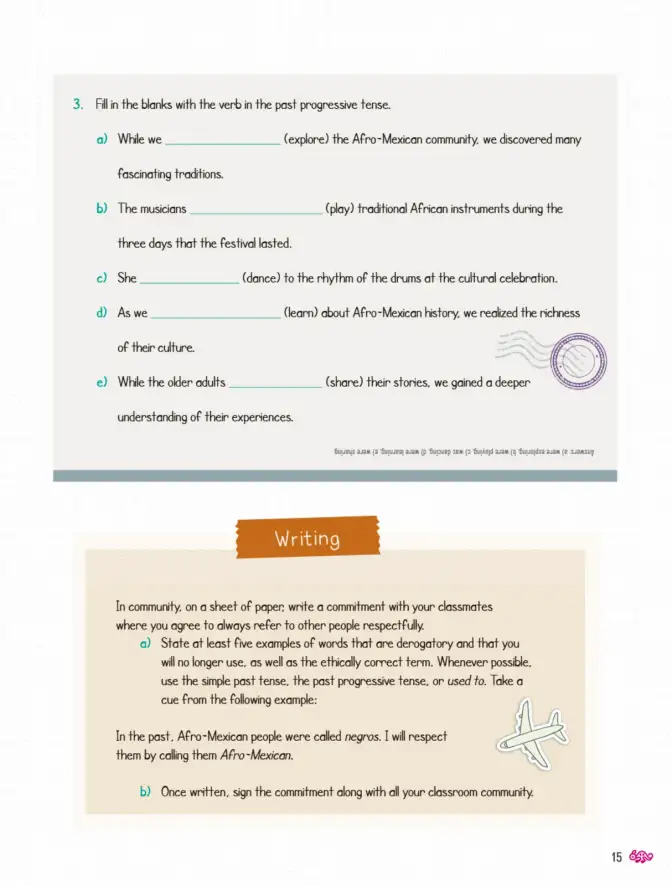
3
Ejercicio 3

Fill in the blanks with the verb in the past progressive tense.

a
Parte 3.a

While we ______ (explore) the Afro-Mexican community, we discovered many fascinating traditions.

  1. El sujeto es we, que en pasado del verbo be es were.
  2. El verbo explore pasa a gerundio: exploring.
  3. Estructura: was/were + verbo-ing → were exploring.
Respuesta

were exploring

b
Parte 3.b

The musicians ______ (play) traditional African instruments during the three days that the festival lasted.

  1. El sujeto es The musicians (plural), por lo que se usa were.
  2. play → playing.
  3. Estructura: were + playing.
Respuesta

were playing

c
Parte 3.c

She ______ (dance) to the rhythm of the drums at the cultural celebration.

  1. El sujeto es She (singular), por lo que se usa was.
  2. dance pierde la e final y agrega -ing: dancing.
  3. Estructura: was + dancing.
Respuesta

was dancing

d
Parte 3.d

As we ______ (learn) about Afro-Mexican history, we realized the richness of their culture.

  1. El sujeto es we, que en pasado del verbo be es were.
  2. learn → learning.
  3. Estructura: were + learning.
Respuesta

were learning

e
Parte 3.e

While the older adults ______ (share) their stories, we gained a deeper understanding of their experiences.

  1. El sujeto es the older adults (plural), por lo que se usa were.
  2. share pierde la e final y agrega -ing: sharing.
  3. Estructura: were + sharing.

Writing

In community, on a sheet of paper, write a commitment with your classmates where you agree to always refer to other people respectfully.

Writing.a

State at least five examples of words that are derogatory and that you will no longer use, as well as the ethically correct term. Whenever possible, use the simple past tense, the past progressive tense, or used to.

  1. Identifico términos derogatorios y su equivalente ético.
  2. Redacto cada ejemplo con used to, was/were + -ing o pasado simple.
  3. Firmo el compromiso con mi grupo.

Respuesta orientativa:

  1. In the past, people used to call Afro-Mexican people negros. I will respect them by calling them Afro-Mexican.
  2. People used to say indio to refer to Indigenous people. I will respect them by calling them Indigenous or by their specific people's name.
  3. Classmates were saying gordo to describe a person's body. I will respect them by calling them by their name.
  4. People used to call someone loco when they had a mental health condition. I will respect them by saying person with a mental health condition.
  5. Students were using naco to mock someone's way of speaking. I will respect them by describing their language as variety of Spanish.

Writing.b

Once written, sign the commitment along with all your classroom community.

Respuesta orientativa: Después de escribir los cinco ejemplos, cada estudiante firma el compromiso y el docente lo coloca en un lugar visible del aula para recordar el acuerdo de usar un lenguaje respetuoso.

Respuesta

were sharing

Contenido de la página

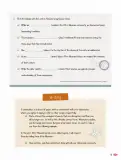
  1. Fill in the blanks with the verb in the past progressive tense.

a) While we ______ (explore) the Afro-Mexican community, we discovered many fascinating traditions.

b) The musicians ______ (play) traditional African instruments during the three days that the festival lasted.

c) She ______ (dance) to the rhythm of the drums at the cultural celebration.

d) As we ______ (learn) about Afro-Mexican history, we realized the richness of their culture.

e) While the older adults ______ (share) their stories, we gained a deeper understanding of their experiences.

Writing

In community, on a sheet of paper, write a commitment with your classmates where you agree to always refer to other people respectfully.

a) State at least five examples of words that are derogatory and that you will no longer use, as well as the ethically correct term. Whenever possible, use the simple past tense, the past progressive tense, or used to. Take a cue from the following example:

In the past, Afro-Mexican people were called negros. I will respect them by calling them Afro-Mexican.

b) Once written, sign the commitment along with all your classroom community.

Ejemplos resueltos

In the past, Afro-Mexican people were called negros. I will respect them by calling them Afro-Mexican.

El ejemplo usa el pasado simple (were called) para describir un término derogatorio del pasado y el futuro con will (will respect) para expresar el compromiso de usar el término ético Afro-Mexican.

Glosario (5)

past progressive tense
Tiempo verbal que expresa una acción en progreso en el pasado; se forma con was/were + verbo-ing.
derogatory
Término ofensivo o que menosprecia a una persona o grupo.
commitment
Compromiso o acuerdo formal que se asume con otras personas.
used to
Expresión que indica hábitos o situaciones que ocurrían en el pasado y ya no.
Afro-Mexican
Persona mexicana de ascendencia africana; término respetuoso para nombrar a esta comunidad.

Preguntas para practicar

Why is it important to use respectful language when talking about communities?

Porque el lenguaje construye la forma en que vemos a los demás; usar términos respetuosos reconoce la dignidad de las personas y evita reproducir discriminación. Además, ayuda a construir una convivencia más justa e inclusiva en el aula y en la comunidad.

Temas y conceptos clave

Past progressive tenseEscritura de un compromiso respetuosoLenguaje inclusivowas/were + verbo-ingused totérminos derogatoriosequivalente éticorespeto a la diversidad
¿Te fue útil esta página?

Figuras de la página (2)

Sello circular con líneas onduladas, similar a una estampilla postal.
Figura 1 image
Ilustración de un avión de papel con líneas de movimiento.
Figura 2 image

Preguntas que la gente también hace

¿Cómo se forma el past progressive tense en inglés?
Consulta la solución completa arriba o explora el libro entero para temas relacionados.
¿Cuándo se usa was y cuándo were en pasado progresivo?
Consulta la solución completa arriba o explora el libro entero para temas relacionados.
¿Qué ejemplos de palabras derogatorias y su equivalente respetuoso puedo usar en inglés?
Consulta la solución completa arriba o explora el libro entero para temas relacionados.
📌 Antes de leer esto
  • • Verbo be en pasado (was/were)
  • • Formación del gerundio (-ing)
  • • Pasado simple
  • • Vocabulario sobre comunidades y cultura
Siguiente tema sugerido
Simple past vs. past progressive: contraste y usos
📝 Transcripción de la página (texto seleccionable) 1226 caracteres
  1. Fillin the blanks with the venb in the past progressive tense.

a)While we (explore) the Afro-Mexican community, we discovered many fascinating traditions.

b) The musicians (play) traditional African instruments during the three days that the festival lasted.

c)She (dance) to the rhythm of the drums at the cultural celebration.

d) As we (learn) about Afro-Mexican history, we realized the richness

e) While the older adults (share) their stories, we gained a deeper understanding of their experiences.

ues a (a ua aa (p p s ud aa ( a aua ( sauy

Writing

In community, on a sheet of paper, write a commitment with your classmates where you agree to always refer to other people respectfully.

a)State at least five examples of words that are derogatory and that you willno longer use, as wellas the ethically correct term. Whenever possible,use the simple past tense, the past progressive tense, or used to. Take a cue from the following example:

In the past, Afro-Mexican people were called negros. I wilrespect them by calling them Afro-Mexican.

b)Once written, sign the commitment along with all your classroom community.

![](page=0,bbox=[992, 598, 1096, 703])

![](page=0,bbox=[893, 1257, 1026, 1391])

15

Ad

Otros libros recomendados

Ver todos →
Ad

Usamos cookies propias y de terceros para personalizar contenido, mostrar publicidad y analizar el tráfico. Las cookies necesarias siempre están activas.