
Worksheet 2 - Oral Communication
Solución — Página 11
Ingles · 1ro BGU · 2024
WORKSHEET 2
ORAL COMMUNICATION
| Campo | Descripción |
|---|---|
| General objective | Listen to short spoken or audio texts in familiar contexts, extract and identify main ideas and details when presented slowly and with visual support, and use spoken examples as models to communicate their own needs and information clearly and simply, employing learned grammatical structures and effectively using newly acquired words and expressions during social interactions, despite occasional errors. |
| Learning objective | Actively listen to short-spoken or audio texts within familiar contexts and extract main ideas and key details when presented at a slower pace and with the support of visual aids. Employ spoken examples as templates to confidently express their own needs and relay information clearly and concisely, using grammatical structures learned in class, and integrate recently acquired vocabulary and expressions in their everyday social interactions, even if occasional errors occur. |
| Descriptor | Understand and recognize spoken language in diverse forms and model communication transmitting the desired message while showing resilience and adaptability in the face of language challenges. |
| Performance indicators | • Recognize and understand the main ideas and key details when the material is presented at a slower pace and accompanied by visual aids. • Use familiar vocabulary to extract meaning from spoken texts. • Extract relevant information from the spoken or audio texts, identifying and summarizing key points. • Employ spoken examples as models to facilitate their communication, effectively express their needs and transmit information clearly and concisely. • Apply grammatical structures and vocabulary they have learned in class when communicating, demonstrating an understanding of basic grammar rules and sentence structures. |
Diagrama 1
Indicadores de desempeño del Worksheet 2 (Oral Communication)
mindmap
  root((Oral Communication))
    Recognize
      Main ideas
      Key details
      Visual aids
    Use vocabulary
      Familiar words
      Extract meaning
    Extract information
      Identify
      Summarize
    Communicate
      Express needs
      Transmit info
    Apply grammar
      Structures
      Sentences
Tablas
| Campo | Descripción |
|---|---|
| General objective | Listen to short spoken/audio texts and use them to communicate clearly. |
| Learning objective | Actively listen and use spoken templates with confidence. |
| Descriptor | Recognize spoken language and adapt to language challenges. |
| Performance indicators | Recognize main ideas, use familiar vocabulary, extract information, communicate, apply grammar. |
Glosario
- oral communication: Comunicación oral: intercambio de información a través del habla y la escucha.
- spoken text: Texto hablado (audio, conversación, narración).
- visual aids: Apoyos visuales (imágenes, esquemas) que facilitan la comprensión.
- main idea: Idea principal de un texto.
- key detail: Detalle clave o información puntual relevante.
- resilience: Capacidad de adaptarse y persistir frente a las dificultades.
- • Ver pág. 12: Continuación del Worksheet 2 con actividades de Oral Communication / movies.
📝 Transcripción de la página (texto seleccionable) 1825 caracteres
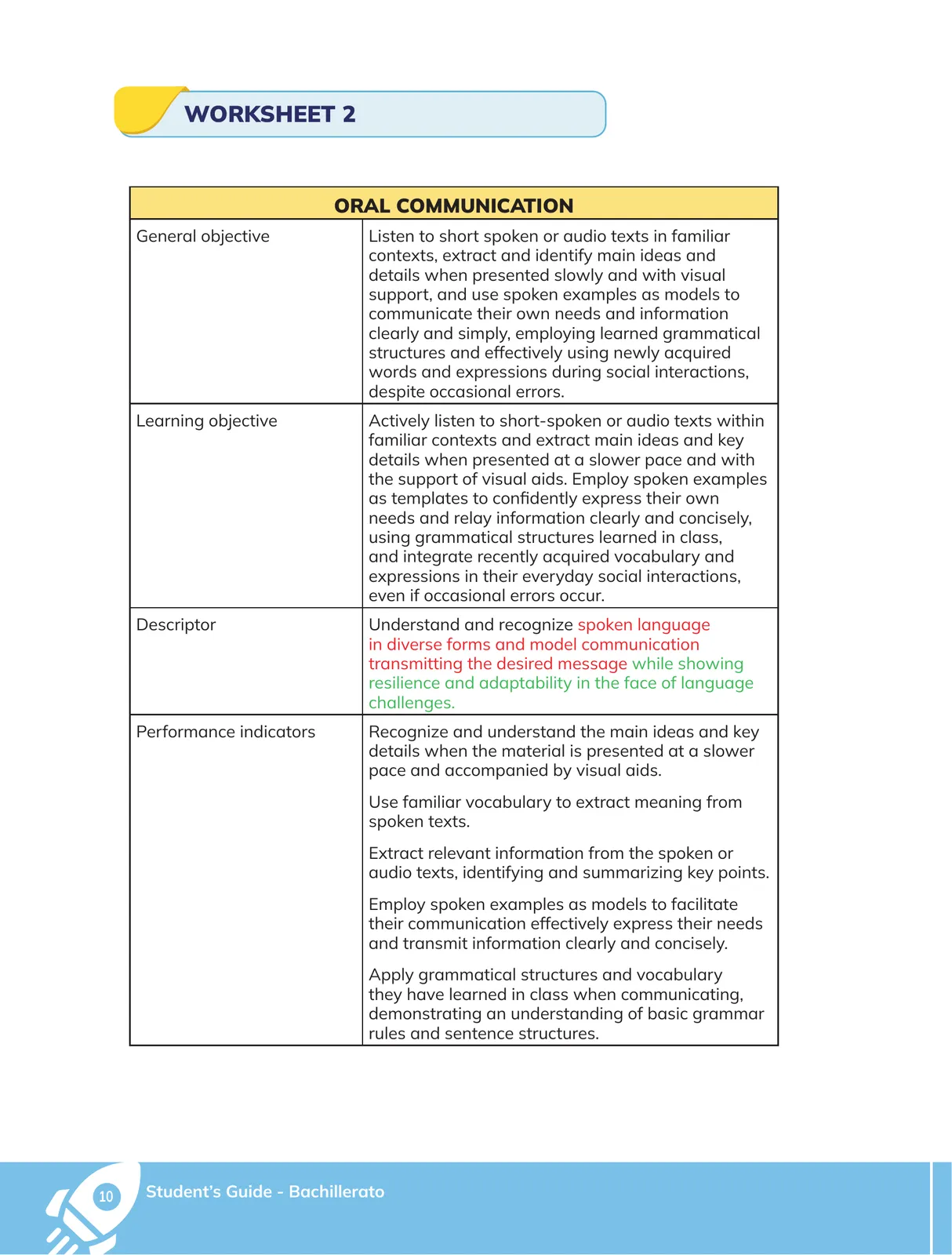
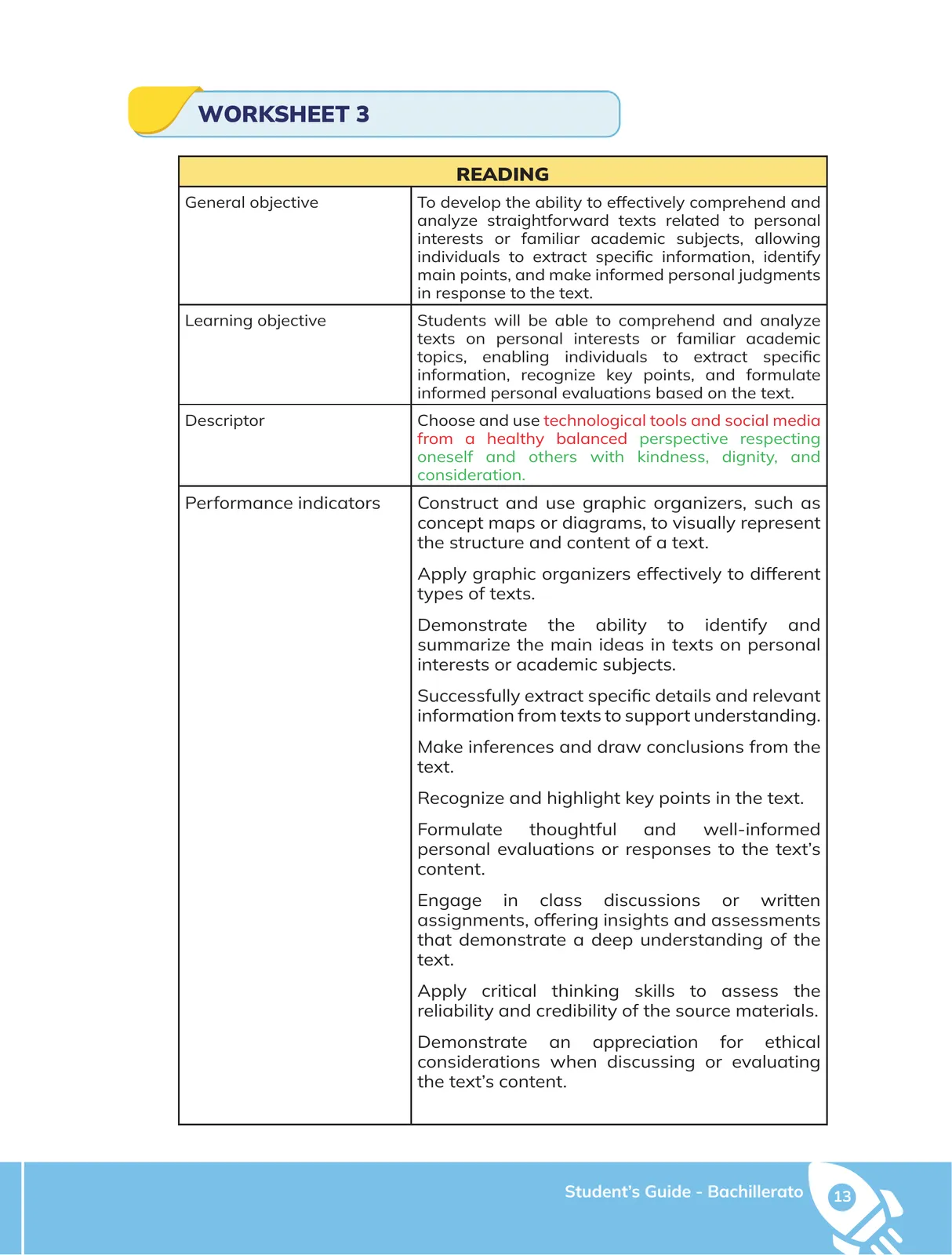
/ WORKSHEET 2 )
General objective Listen to short spoken or audio texts in familiar contexts, extract and identify main ideas and details when presented slowly and with visual support, and use spoken examples as models to communicate their own needs and information clearly and simply, employing learned grammatical structures and effectively using newly acquired words and expressions during social interactions, despite occasional errors.
Learning objective Actively listen to short-spoken or audio texts within familiar contexts and extract main ideas and key details when presented at a slower pace and with the support of visual aids. Employ spoken examples as templates to confidently express their own needs and relay information clearly and concisely, using grammatical structures learned in class,
and integrate recently acquired vocabulary and expressions in their everyday social interactions, even if occasional errors occur.
Descriptor Understand and recognize spoken language
in diverse forms and model communication transmitting the desired message while showing resilience and adaptability in the face of language challenges.
Performance indicators Recognize and understand the main ideas and key details when the material is presented at a slower pace and accompanied by visual aids.
Use familiar vocabulary to extract meaning from spoken texts.
Extract relevant information from the spoken or audio texts, identifying and summarizing key points.
Employ spoken examples as models to facilitate their communication effectively express their needs and transmit information clearly and concisely.
Apply grammatical structures and vocabulary
they have learned in class when communicating, demonstrating an understanding of basic grammar rules and sentence structures.
@ Student's Guide - Bachillerato

Otros libros recomendados
Ingles · 2 EGB · 2024
Ministerio de Educación del Ecuador
48 págs.
Ciencias Naturales · 2 EGB · 2025
Ministerio de Educación del Ecuador
146 págs.
Lengua Y Literatura · 2 EGB · 2025
Ministerio de Educación del Ecuador
246 págs.
Lengua Y Literatura · 2 EGB · 2024
Ministerio de Educación del Ecuador
70 págs.
Matematica · 6 EGB · 2025
Ministerio de Educación del Ecuador
218 págs.
Estudios Sociales · 6 EGB · 2025
Ministerio de Educación del Ecuador
226 págs.
Ingles · 6 EGB · 2024
Ministerio de Educación del Ecuador
50 págs.
Etnoeducacion · 6 EGB · 2024
Ministerio de Educación del Ecuador
100 págs.