Grammar
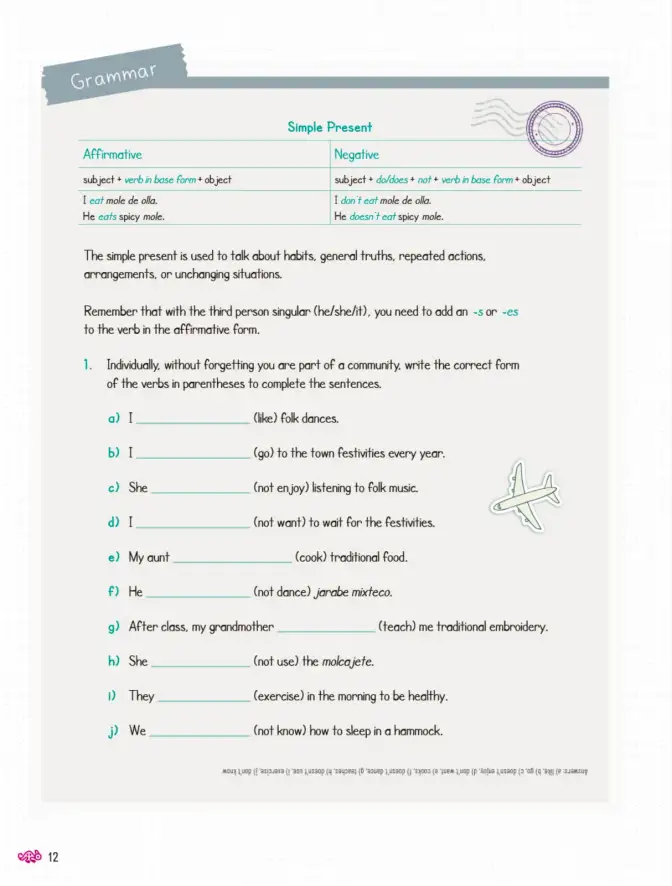
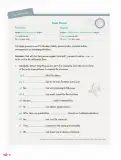
The simple present is used to talk about habits, general truths, repeated actions,arrangements, or unchanging situations.
Remember that with the third person singular (he/she/it), you need to add an -s or -es to the verb in the affirmative form.
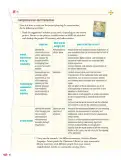
1.1Individually, without forgetting you are part of a community, write the correct form of the verbs in parentheses to complete the sentences.
a)I (like) folk dances.
b)Ⅰ_(go) to the town festivities every year.
c) She (not en joy) listening to folk music.
d)I (not want) to wait for the festivities.
e) My aunt (cook) traditional food.
f) He (not dance) jarabe mixteco.
g)After class, my grandmother (teach) me traditional embroidery.
h) She (not use) the molcajete.
i) They (exercise) in the morning to be healthy.
j) We (not know) how to sleep in a hammock.
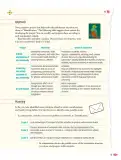
Simple Present
| Affirmative | Negative |
| subject + venb in base fonm+ object | subject + do/does + not + venb in base form + object |
| I eat mole de olla. He eats spicy mole. | I don't eat mole de olla. He doesn't eat spicy mole. |
| |

)
12