












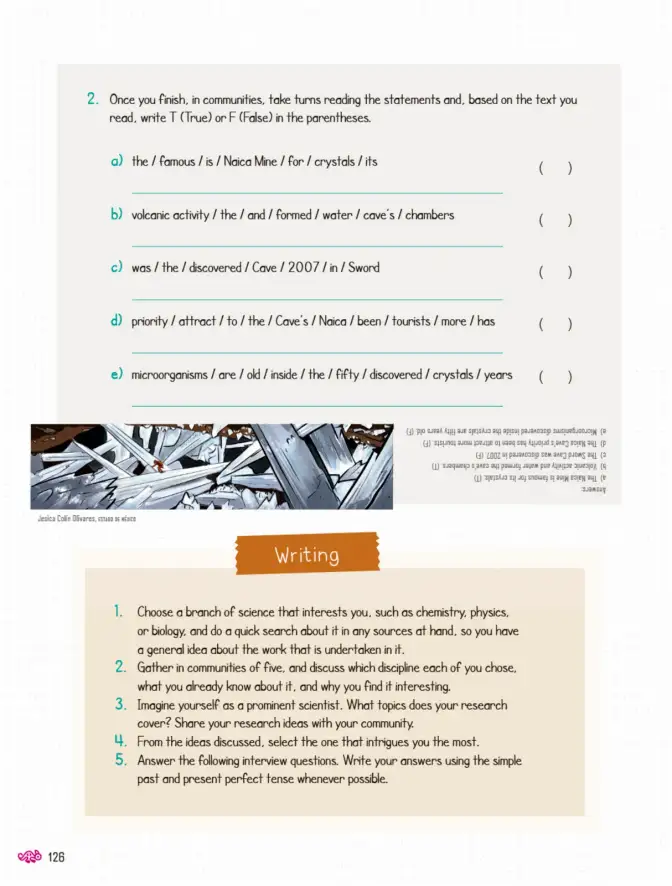
Once you finish, in communities, take turns reading the statements and, based on the text you read, write T (True) or F (False) in the parentheses.
the / famous / is / Naica Mine / for / crystals / its
- Ordenamos las palabras para formar una oración con sentido: sujeto + verbo + complemento.
- Sujeto: Naica Mine; verbo: is; adjetivo: famous; preposición: for; complemento: its crystals.
- Oración: Naica Mine is famous for its crystals.
- El texto afirma que la mina es famosa por sus cristales, por lo que la afirmación es verdadera.
T (True)
volcanic activity / the / and / formed / water / cave's / chambers
- Sujeto: the cave's chambers; verbo: formed; agentes: volcanic activity and water.
- Oración: The cave's chambers formed water and volcanic activity. (orden literal) → sentido correcto: The cave's chambers were formed by water and volcanic activity.
- El texto indica que las cámaras se formaron por agua y actividad volcánica.
T (True)
was / the / discovered / Cave / 2007 / in / Sword
- Sujeto: The Sword Cave; verbo pasivo: was discovered; complemento: in 2007.
- Oración: The Sword Cave was discovered in 2007.
- El texto confirma que la Cueva de la Espada fue descubierta en 2007.
T (True)
priority / attract / to / the / Cave's / Naica / been / tourists / more / has
- Sujeto: The Naica Cave's priority; verbo: has been; infinitivo: to attract; complemento: more tourists.
- Oración: The Naica Cave's priority has been to attract more tourists.
- El texto dice que la prioridad de la mina ha sido no atraer más turistas, sino la investigación y conservación.
F (False)
microorganisms / are / old / inside / the / fifty / discovered / crystals / years
- Sujeto: microorganisms; verbo: are; complemento: inside the crystals; modificador: fifty years old.
- Oración: Microorganisms discovered inside the crystals are fifty years old.
- El texto afirma que los microorganismos hallados tienen más de cincuenta mil años, no cincuenta años.
Writing
Paso 1
Choose a branch of science that interests you, such as chemistry, physics, or biology, and do a quick search about it in any sources at hand, so you have a general idea about the work that is undertaken in it.
Respuesta orientativa: I chose biology because I am interested in how living organisms work. I searched in an encyclopedia and learned that biologists study cells, ecosystems, and the human body. They also do field work and laboratory experiments to understand life.
Paso 2
Gather in communities of five, and discuss which discipline each of you chose, what you already know about it, and why you find it interesting.
Respuesta orientativa: In my community, one classmate chose chemistry because she likes reactions, another chose physics because he enjoys forces and motion, and I chose biology. We shared what we knew and explained why each discipline caught our attention.
Paso 3
Imagine yourself as a prominent scientist. What topics does your research cover? Share your research ideas with your community.
Respuesta orientativa: As a prominent biologist, my research covers the microorganisms that live inside the Naica crystals. I have studied how they survive without light and with extreme heat. I have also published articles about their DNA and their possible use in medicine.
Paso 4
From the ideas discussed, select the one that intrigues you the most.
Respuesta orientativa: The idea that intrigues me the most is how microorganisms can live inside crystals for thousands of years. It shows that life can adapt to extreme conditions.
Paso 5
Answer the following interview questions. Write your answers using the simple past and present perfect tense whenever possible.
Respuesta orientativa:
- What did you discover? I discovered new microorganisms inside the Naica crystals.
- How long have you worked on this project? I have worked on this project for five years.
- What have you learned? I have learned that life is more resistant than we thought.
- When did you start your research? I started my research in 2018.
F (False)