














Página — Uerakua Anapu Uantakua Projects And Readings 2° Secundaria (pág. 13)
Solución no disponible aún
Esta página está en proceso de revisión.
Pídela y la resolveremos antes. Sin registro.
📝 Transcripción de la página (texto seleccionable) 1850 caracteres
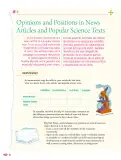
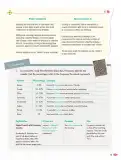
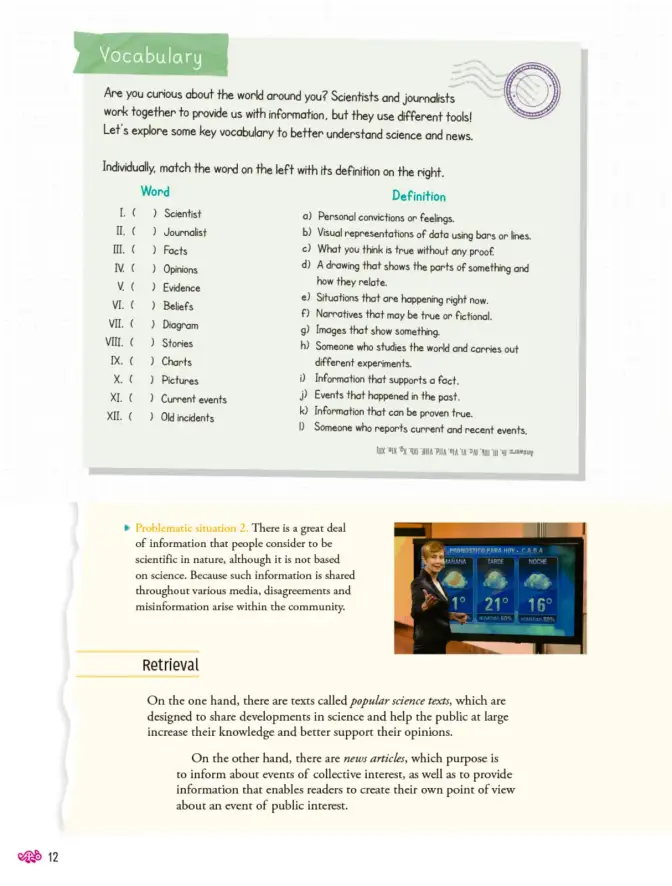
Vocabulary
Ane you cunious about the world around you? Scientists and journalists wonk together to provide us with information, but they use different tools!Let's explore some key vocabulary to better understand science and news.
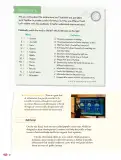
Individually, match the word on the left with its definition on the right.
Word
Definition
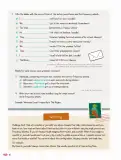
I.( ) Scientist a) Personal convictions or feelings. II.( ) Journalist b)Visual representations of data using bars or lines. III.()facts c) What you think is true without any proof. IV.()Opinions d) A drawing that shows the parts of something and V.()Evidence how they relate.
VI.()Beliefs e) Situations that are hoppening right now. f)Nannatives that may be true on fictional. VII.()Diagram g) Images that show something. VI.()Stories h) Someone who studies the world and carries out IX.()Charts different experiments. X.()Pictures i)Information that supports a fact. XI.( ) Current events j) Events that happened in the past. XII.( )Old incidents k) Information that can be proven true.
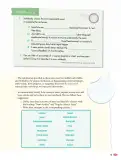
- Someone who reports current and recent events.
A
Problematic situation 2. There is a great deal of information that people consider to be scientific in nature, although it is not based on science. Because such information is shared throughout various media, disagreements and misinformation arise within the community.
Retrieval
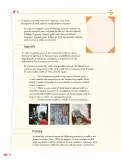
On the one hand, there are texts called popular science texts, which are designed to share developments in science and help the public at large increase their knowledge and better support their opinions.
On the other hand, there are news articles, which purpose is to inform about events of collective interest, as well as to provide information that enables readers to create their own point of view about an event of public interest.

乐
12
Otros libros recomendados

Uérakua anapu uantakua. Projects and Readings. Libro de Educación Telesecundaria Grado 3° Ciclo Escolar 2025 - 2026
SEP/CONALITEG
187 págs.

Uérakua anapu uantakua. Projects and Readings. Libro de Educación Telesecundaria Grado 2° Ciclo Escolar 2025 - 2026
SEP/CONALITEG
171 págs.

Uérakua anapu uantakua. Projects and Readings. Libro de Educación Telesecundaria Grado 1° Ciclo Escolar 2025 - 2026
SEP/CONALITEG
187 págs.

Uérakua anapu uantakua. Projects and Readings. Libro de Educación Secundaria Grado 3° Ciclo Escolar 2025 - 2026
SEP/CONALITEG
187 págs.

Colección Sk´asolil. De lo humano y lo comunitario. Libro de Educación Secundaria Grado 2° Ciclo Escolar 2025 - 2026
SEP/CONALITEG
259 págs.

Colección Sk´asolil. Nuestro libro de proyectos. Libro de Educación Secundaria Grado 2° Ciclo Escolar 2025 - 2026
SEP/CONALITEG
259 págs.

Colección Sk´asolil. Múltiples lenguajes. Libro de Educación Secundaria Grado 2° Ciclo Escolar 2025 - 2026
SEP/CONALITEG
163 págs.

Uérakua anapu uantakua. Projects and Readings Libro de Educación Secundaria Grado 1° Ciclo Escolar 2025 - 2026
SEP/CONALITEG
187 págs.