
















Saltar al contenido
MisLibrosTexto
Ad

Frequency Adverbs: Project Objectives and Grammar

📄 teoria ingles 🎓 secundaria · 2° Secundaria México 🇲🇽 MX 🗣 Español
Página 16
16 de 171
Página 16 de Uérakua anapu uantakua. Projects and Readings.  Libro de Educación Secundaria Grado 2°  Ciclo Escolar 2025 - 2026
Anterior Página 16 / 171 Siguiente

Respuesta rápida

Los adverbios de frecuencia (always, usually, often, sometimes, occasionally, seldom, rarely, never) indican la frecuencia de una acción y se colocan antes del verbo principal en presente simple.

📚 theory ingles ⭐⭐ Dificultad 2/5 ⏱ 5 min lectura

Solución — Página 16

Uérakua anapu uantakua. Projects and Readings. Libro de Educación Secundaria Grado 2° Ciclo Escolar 2025 - 2026

1
Ejercicio 1

Project's Objective and Means to Achieve It

  1. Read the table. The project's objective is to analyze journalistic and popular science texts and their role in critical thinking.
  2. The means to achieve it is drafting a journalistic text or news article with social impact.
  3. Another objective can be: To create a school newspaper that reports on local environmental issues.
  4. The means to reach this objective can be: To interview students and teachers, write articles, and publish a monthly bulletin.

Respuesta orientativa: Los objetivos del proyecto se centran en analizar textos periodísticos y de divulgación científica, y en redactar mensajes que rechacen la violencia y promuevan una vida saludable. Los medios para lograrlo incluyen la redacción de artículos y campañas de concientización en la escuela.

Grammar: Frequency Adverbs

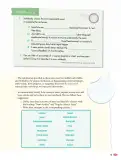
  1. Study the table of frequency adverbs and their percentages.
  2. The adverbs are: always (100%), usually (80-90%), often (50-70%), sometimes (30-40%), occasionally (20-30%), seldom (10-20%), rarely (5-10%), never (0%).
  3. The structure is: subject + adverb of frequency + verb in present tense + complement.
  4. Example: She often exercises in the morning.
  5. Frequency adverbs tell us how often something happens. They are usually placed before the main verb (the verb without 'to').

Respuesta orientativa: Los adverbios de frecuencia indican la periodicidad de una acción. Se colocan antes del verbo principal en presente simple. Por ejemplo: Scientists always wear lab coats in the lab.

1
Ejercicio 1

In communities, study the information below about frequency adverbs and consider that the percentages refer to the frequency the adverb represents.

  1. Observa la tabla de adverbios de frecuencia y sus porcentajes.
  2. Identifica la estructura: sujeto + adverbio de frecuencia + verbo en presente simple + complemento.
  3. Reconoce que los adverbios de frecuencia se colocan antes del verbo principal.
Respuesta

Los adverbios de frecuencia expresan cada cuánto ocurre una acción; se usan con el presente simple y van antes del verbo principal.

Contenido de la página

Project's Objective

Project's Objective Means to Achieve It
Analyzing the characteristics of journalistic and popular science texts, as well as their role in the construction of collective critical thinking. Drafting of a journalistic text or news article to provide information with social or community impact in a conscious, truthful, and brief way.
Writing and spreading messages rejecting violence, promoting a healthy lifestyle, or fostering equity and inclusion. Other matters of personal or collective interest can be added, as long as the message they transmit is based on research and scientific evidence. Conducting an awareness campaign in the classroom or the school to promote a culture of peace (rejection of violence), a healthy lifestyle, a harmonious coexistence, or any other topic chosen.
Another objective can be... (Write it in your notebook.) The means to reach this objective can be... (Write it in your notebook.)

Grammar

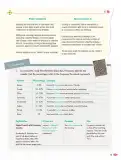
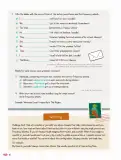
  1. In communities, study the information below about frequency adverbs and consider that the percentages refer to the frequency the adverb represents.
Adverb Percentage Example
Always 100% Scientists always wear lab coats in the lab.
Usually 80-90% Editors usually proofread articles before publishing.
Often 50-70% Reporters often interview multiple sources for a story.
Sometimes 30-40% A journalist sometimes writes opinion pieces.
Occasionally 20-30% Astronauts occasionally perform spacewalks during missions.
Seldom 10-20% Scientists seldom share unfinished research findings.
Rarely 5-10% A journalist rarely misses a deadline.
Never 0% Good scientists never falsify data.
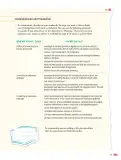
Explanation Structure Example Use
Simple Present with Frequency Adverbs. As adverbs of frequency are used to talk about routines or repeated activities, they often appear in sentences where the verb is in the present simple tense. subject + adverb of frequency + verb in present tense + complement She often exercises in the morning. Frequency adverbs tell us how often something happens. They are usually placed before the main verb (the verb without 'to').

Ejemplos resueltos

She often exercises in the morning.

Estructura: sujeto (She) + adverbio de frecuencia (often) + verbo en presente (exercises) + complemento (in the morning).

Tablas (2)

Adverb Percentage Example
Always 100% Scientists always wear lab coats in the lab.
Usually 80-90% Editors usually proofread articles before publishing.
Often 50-70% Reporters often interview multiple sources for a story.
Sometimes 30-40% A journalist sometimes writes opinion pieces.
Occasionally 20-30% Astronauts occasionally perform spacewalks during missions.
Seldom 10-20% Scientists seldom share unfinished research findings.
Rarely 5-10% A journalist rarely misses a deadline.
Never 0% Good scientists never falsify data.
Explanation Structure Example Use
Simple Present with Frequency Adverbs. As adverbs of frequency are used to talk about routines or repeated activities, they often appear in sentences where the verb is in the present simple tense. subject + adverb of frequency + verb in present tense + complement She often exercises in the morning. Frequency adverbs tell us how often something happens. They are usually placed before the main verb (the verb without 'to').

Glosario (8)

Always
Siempre, en un 100% de las ocasiones.
Usually
Usualmente, en un 80-90% de las ocasiones.
Often
A menudo, en un 50-70% de las ocasiones.
Sometimes
A veces, en un 30-40% de las ocasiones.
Occasionally
Ocasionalmente, en un 20-30% de las ocasiones.
Seldom
Rara vez, en un 10-20% de las ocasiones.
Rarely
Raramente, en un 5-10% de las ocasiones.
Never
Nunca, en un 0% de las ocasiones.

Preguntas para practicar

Another objective can be... (Write it in your notebook.)

To create a school newspaper that reports on local environmental issues and promotes community participation.

The means to reach this objective can be... (Write it in your notebook.)

To interview students and teachers, write articles, and publish a monthly bulletin with the information gathered.

Temas y conceptos clave

Adverbios de frecuenciaPresente simpleObjetivos de proyectoFrequency adverbsSimple presentPercentage of frequencyWord order
¿Te fue útil esta página?

Figuras de la página (1)

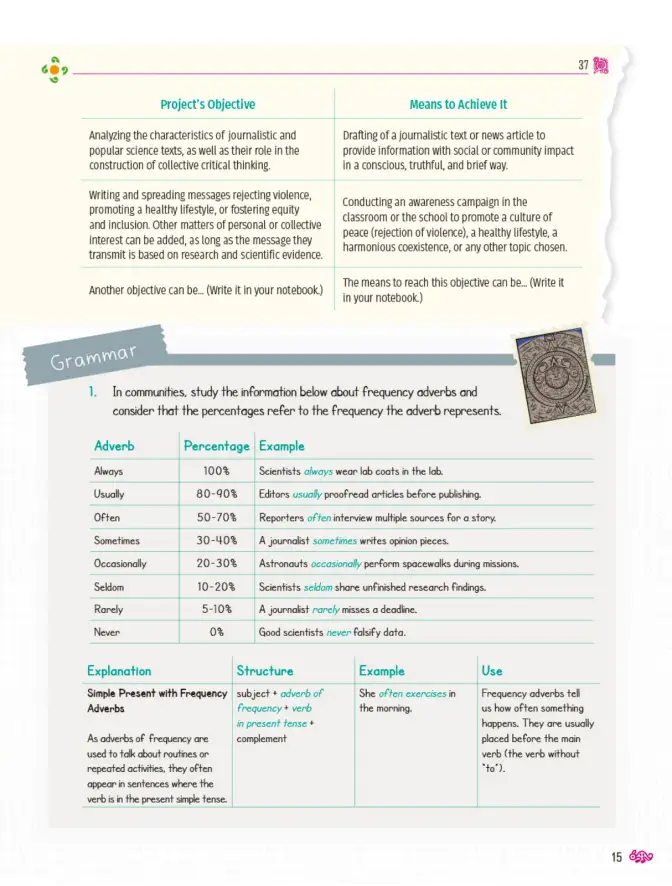
Número de página 37 con un adorno floral.
Figura 1 image

Preguntas que la gente también hace

¿Cómo se usan los adverbios de frecuencia en inglés?
Consulta la solución completa arriba o explora el libro entero para temas relacionados.
¿Cuál es la diferencia entre 'often' y 'usually'?
Consulta la solución completa arriba o explora el libro entero para temas relacionados.
¿Dónde se colocan los adverbios de frecuencia en una oración?
Consulta la solución completa arriba o explora el libro entero para temas relacionados.
📌 Antes de leer esto
  • • Conocimiento básico del presente simple en inglés
  • • Identificación de sujeto y verbo en una oración
Siguiente tema sugerido
Uso de adverbios de frecuencia en preguntas y negaciones
📝 Transcripción de la página (texto seleccionable) 2733 caracteres

Grammar

1.In communities, study the information below about frequency adverbs and consider that the percentages refer to the frequency the adverb represents.

37

Project's objectiveMeans to Achieve It
Analyzing the characteristics of journalistic and popular science texts, as well as their role in the construction of collective critical thinking.Drafting of a journalistic text or news article to provide information with social or community impact in a conscious, truthful, and brief way.
Writing and spreading messages rejecting violence, promoting a healthy lifestyle, or fostering equity and inclusion. Other matters of personal or collective interest can be added, as long as the message they transmit is based on research and scientific evidence.Conducting an awareness campaign in the classroom or the school to promote a culture of peace (rejection of violence), a healthy lifestyle, a harmonious coexistence, or any other topic chosen.
Another objective can be. (Write it in your notebook.)The means to reach this objective can be. (write it in your notebook.)

![](page=0,bbox=[932, 587, 1074, 766])

AdverbPercentageExample
Always100%Scientists always wear lab coats in the lab.
Usually80-90%Editors usuallyproofread articles before publishing.
Often50-70%Reporters often interview multiple sources for a story.
Sometimes30-40%A journalist sometimes writes opinion pieces.
Occasionally20-30%Astronauts occasionally perform spacewalks during missions.
Seldom10-20%Scientists seldom share unfinished research findings.
Ranely5-10%A journalist ranely misses a deadline.
Neven0%Good scientists never falsify data.
ExplanationStructureExampleUse
Simple Present with Frequency Adverbs As advenbs of frequency are used to talk about routines on repeated activities, they often appear in sentences where the venb is in the present simple tense.subject + advenb of frequency + venb in present tense + complementShe often exercises in the morning.Frequency adverbs tell us how often something happens. They are usully placed before the main verb (the verb without 'to).

15

乐

Ad

Otros libros recomendados

Ver todos →
Ad

Usamos cookies propias y de terceros para personalizar contenido, mostrar publicidad y analizar el tráfico. Las cookies necesarias siempre están activas.