















Saltar al contenido
MisLibrosTexto
Ad

Quantifiers: countable and uncountable nouns

📄 ejercicios ingles 🎓 secundaria · 2° Secundaria México 🇲🇽 MX 🗣 Español
Página 72
72 de 171
Página 72 de Uérakua anapu uantakua. Projects and Readings.  Libro de Educación Secundaria Grado 2°  Ciclo Escolar 2025 - 2026
Anterior Página 72 / 171 Siguiente

Respuesta rápida

h) Yes, it did; teamwork and feedback helped me grow. 2.a) Use better materials and calibrate it. 2.b) Yes, temperature and pressure effects. 2.c) Repeat measurements and control variables. Grammar: many/a few + contables; much/a little + incontables.

📚 exercise ingles ⭐⭐ Dificultad 2/5 ⏱ 6 min lectura

Solución — Página 72

Uérakua anapu uantakua. Projects and Readings. Libro de Educación Secundaria Grado 2° Ciclo Escolar 2025 - 2026

1
Ejercicio 1

Ejercicio h

Did your interaction with the rest of the community contribute to your personal and academic growth? Explain why.

  1. Identifico la pregunta: pide explicar si la interacción con la comunidad aportó al crecimiento personal y académico.
  2. Recuerdo mi participación: compartí ideas, escuché a mis compañeros y recibí retroalimentación sobre mi instrumento.
  3. Explico el aporte: aprendí a comunicar mis hallazgos y a aceptar críticas constructivas.

Respuesta orientativa: Yes, it did. Sharing my ideas and listening to my classmates helped me improve my instrument and learn how to work in a team, which contributed to my personal and academic growth.


2
Ejercicio 2

In communities, evaluate your teacher's and classmates' contributions and answer the following questions:

a
Parte 2.a

How can you modify your instrument to make it better?

  1. Reviso mi instrumento y detecto fallas (precisión, materiales, escala).
  2. Propongo mejoras concretas: usar materiales más resistentes, calibrar la escala o agregar un soporte.
  3. Justifico la mejora con base en los resultados obtenidos.

Respuesta orientativa: I can modify my instrument by using more precise materials, adding a better scale, and calibrating it before each measurement to reduce errors.

b
Parte 2.b

Was there some information you failed to investigate about the operating principles of your instrument?

  1. Comparo lo que investigué con lo que el instrumento realmente requiere.
  2. Identifico vacíos: por ejemplo, no investigué cómo afecta la temperatura o la presión.
  3. Menciono cómo completaría esa información.

Respuesta orientativa: Yes, I did not investigate how temperature or air pressure can affect the measurements. I would research those factors to understand the operating principles better.

c
Parte 2.c

How can you redesign your experiment to obtain better results?

  1. Analizo los errores del experimento anterior.
  2. Propongo cambios: repetir mediciones, controlar variables y registrar datos en tablas.
  3. Defino cómo comprobaría la mejora.

Respuesta orientativa: I can redesign my experiment by repeating measurements several times, controlling the variables, and recording the data in tables to compare results and reduce errors.

3
Ejercicio 3

Share your answers with your classmates and ask them for ideas to improve your instrument.

  1. Preparo mis respuestas de forma clara y ordenada.
  2. Escucho las sugerencias de mis compañeros y las anoto.
  3. Selecciono las ideas más viables para mejorar mi instrumento.

Respuesta orientativa: I would present my answers to the class, listen to my classmates' suggestions, and choose the most useful ideas to improve my instrument.

Ad
4
Ejercicio 4

Finally, write in your notebooks the assembly agreements reached by the community in order to contrast your knowledge about the natural phenomena and the physical magnitudes through experimentation.

  1. Reviso los acuerdos tomados en la asamblea del grupo.
  2. Los escribo en mi cuaderno de forma ordenada.
  3. Relaciono esos acuerdos con los fenómenos naturales y las magnitudes físicas estudiadas.

Respuesta orientativa: In my notebook I would write the agreements of the assembly, such as respecting opinions and verifying data, and relate them to the natural phenomena and physical magnitudes we studied through experimentation.

Grammar: Quantifiers

A quantifier is a word used before a noun to express quantity. Frequent quantifiers are some, any, much, many, a few, a little and a lot.

Some quantifiers are used with countable nouns (you can tell their exact number) and others with uncountable nouns (you cannot tell their exact number). Uncountable nouns are always singular.

1
Ejercicio 1

In communities, read and discuss the table on the following page.

  1. Observo la tabla de la página siguiente.
  2. Identifico qué cuantificadores acompañan a sustantivos contables y cuáles a incontables.
  3. Comento con mi comunidad las diferencias y doy ejemplos.

Respuesta orientativa: I would read the table, identify that many and a few go with countable nouns, while much and a little go with uncountable nouns, and discuss examples with my classmates.

Contenido de la página

h) Did your interaction with the rest of the community contribute to your personal and academic growth? Explain why.

  1. In communities, evaluate your teacher's and classmates' contributions and answer the following questions:

a) How can you modify your instrument to make it better?

b) Was there some information you failed to investigate about the operating principles of your instrument?

c) How can you redesign your experiment to obtain better results?

  1. Share your answers with your classmates and ask them for ideas to improve your instrument.

  2. Finally, write in your notebooks the assembly agreements reached by the community in order to contrast your knowledge about the natural phenomena and the physical magnitudes through experimentation.

Grammar

Quantifiers

A quantifier is a word that we use before a noun to express the quantity of the object. Frequent quantifiers are some, any, much, many, a few, a little and a lot.

Some quantifiers are used with countable nouns (you can tell their exact number) and some others are used with uncountable nouns (you cannot tell their exact number). Uncountable nouns are always singular:

  1. In communities, read and discuss the table on the following page:

Ejemplos resueltos

Clasifica los cuantificadores según el tipo de sustantivo.

Contables: many, a few, some, any, a lot of. Incontables: much, a little, some, any, a lot of.

Tabla

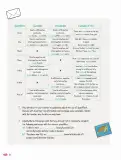
Quantifier Countable nouns Uncountable nouns
some ✔ ✔
any ✔ ✔
many ✔ ✘
much ✘ ✔
a few ✔ ✘
a little ✘ ✔
a lot of ✔ ✔

Diagrama

graph TD
  Q[Quantifiers] --> C[Countable nouns]
  Q --> U[Uncountable nouns]
  C --> M[many]
  C --> F[a few]
  U --> MU[much]
  U --> L[a little]
  Q --> B[some / any / a lot]

Glosario (5)

quantifier
Palabra que se usa antes de un sustantivo para expresar cantidad (some, any, much, many, a few, a little, a lot).
countable noun
Sustantivo contable; se puede contar y tiene forma singular y plural (book/books).
uncountable noun
Sustantivo incontable; no se puede contar con exactitud y siempre es singular (water, information).
instrument
Herramienta o dispositivo usado para medir o experimentar.
assembly
Reunión de la comunidad para tomar acuerdos.

Preguntas para practicar

Did your interaction with the rest of the community contribute to your personal and academic growth?

Yes, it did, because sharing and receiving feedback improved my work and my teamwork skills.

How can you modify your instrument to make it better?

By using better materials, calibrating it, and adding a more precise scale.

How can you redesign your experiment to obtain better results?

By repeating measurements, controlling variables, and recording data in tables.

Temas y conceptos clave

QuantifiersCountable and uncountable nounsEvaluación de proyecto científicoquantifiercountable noununcountable nounsingularinstrumentexperiment
¿Te fue útil esta página?

Figuras de la página (2)

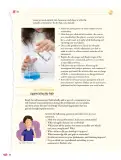
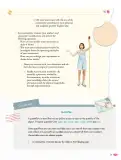
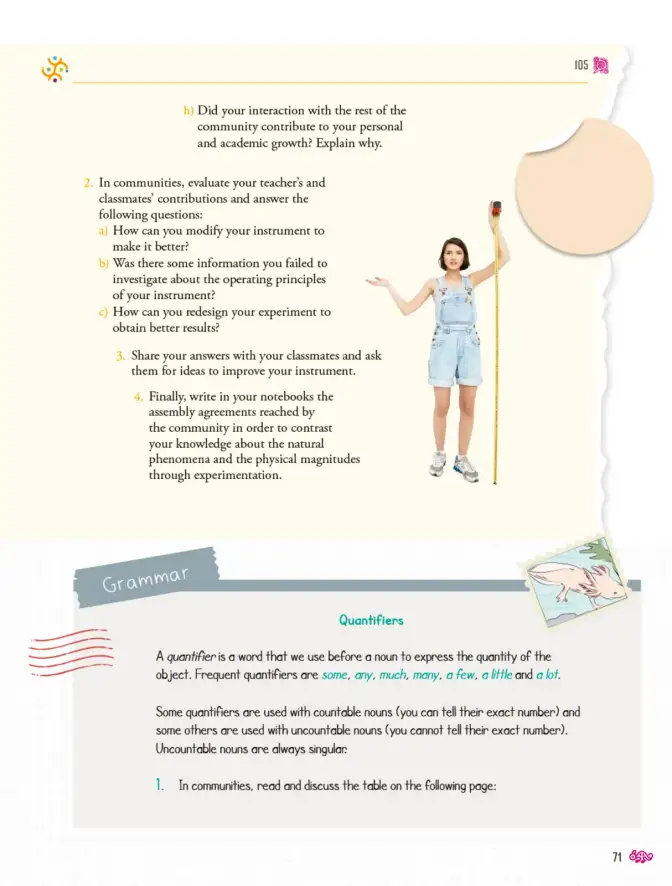
Estudiante con overol sosteniendo una cinta métrica amarilla extendida verticalmente.
Figura 1 image
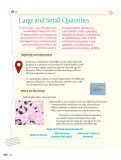
Ilustración de un ajolote sobre una hoja, junto a la sección Grammar.
Figura 2 image

Preguntas que la gente también hace

¿Qué son los quantifiers en inglés y cómo se usan?
Consulta la solución completa arriba o explora el libro entero para temas relacionados.
¿Cuál es la diferencia entre countable y uncountable nouns?
Consulta la solución completa arriba o explora el libro entero para temas relacionados.
¿Cuándo se usa much y cuándo many?
Consulta la solución completa arriba o explora el libro entero para temas relacionados.
📌 Antes de leer esto
  • • Vocabulario básico de sustantivos en inglés
  • • Uso básico del presente simple
  • • Nociones de medición y magnitudes físicas
Siguiente tema sugerido
Tabla de cuantificadores con sustantivos contables e incontables
📝 Transcripción de la página (texto seleccionable) 1314 caracteres

h) Did your interaction with the rest of the community contribute to your personal and academic growth? Explain why.

  1. In communities, evaluate your teacher's and classmates'contributions and answer the following questions:

a) How can you modify your instrument to make it better?

b) Was there some information you failed to investigate about the operating principles of your instrument?

How can you redesign your experiment to obtain better results?

  1. Share your answers with your classmates and ask them for ideas to improve your instrument.

4.Finally, write in your notebooks the assembly agreements reached by the community in order to contrast your knowledge about the natural phenomena and the physical magnitudes through experimentation.

Grammar

A quantifier is a word that we use before a noun to express the quantity of the object. Frequent quantifiers are some, any, much, many, a few, a liHle and a lot.

Quantifiers

Some quantifiers are used with countable nouns (you can tell their exact number) and some others are used with uncountable nouns (you cannot tell their exact number).Uncountable nouns are always singular:

  1. In communities, read and discuss the table on the following page:

8

105

![](page=0,bbox=[47, 1130, 207, 1222])

![](page=0,bbox=[946, 962, 1157, 1135])

7180

Ad

Otros libros recomendados

Ver todos →
Ad

Usamos cookies propias y de terceros para personalizar contenido, mostrar publicidad y analizar el tráfico. Las cookies necesarias siempre están activas.