Saltar al contenido
MisLibrosTexto
Ad

Indicadores naturales de pH: procedimiento experimental con hibisco y col morada

📄 ejercicios quimica 🎓 bachillerato · 3° Secundaria México 🇲🇽 MX 🗣 Español
Página 159
159 de 187
Página 159 de Uérakua anapu uantakua. Projects and Readings.  Libro de Educación Secundaria Grado 3°  Ciclo Escolar 2025 - 2026
Anterior Página 159 / 187 Siguiente

Respuesta rápida

Indicadores naturales: hibisco y col morada. Ácidos → rojo/rosa; bases → verde/azul; neutros → sin cambio. Se identifican 10 sustancias cotidianas.

📚 exercise quimica ⭐⭐ Dificultad 2/5 ⏱ 8 min lectura

Solución — Página 159

Uérakua anapu uantakua. Projects and Readings. Libro de Educación Secundaria Grado 3° Ciclo Escolar 2025 - 2026

1
Ejercicio 1

Draw a table in your notebook with the substances you will use and indicators. / Elabora una tabla con las sustancias y los indicadores.

  1. Se identifican las columnas: Substance, Characteristics, Hibiscus Indicator, Purple Cabbage Indicator.
  2. Se registran las sustancias del paso 7: Baking Soda, Salt, Acetylsalicylic Acid, Soap Powder, Antacid, Alcohol, Vinegar, Milk, Lemon Juice, Liquid Soap.
  3. Se completa la tabla con las características y el color observado con cada indicador.
Respuesta

Tabla completada con las 10 sustancias y los colores de cada indicador (ver tabla en contenido estructurado).

2
Ejercicio 2

Measure 100 ml of drinking water with the baby bottle and pour it into the hibiscus flowers in the beaker. Boil them until the volume reduces by half.

  1. Se miden 100 \, \text{ml} de agua potable.
  2. Se vierten sobre las flores de hibisco en el vaso de precipitados.
  3. Se hierven hasta reducir el volumen a la mitad: 100 \, \text{ml} \div 2 = 50 \, \text{ml}.
Respuesta

Quedan aproximadamente 50 \, \text{ml} de extracto concentrado de hibisco.

3
Ejercicio 3

Wait until it cools down, filter the liquid with a strainer, and put it in a flask, bottle, or dropper.

  1. Se deja enfriar para evitar quemaduras y degradación de las antocianinas.
  2. Se filtra con un colador para retirar restos sólidos.
  3. Se guarda el líquido en un frasco o gotero.
Respuesta

Indicador de hibisco listo para usar.

Ad
4
Ejercicio 4

Cut a few leaves of purple cabbage carefully into small pieces.

  1. Se lavan las hojas de col morada.
  2. Se cortan en trozos pequeños con cuidado.
Respuesta

Hojas de col morada troceadas.

5
Ejercicio 5

Boil them in 100 ml of drinking water until the volume is reduced by half.

  1. Se añaden 100 \, \text{ml} de agua.
  2. Se hierven hasta reducir a 50 \, \text{ml}.
Respuesta

Extracto concentrado de col morada.

6
Ejercicio 6

Let it cool down, filter, and keep the infusion in a flask or bottle.

  1. Se enfría la infusión.
  2. Se filtra y se almacena.
Respuesta

Indicador de col morada listo; a más hojas, mayor concentración.

Ad
7
Ejercicio 7

Put the following labels on the cups: "Baking Soda," "Salt," "Acetylsalicylic Acid," "Soap Powder," "Antacid," "Alcohol," "Vinegar," "Milk," "Lemon Juice," and "Liquid Soap."

  1. Se etiquetan 10 vasos con los nombres indicados.
  2. Se colocan en orden para evitar confusiones.
Respuesta

10 vasos etiquetados.

8
Ejercicio 8

With a syringe, put 10 ml of each liquid in the corresponding cup and squeeze the juice of two lemons into each cup. Put the solids in a cup, dissolve them with about 10 ml of water, and stir.

  1. Se miden 10 \, \text{ml} de cada líquido con la jeringa.
  2. Se exprime el jugo de dos limones en cada vaso.
  3. Los sólidos (bicarbonato, sal, jabón en polvo) se disuelven en 10 \, \text{ml} de agua y se agitan.
Respuesta

Muestras preparadas para la prueba.

9
Ejercicio 9

Cut the acetylsalicylic acid tablets into small pieces and put half of them in each cup. Then, add 10 ml of water and stir.

  1. Se parten las tabletas de ácido acetilsalicílico.
  2. Se coloca la mitad en cada vaso.
  3. Se añaden 10 \, \text{ml} de agua y se agita.
Respuesta

Muestras de ácido acetilsalicílico disueltas.

Ad
10
Ejercicio 10

Once you have put all the products in the cups, write their characteristics in the table, take pictures, or draw the samples.

  1. Se observan color, olor, textura y estado de cada muestra.
  2. Se registran en la tabla o se fotografían.
Respuesta

Tabla de características completada.

11
Ejercicio 11

Add five drops of the hibiscus indicator liquid to a batch of cups with the products. Take pictures or draw the changes you noticed and write them in the table.

  1. Se añaden 5 gotas del indicador de hibisco a cada vaso.
  2. Se observa el cambio de color.
  3. Se repite con el indicador de col morada.
  4. Se registran los colores en la tabla.
Respuesta

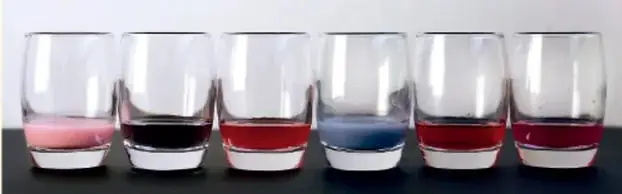
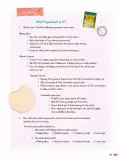
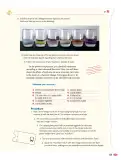
Los ácidos (vinagre, limón) tornan el indicador a rojo/rosa; las bases (bicarbonato, jabón, antiácido) a verde/azul; las sustancias neutras (sal, leche) no cambian el color.

Contenido de la página

Procedure

  1. Draw a table in your notebook with the substances you will use and indicators.
Substance Characteristics Hibiscus Indicator Purple Cabbage Indicator
Antacid
White vinegar
  1. Measure 100 ml of drinking water with the baby bottle and pour it into the hibiscus flowers in the beaker. Boil them until the volume reduces by half.

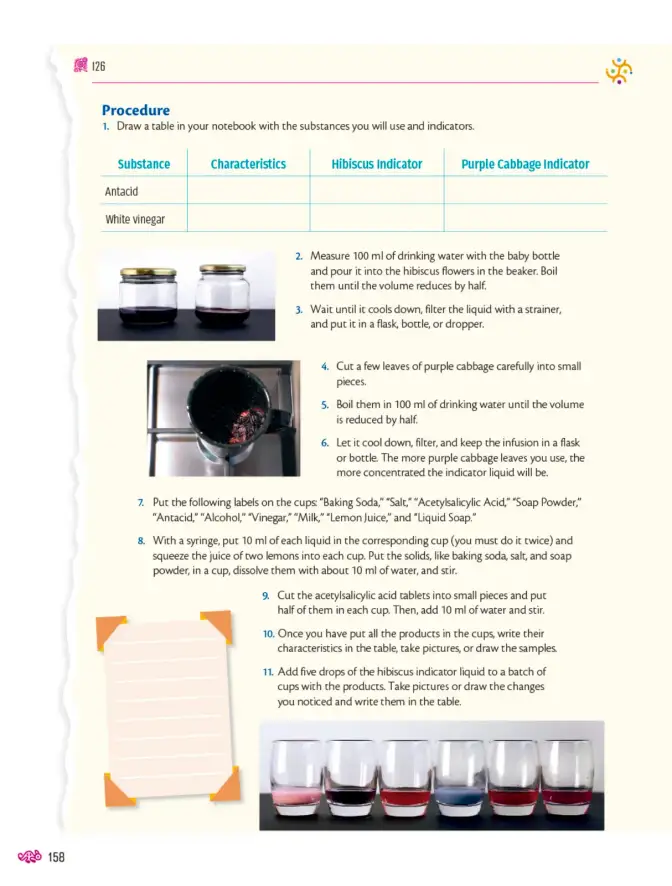
  2. Wait until it cools down, filter the liquid with a strainer, and put it in a flask, bottle, or dropper.

  3. Cut a few leaves of purple cabbage carefully into small pieces.

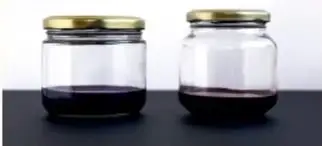
  4. Boil them in 100 ml of drinking water until the volume is reduced by half.

  5. Let it cool down, filter, and keep the infusion in a flask or bottle. The more purple cabbage leaves you use, the more concentrated the indicator liquid will be.

  6. Put the following labels on the cups: "Baking Soda," "Salt," "Acetylsalicylic Acid," "Soap Powder," "Antacid," "Alcohol," "Vinegar," "Milk," "Lemon Juice," and "Liquid Soap."

  7. With a syringe, put 10 ml of each liquid in the corresponding cup (you must do it twice) and squeeze the juice of two lemons into each cup. Put the solids, like baking soda, salt, and soap powder, in a cup, dissolve them with about 10 ml of water, and stir.

  8. Cut the acetylsalicylic acid tablets into small pieces and put half of them in each cup. Then, add 10 ml of water and stir.

  9. Once you have put all the products in the cups, write their characteristics in the table, take pictures, or draw the samples.

  10. Add five drops of the hibiscus indicator liquid to a batch of cups with the products. Take pictures or draw the changes you noticed and write them in the table.

Ejemplos resueltos

Se hierven 100 \, \text{ml} de agua con flores de hibisco hasta reducir el volumen a la mitad. ¿Cuánto extracto se obtiene?

Se divide el volumen inicial entre 2: 100 \, \text{ml} \div 2 = 50 \, \text{ml}. Se obtienen 50 \, \text{ml} de extracto concentrado.

Tabla

Substance Characteristics Hibiscus Indicator Purple Cabbage Indicator
Baking Soda Sólido blanco, se disuelve en agua Verde azulado Verde
Salt Sólido cristalino blanco Sin cambio Sin cambio
Acetylsalicylic Acid Sólido blanco, poco soluble Rosa claro Rosa
Soap Powder Polvo blanco, espumoso Verde Verde azulado
Antacid Sólido blanco, suspensión Verde Verde
Alcohol Líquido transparente Sin cambio Sin cambio
Vinegar Líquido transparente, olor fuerte Rojo Rojo rosado
Milk Líquido blanco opaco Sin cambio Sin cambio
Lemon Juice Líquido amarillento, ácido Rojo Rojo
Liquid Soap Líquido viscoso Verde Verde azulado

Diagrama

flowchart TD
A[Preparar indicadores] --> B[Hibisco: hervir 100 ml y reducir a 50 ml]
A --> C[Col morada: hervir 100 ml y reducir a 50 ml]
B --> D[Filtrar y envasar]
C --> D
D --> E[Etiquetar 10 vasos]
E --> F[Colocar 10 ml de cada sustancia]
F --> G[Agregar 5 gotas de indicador]
G --> H[Observar y registrar colores]

Fórmulas y ecuaciones

\text{Volumen final} = \frac{\text{Volumen inicial}}{2}

100 \, \text{ml} \div 2 = 50 \, \text{ml}

Glosario (5)

Indicator
Sustancia que cambia de color según el pH de la disolución.
Hibiscus
Flor rica en antocianinas usada como indicador natural.
Purple cabbage
Col morada, contiene antocianinas que sirven como indicador de pH.
Antacid
Medicamento que neutraliza la acidez estomacal; es una base.
Acetylsalicylic acid
Ácido acetilsalicílico, principio activo de la aspirina; es un ácido débil.

Preguntas para practicar

¿Por qué el indicador de col morada cambia de color?

Porque contiene antocianinas, pigmentos que modifican su estructura química según la concentración de iones hidrógeno (pH) del medio. En medio ácido se tornan rojos o rosados, y en medio básico, verdes o azules.

¿Qué sustancias resultaron ácidas y cuáles básicas?

El vinagre y el jugo de limón son ácidos; el bicarbonato, el jabón, el antiácido y el polvo para lavar son básicos; la sal, el alcohol y la leche son prácticamente neutros.

Temas y conceptos clave

Indicadores naturales de pHÁcidos y bases cotidianosProcedimiento experimentalIndicadorAntocianinapHÁcidoBaseNeutralización
¿Te fue útil esta página?

Figuras de la página (4)

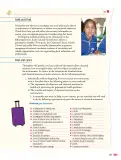
Dos frascos de vidrio con tapa dorada que contienen líquido oscuro, probablemente extracto de hibisco y de col morada.
Figura 1 image
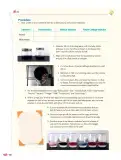
Vaso de precipitados sobre una parrilla eléctrica con líquido oscuro hirviendo.
Figura 2 image
Hoja de papel con esquinas decoradas, espacio para escribir observaciones.
Figura 3 image
Seis vasos de vidrio con líquidos de distintos colores: rosa, morado, rojo, azul, rojo y rojo, que muestran los resultados del indicador.
Figura 4 image

Preguntas que la gente también hace

¿Cómo funciona el indicador de col morada?
Consulta la solución completa arriba o explora el libro entero para temas relacionados.
¿Qué sustancias son ácidas y cuáles básicas en la cocina?
Consulta la solución completa arriba o explora el libro entero para temas relacionados.
¿Por qué cambia de color el hibisco con el vinagre?
Consulta la solución completa arriba o explora el libro entero para temas relacionados.
📌 Antes de leer esto
  • • Estados de la materia
  • • Mezclas y disoluciones
  • • Concepto de ácido y base
Siguiente tema sugerido
Escala de pH y cálculo de concentración de iones hidrógeno
📝 Transcripción de la página (texto seleccionable) 1960 caracteres

Procedure

  1. Draw a table in your notebook with the substances you will use and indicators.

  2. Measure 100 ml of drinking water with the baby bottle and pour it into the hibiscus flowers in the beaker. Boil them until the volume reduces by half.

3.Wait until it cools down, filter the liquid with a strainer,and put it in a flask, bottle, or dropper.

4.Cut a few leaves of purple cabbage carefully into small pieces.

5.Boil them in 100 ml of drinking water until the volume is reduced by half.

6.Let it cool down, filter, and keep the infusion in a flask or bottle. The more purple cabbage leaves you use, the more concentrated the indicator liquid will be.

  1. Put the following labels on the cups:"Baking Soda,""Salt,""Acetylsalicylic Acid,""Soap Powder,""Antacid,""Alcohol,""Vinegar,""Milk,""Lemon Juice,"and "Liquid Soap."

8.With a syringe, put 10 ml of each liquid in the corresponding cup (you must do it twice) and squeeze the juice of two lemons into each cup. Put the solids, ike baking soda, salt, and soap powder, in a cup, dissolve them with about 10 ml of water, and stir.

9.Cut the acetylsalicylic acid tablets into small pieces and put half of them in each cup. Then, add 10 ml of water and stir.

  1. Once you have put all the products in the cups, write their characteristics in the table, take pictures, or draw the samples.

  2. Add five drops of the hibiscus indicator liquid to a batch of cups with the products. Take pictures or draw the changes you noticed and write them in the table.

126

substanceCharacteristicsHibiscus IndicatorPurple Cabbage Indicator
Antacid
White vinegar

![](page=0,bbox=[174, 468, 496, 614])

![](page=0,bbox=[262, 649, 541, 858])

![](page=0,bbox=[171, 1096, 435, 1473])

![](page=0,bbox=[467, 1304, 1089, 1498])

4

158
Ad

Otros libros recomendados

Ver todos →
Ad

Usamos cookies propias y de terceros para personalizar contenido, mostrar publicidad y analizar el tráfico. Las cookies necesarias siempre están activas.