
















Saltar al contenido
MisLibrosTexto
Ad

Adjective Clauses: relative clauses with that, who, which

📄 ejercicios ingles 🎓 bachillerato · 3° Secundaria México 🇲🇽 MX 🗣 Español
Página 87
87 de 187
Página 87 de Uérakua anapu uantakua. Projects and Readings.  Libro de Educación Secundaria Grado 3°  Ciclo Escolar 2025 - 2026
Anterior Página 87 / 187 Siguiente

Respuesta rápida

2.I a; 2.II f; 2.III e; 2.IV b; 2.V d; 2.VI c.

📚 exercise ingles ⭐⭐ Dificultad 2/5 ⏱ 8 min lectura

Solución — Página 87

Uérakua anapu uantakua. Projects and Readings. Libro de Educación Secundaria Grado 3° Ciclo Escolar 2025 - 2026

1
Ejercicio 1

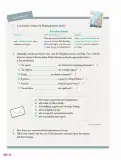
In communities, analyze the following grammar section: Adjective Clauses.

  1. Una adjective clause (cláusula adjetiva o relativa) modifica a un sustantivo o pronombre, igual que un adjetivo.
  2. Su estructura es: \text{noun} + \text{that/who/which} + \text{verb} + \text{complement or object}
  3. Se usa para dar más información sobre qué es algo, quién es alguien o de cuál estamos hablando.
  4. Ejemplo del libro: This project, which will help you understand the most effective strategies, must be completed in 5 days. Aquí which will help you understand the most effective strategies describe a project.
Respuesta

La cláusula adjetiva se coloca después del sustantivo y usa that / who / which según si el antecedente es cosa (that/which) o persona (who/that).

2
Ejercicio 2

Individually, read the sentences and relate them with the adjective clauses in the box by writing the appropriate letters in the parentheses.

  1. Identifico el antecedente de cada oración: sports, children, people, a person, a person, the activities.
  2. Eligo la cláusula cuyo significado y concordancia (singular/plural, persona/cosa) coincidan.
  3. Verifico la concordancia del verbo: sports es plural → require; children es plural → enjoy; people es plural → are; a person es singular → is.
i
Parte 2.i

I. The sports that require cooperation and communication are the best for developing teamwork. (a)

Respuesta

a

2
Ejercicio 2

II

II. The children who enjoy playing team sports are probably happy. (f)

Respuesta

f

Ad
2
Ejercicio 2

III

III. People who are good at communicating clearly are always in demand. (e)

Respuesta

e

2
Ejercicio 2

IV

IV. A person who is able to think critically is good at solving problems. (b)

Respuesta: b

v
Parte 2.v

V. A person who is outgoing and loyal would be a good friend. (d)

Respuesta

d

2
Ejercicio 2

VI

VI. The activities that challenge cognitive and strategic thinking are significant. (c)

Respuesta

c

Ad
3
Ejercicio 3

Now, share your answers with the classmate next to you.

Respuesta orientativa: Al comparar respuestas con un compañero se practica la pronunciación de las cláusulas relativas y se justifica la elección de who (personas) frente a that/which (cosas). También se detectan errores de concordancia verbal.

4
Ejercicio 4

Talk to your teacher and the rest of the classroom community about the answers and their meaning.

Respuesta orientativa: Discute con el grupo cómo las cláusulas adjetivas aportan información esencial o adicional sobre las personas y las actividades de una comunidad. Reflexiona sobre qué cualidades (cooperación, pensamiento crítico, comunicación) hacen fuerte a un equipo.

Contenido de la página

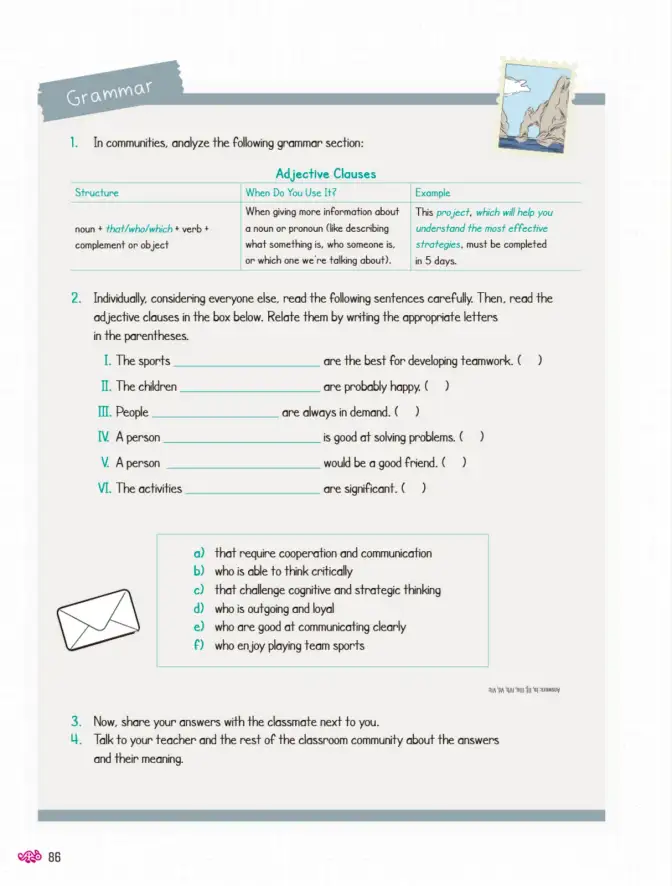
Grammar

1. In communities, analyze the following grammar section:

Adjective Clauses

Structure When Do You Use It? Example
noun + that/who/which + verb + complement or object When giving more information about a noun or pronoun (like describing what something is, who someone is, or which one we're talking about). This project, which will help you understand the most effective strategies, must be completed in 5 days.

2. Individually, considering everyone else, read the following sentences carefully. Then, read the adjective clauses in the box below. Relate them by writing the appropriate letters in the parentheses.

I. The sports ______________________ are the best for developing teamwork. ( )

II. The children ______________________ are probably happy. ( )

III. People ______________________ are always in demand. ( )

IV. A person ______________________ is good at solving problems. ( )

V. A person ______________________ would be a good friend. ( )

VI. The activities ______________________ are significant. ( )

Box:

a) that require cooperation and communication b) who is able to think critically c) that challenge cognitive and strategic thinking d) who is outgoing and loyal e) who are good at communicating clearly f) who enjoy playing team sports

3. Now, share your answers with the classmate next to you.

4. Talk to your teacher and the rest of the classroom community about the answers and their meaning.

Ejemplos resueltos

This project, which will help you understand the most effective strategies, must be completed in 5 days.

El antecedente es This project (cosa) → se usa which. La cláusula which will help you understand the most effective strategies da información adicional sobre el proyecto.

Tabla

Structure When Do You Use It? Example
noun + that/who/which + verb + complement or object When giving more information about a noun or pronoun (like describing what something is, who someone is, or which one we're talking about). This project, which will help you understand the most effective strategies, must be completed in 5 days.

Diagrama

graph LR
  A[Adjective Clause] --> B[that]
  A --> C[who]
  A --> D[which]
  B --> E[cosas y personas]
  C --> F[personas]
  D --> G[cosas]

Fórmulas y ecuaciones

\text{noun} + \text{that/who/which} + \text{verb} + \text{complement or object}

Glosario (6)

adjective clause
Cláusula que modifica a un sustantivo o pronombre y funciona como adjetivo.
relative pronoun
Pronombre relativo (that, who, which) que introduce una cláusula adjetiva.
teamwork
Trabajo en equipo.
outgoing
Extrovertido, sociable.
loyal
Leal, fiel.
cognitive
Cognitivo, relacionado con el pensamiento.

Preguntas para practicar

Why do we use 'who' instead of 'that' in some sentences?

Usamos *who* cuando el antecedente es una persona o un grupo de personas, como *children* o *people*. *That* puede usarse para personas y cosas, pero *who* es más específico y formal para personas.

What makes a good team according to the sentences?

Un buen equipo se forma con deportes que requieren cooperación y comunicación, con niños que disfrutan jugar en equipo y con personas que se comunican con claridad. Estas cualidades fortalecen la convivencia y el logro de metas comunes.

Temas y conceptos clave

GrammarAdjective ClausesRelative pronounsadjective clauserelative pronounthatwhowhichnouncomplementobject
¿Te fue útil esta página?

Figuras de la página (1)

Ilustración de un paisaje costero con acantilados y mar.
Figura 1 image

Preguntas que la gente también hace

¿Cuándo se usa who y cuándo that en una adjective clause?
Consulta la solución completa arriba o explora el libro entero para temas relacionados.
¿Cuál es la diferencia entre una cláusula adjetiva esencial y una no esencial?
Consulta la solución completa arriba o explora el libro entero para temas relacionados.
¿Cómo se forma una oración con relative clause en inglés?
Consulta la solución completa arriba o explora el libro entero para temas relacionados.
📌 Antes de leer esto
  • • Reconocer sustantivos y pronombres en inglés
  • • Conocer la concordancia sujeto-verbo (singular/plural)
  • • Diferenciar personas y cosas
Siguiente tema sugerido
Cláusulas adjetivas no esenciales (non-defining relative clauses) con comas
📝 Transcripción de la página (texto seleccionable) 1431 caracteres

Grammar

1. In communities, analyze the following grammar section:

2.1Individually, considering everyone else, read the following sentences carefully. Then, read the adjective clauses in the box below. Relate them by writing the appropriate letters in the parentheses.

I. The sports are the best for developing teamwork.( )

II. The children are probably happy.( )

Ⅲ. People are always in demand.( )

IV.A person is good at solving problems.()

V.A person would be a good friend.( )

VI. The activities are significant.( )

a)that require cooperation and communication b)who is able to think critically c)that challenge cognitive and strategic thinking d who is outgoing and loyal e)who are good at communicating clearly f)who en joy playing team sports

  1. Now, share your answers with the classmate next to you.

  2. Talk to your teacher and the rest of the classroom community about the answers and their meaning.

Adjective Clauses

StructureWhen Do You Use It?Example
noun +that/who/which+ verb + complement or objectWhen giving more information about a noun or pronoun (like describing what something is, who someone is, or which one we'ne talking about).This project, which wil help you understand the most effective strategies, must be completed in 5 days.

![](page=0,bbox=[99, 1059, 253, 1174])

正

86

Ad

Otros libros recomendados

Ver todos →
Ad

Usamos cookies propias y de terceros para personalizar contenido, mostrar publicidad y analizar el tráfico. Las cookies necesarias siempre están activas.