Modelos tridimensionales de las reacciones químicas
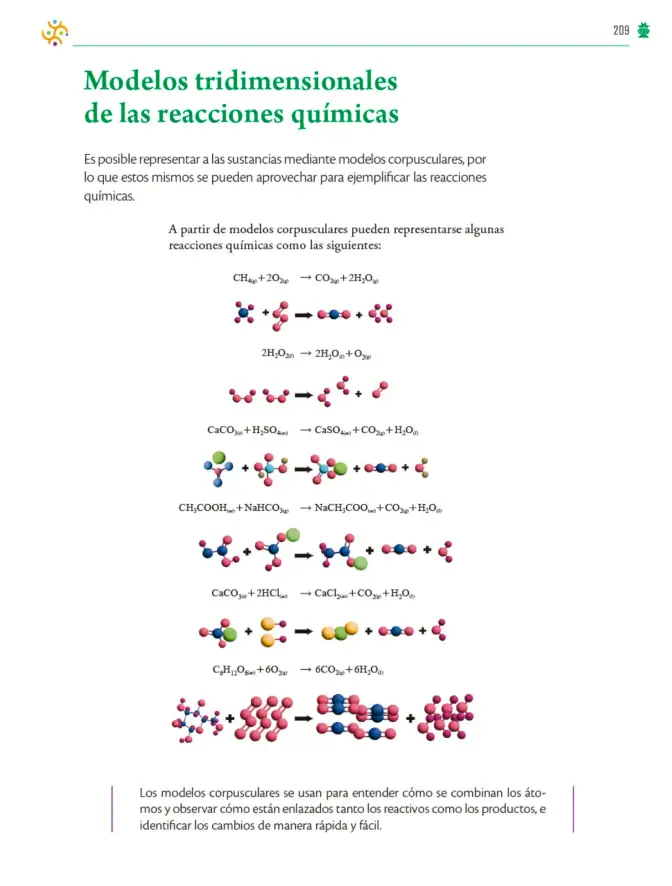
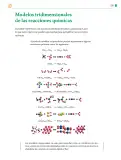
Es posible representar a las sustancias mediante modelos corpusculares, por lo que estos mismos se pueden aprovechar para ejemplificar las reacciones químicas.
A partir de modelos corpusculares pueden representarse algunas reacciones quimicas como las siguientes:
\mathrm{CH_{4(p)}+2O_{2(p)}\rightarrow CO_{2(p)}+2H_{2}O_{(p)}}
2\mathrm{H}_{2}\mathrm{O}_{2(t)}\rightarrow2\mathrm{H}_{2}\mathrm{O}_{(t)}+\mathrm{O}_{2(p)}
\mathrm{CaCO}_{3(\omega)}+\mathrm{H}_{2}\mathrm{SO}_{4(\omega)}\quad\rightarrow\mathrm{CaSO}_{4(\omega)}+\mathrm{CO}_{2(\varphi)}+\mathrm{H}_{2}\mathrm{O}_{(\varphi)}
\begin{array}{l}\mathrm{CH}_{3}\mathrm{COOH}_{(\alpha)}+\mathrm{NaHCO}_{3(\varphi)}\quad\rightarrow\mathrm{NaCH}_{3}\mathrm{COO}_{(\alpha)}+\mathrm{CO}_{2(\varphi)}+\mathrm{H}_{2}\mathrm{O}_{(\varphi)}\end{array}
\mathrm{CaCO}_{3(\omega)}+2\mathrm{HCl}_{(\omega)}\rightarrow\mathrm{CaCl}_{2(\omega)}+\mathrm{CO}_{2(\omega)}+\mathrm{H}_{2}\mathrm{O}_{(\omega)}
\mathrm{C_6H_{12}O_{6(a)}+6O_{2(p)}}\longrightarrow\mathrm{6CO_{2(p)}+6H_2O_{(t)}}
Los modelos corpusculares se usan para entender cómo se combinan los átomos y observar cómo están enlazados tanto los reactivos como los productos, e identificar los cambios de manera rápida y facil.
S
209敬