














Página — Uerakua Anapu Uantakua Projects And Readings 3 (pág. 61)
Solución no disponible aún
Esta página está en proceso de revisión.
Pídela y la resolveremos antes. Sin registro.
📝 Transcripción de la página (texto seleccionable) 1639 caracteres
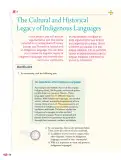
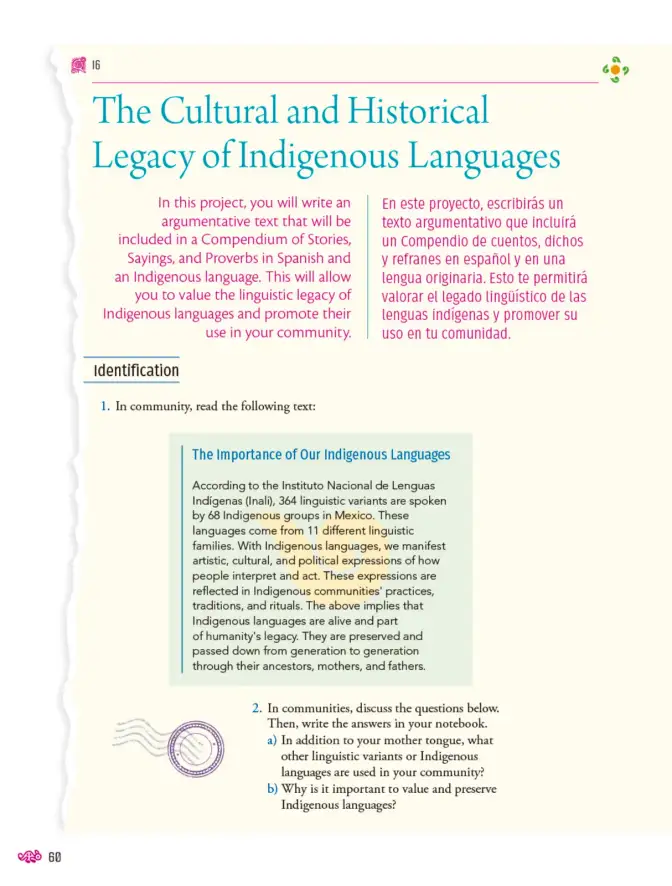
The Cultural and Historical Legacy of Indigenous Languages
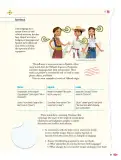
In this project, you will write an argumentative text that will be included in a Compendium of Stories,Sayings, and Proverbs in Spanish and an Indigenous language. This will allow you to value the linguistic legacy of Indigenous languages and promote their use in your community.
Identification
- In community, read the following text:
En este proyecto, escribirás un texto argumentativo que incluiráun Compendio de cuentos, dichos y refranes en español y en una lengua originaria. Esto te permitirávalorar el legado lingüístico de las lenguas indigenas y promover su uso en tu comunidad.
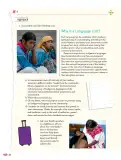
The Importance of Our Indigenous Languages
According to the Instituto Nacional de Lenguas Indígenas (Inali), 364 linguistic variants are spoken by 68 Indigenous groups in Mexico. These languages come from 11 different linguistic families. With Indigenous languages, we manifest artistic, cultural, and political expressions of how people interpret and act. These expressions are reflected in Indigenous communities'practices,traditions, and rituals. The above implies that Indigenous languages are alive and part of humanity's legacy. They are preserved and passed down from generation to generation through their ancestors, mothers, and fathers.
- In communities, discuss the questions below.Then, write the answers in your notebook.a) In addition to your mother tongue, what other linguistic variants or Indigenous languages are used in your community?b) Why is it important to value and preserve Indigenous languages?
16
,

A
60
Otros libros recomendados

Colección Nanahuatzin. De lo humano y lo comunitario. Libro de Educación Telesecundaria Grado 3° Ciclo Escolar 2025 - 2026
SEP/CONALITEG
259 págs.

Colección Nanahuatzin. Nuestro libro de Proyectos. Tomo II. Libro de Educación Telesecundaria Grado 3° Ciclo Escolar 2025 - 2026
SEP/CONALITEG
275 págs.

Colección Nanahuatzin. Saberes y pensamiento científico. Libro de Educación Telesecundaria Grado 3° Ciclo Escolar 2025 - 2026
SEP/CONALITEG
339 págs.

Colección Nanahuatzin. Nuestro libro de Proyectos. Tomo I. Libro de Educación Telesecundaria Grado 3° Ciclo Escolar 2025 - 2026
SEP/CONALITEG
299 págs.

Colección Nanahuatzin. Nuestro libro de Proyectos. Tomo III. Libro de Educación Telesecundaria Grado 3° Ciclo Escolar 2025 - 2026
SEP/CONALITEG
291 págs.

Colección Nanahuatzin. Múltiples lenguajes. Libro de Educación Telesecundaria Grado 3° Ciclo Escolar 2025 - 2026
SEP/CONALITEG
163 págs.

Uérakua anapu uantakua. Projects and Readings. Libro de Educación Telesecundaria Grado 2° Ciclo Escolar 2025 - 2026
SEP/CONALITEG
171 págs.

Uérakua anapu uantakua. Projects and Readings. Libro de Educación Telesecundaria Grado 1° Ciclo Escolar 2025 - 2026
SEP/CONALITEG
187 págs.