














Saltar al contenido
MisLibrosTexto
Ad

Comprehension and Production: Indigenous Language Compendium Project

📄 ejercicios ingles 🎓 otro · 3° TELESECUNDARIA México 🇲🇽 MX 🗣 Español
Página 67
67 de 187
Página 67 de Uérakua anapu uantakua. Projects and Readings.  Libro de Educación Telesecundaria Grado 3°  Ciclo Escolar 2025 - 2026
Anterior Página 67 / 187 Siguiente

Respuesta rápida

1.a Entrevistar a hablantes mayores. 1.b Registrar traducciones en tabla. 1.c Investigar la lengua local, definir campos semánticos y verificar fuentes. 2. Redactar texto argumentativo bilingüe para el compendio.

📚 exercise ingles ⭐⭐ Dificultad 2/5 ⏱ 6 min lectura

Solución — Página 67

Uérakua anapu uantakua. Projects and Readings. Libro de Educación Telesecundaria Grado 3° Ciclo Escolar 2025 - 2026

1
Ejercicio 1

In communities, and with the help of your teacher, search for possible sources of information that will help you carry out your strategy.

a
Parte 1.a

Talk to the older adults who still speak the Indigenous language.

Respuesta orientativa: Entrevista a los adultos mayores de la comunidad que aún hablan la lengua indígena. Prepara preguntas sencillas sobre palabras cotidianas, su significado y su uso; pide permiso para grabar o anotar y agradece su tiempo. Esta fuente oral es la más valiosa porque conserva la pronunciación y el sentido cultural.

b
Parte 1.b

Search in books, magazines, or online for the translation of names of objects that you ordinarily use, from the mother tongue into Spanish.

Respuesta orientativa: Busca diccionarios, vocabularios, revistas o sitios confiables (INPI, INALI, universidades) que traduzcan al español los nombres de objetos de uso diario: alimentos, utensilios, plantas, animales y prendas. Registra cada palabra en una tabla con tres columnas: palabra en lengua indígena, traducción al español y ejemplo de uso.

c
Parte 1.c

Now it's time to follow these steps:

  1. Investiga qué lengua indígena se habla en tu localidad o región, su trayectoria histórica y cultural, y la importancia de hablarla para promover su uso y preservación.
  2. Para desarrollar el Compendium of Stories, Sayings, and Proverbs, define los campos semánticos que incorporarás: las palabras cuyo significado y traducción buscarás. Después, en comunidad, comparte y reconoce las palabras que investigaste.
  3. Si elaboras un compendio de relatos en español y en la lengua indígena, busca los textos que incluirás en ambos idiomas. Es importante verificar que la fuente de la que los obtengas sea confiable.

Respuesta orientativa: Elige campos semánticos claros (familia, comida, naturaleza, oficios, festividades). Para cada palabra anota su significado, su traducción y una oración de ejemplo. Al compartir en comunidad, compara variantes dialectales y valora el conocimiento de los hablantes nativos. Verifica siempre la fuente: diccionarios oficiales, hablantes reconocidos o publicaciones académicas.


2
Ejercicio 2

Organize the information gathered and write the argumentative text documenting the reasons for promoting the use and preservation of an Indigenous language and its historical and cultural path.

Respuesta orientativa: Redacta un texto argumentativo con esta estructura: introducción (presenta la lengua indígena de tu región y su situación actual), desarrollo (tres razones: identidad cultural, transmisión de saberes y derecho lingüístico; apóyalas con datos de tu investigación) y conclusión (llamado a usarla y preservarla). Usa conectores como first, moreover, therefore y cierra recordando que el texto se integrará al Compendium of Stories, Sayings, and Proverbs.

Respuesta

Proyecto completado: investigación de fuentes orales y escritas, definición de campos semánticos y redacción de un texto argumentativo bilingüe sobre la preservación de la lengua indígena.

Contenido de la página

Comprehension and Production

  1. In communities, and with the help of your teacher, search for possible sources of information that will help you carry out your strategy.

    a) Talk to the older adults who still speak the Indigenous language.

    b) Search in books, magazines, or online for the translation of names of objects that you ordinarily use, from the mother tongue into Spanish.

    c) Now it's time to follow these steps:

    • Investigate which Indigenous language is spoken in the locality or region where you live, its historical and cultural path, and the importance of saying it to promote its use and preservation.
    • To develop the Compendium of Stories, Sayings, and Proverbs, determine the semantic fields you will incorporate: The words whose meaning and translation you'll seek. Then, in community, share and recognize the words you looked up.
    • If you develop a compendium of stories in Spanish and the Indigenous language, search for the texts you will include in the two languages. It is important to verify that the source you got them from is reliable.
  2. Organize the information gathered and write the argumentative text documenting the reasons for promoting the use and preservation of an Indigenous language and its historical and cultural path.

While writing it, remember that your text will be integrated into the Compendium of Stories, Sayings, and Proverbs.

Tabla

Palabra en lengua indígena Traducción al español Ejemplo de uso
(registro del estudiante) (significado) (oración)

Diagrama

flowchart TD
  A[Proyecto: Compendio bilingüe] --> B[Fuentes de información]
  B --> B1[Adultos mayores hablantes]
  B --> B2[Libros, revistas y sitios confiables]
  A --> C[Campos semánticos]
  C --> C1[Familia]
  C --> C2[Comida]
  C --> C3[Naturaleza]
  A --> D[Texto argumentativo]
  D --> D1[Introducción]
  D --> D2[Desarrollo: 3 razones]
  D --> D3[Conclusión]

Glosario (6)

Indigenous language
Lengua originaria hablada por un pueblo indígena antes de la llegada de otras lenguas dominantes.
Mother tongue
Lengua materna; primera lengua que una persona aprende en su comunidad.
Semantic field
Conjunto de palabras relacionadas por compartir un mismo ámbito de significado.
Compendium
Compilación ordenada de relatos, dichos y refranes en una o varias lenguas.
Argumentative text
Texto que presenta una tesis y la defiende con razones y evidencias.
Reliable source
Fuente confiable, verificable y con respaldo académico o comunitario.

Preguntas para practicar

Why is it important to preserve Indigenous languages?

Because they carry the history, knowledge and identity of a community. Losing a language means losing ways of understanding the world, traditional medicine, stories and values. Preserving them guarantees cultural diversity and the right of peoples to express themselves in their own tongue.

How can young people promote the use of an Indigenous language in their community?

By speaking it at home and at school, creating bilingual materials, recording elders' stories, using it on social media and organizing cultural events. Small daily actions keep the language alive and make it visible to new generations.

Temas y conceptos clave

Investigación comunitaria sobre la lengua indígena localRecopilación de vocabulario y campos semánticosRedacción de un texto argumentativo bilingüeLengua indígenaCampos semánticosTexto argumentativoCompendio de relatos, dichos y refranesFuentes confiablesPreservación cultural

Fuentes y referencias

  • INALI (Instituto Nacional de Lenguas Indígenas)
  • INPI (Instituto Nacional de los Pueblos Indígenas)
  • Diccionarios y vocabularios bilingües de lenguas indígenas
¿Te fue útil esta página?

Figuras de la página (2)

Ilustración de un boleto o ticket de autobús con líneas punteadas y el dibujo de un autobús.
Figura 1 image
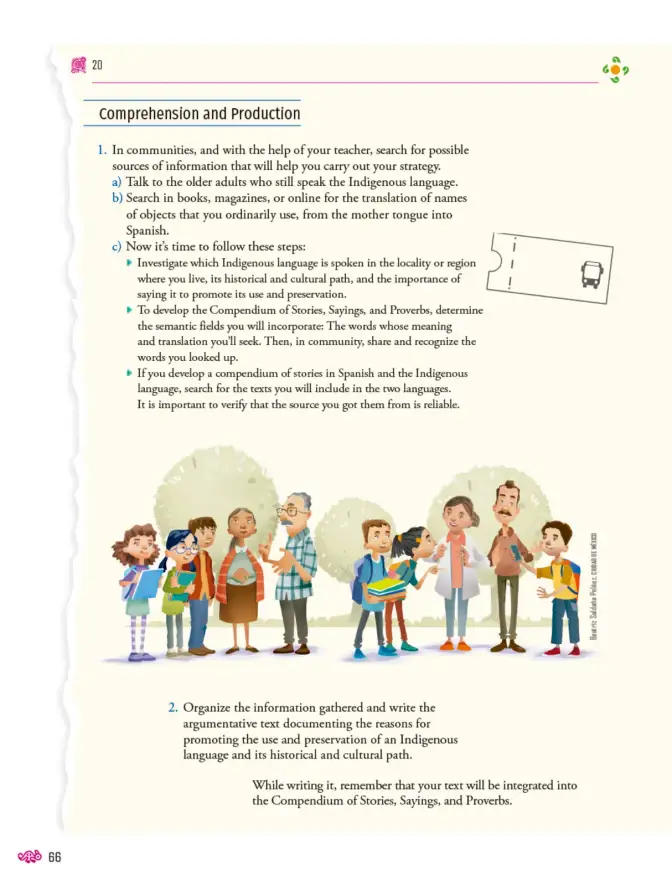
Ilustración de un grupo de estudiantes y adultos mayores conversando al aire libre, representando el diálogo intergeneracional para rescatar la lengua indígena.
Figura 2 image

Preguntas que la gente también hace

¿Cómo se elabora un texto argumentativo sobre la preservación de una lengua indígena?
Consulta la solución completa arriba o explora el libro entero para temas relacionados.
¿Qué son los campos semánticos y cómo se aplican en un compendio bilingüe?
Consulta la solución completa arriba o explora el libro entero para temas relacionados.
¿Qué fuentes confiables existen para traducir palabras de lenguas indígenas al español?
Consulta la solución completa arriba o explora el libro entero para temas relacionados.
📌 Antes de leer esto
  • • Identificar la estructura de un texto argumentativo
  • • Reconocer la lengua indígena hablada en su región
  • • Manejar vocabulario básico en inglés sobre investigación y cultura
Siguiente tema sugerido
Redacción y edición final del compendio bilingüe de relatos, dichos y refranes
📝 Transcripción de la página (texto seleccionable) 1471 caracteres

Comprehension and Production

  1. In communities, and with the help of your teacher, search for possible sources of information that will help you carry out your strategy.a) Talk to the older adults who still speak the Indigenous language.

b) Search in books, magazines, or online for the translation of names of objects that you ordinarily use, from the mother tongue into Spanish.

c) Now it's time to follow these steps:

Investigate which Indigenous language is spoken in the locality or region where you live, its historical and cultural path, and the importance of saying it to promote its use and preservation.

To develop the Compendium of Stories, Sayings, and Proverbs, determine the semantic fields you will incorporate: The words whose meaning and translation you'll seek. Then, in community, share and recognize the words you looked up.

If you develop a compendium of stories in Spanish and the Indigenous language, search for the texts you will include in the two languages.It is important to verify that the source you got them from is reliable.

  1. Organize the information gathered and write the argumentative text documenting the reasons for promoting the use and preservation of an Indigenous language and its historical and cultural path.

While writing it, remember that your text will be integrated into the Compendium of Stories, Sayings, and Proverbs.

20

![](page=0,bbox=[875, 417, 1105, 548])

![](page=0,bbox=[193, 800, 1078, 1192])

乐

66

Ad

Otros libros recomendados

Ver todos →
Ad

Usamos cookies propias y de terceros para personalizar contenido, mostrar publicidad y analizar el tráfico. Las cookies necesarias siempre están activas.