
















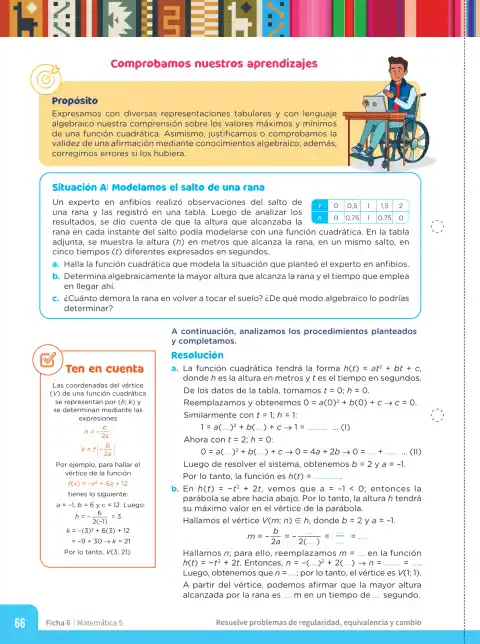
Un experto en anfibios realizó observaciones del salto de una rana y las registró en una tabla. La altura (h) en metros que alcanza la rana en cinco tiempos (t) diferentes en segundos es la siguiente:
| t (s) | h (m) |
|---|---|
| 0 | 0 |
| 0.5 | 0.75 |
| 1 | 1 |
| 1.5 | 0.75 |
| 2 | 0 |
Halla la función cuadrática
La función cuadrática tendrá la forma h(t) = at^2 + bt + c, donde h es la altura en metros y t es el tiempo en segundos. Tomamos los datos de la tabla:
Para t = 0, h = 0: 0 = a(0)^2 + b(0) + c \Rightarrow c = 0
Para t = 1, h = 1: 1 = a(1)^2 + b(1) + 0 \Rightarrow 1 = a + b \quad (1)
Para t = 2, h = 0: 0 = a(2)^2 + b(2) + 0 \Rightarrow 0 = 4a + 2b \Rightarrow 0 = 2a + b \quad (2)
Ahora resolvemos el sistema de ecuaciones (1) y (2):
De (1): b = 1 - a.
Sustituyendo en (2): 0 = 2a + (1 - a) \Rightarrow 0 = 2a + 1 - a \Rightarrow 0 = a + 1 \Rightarrow a = -1
Sustituyendo a en (1): 1 = -1 + b \Rightarrow b = 2
Por lo tanto, la función es: h(t) = -t^2 + 2t
Determina la mayor altura y el tiempo
Para encontrar la altura máxima, hallamos el vértice de la parábola:
h = -\frac{b}{2a} = -\frac{2}{2(-1)} = 1
Sustituyendo t = 1 en la función: h(1) = -1^2 + 2(1) = -1 + 2 = 1
Por lo tanto, la mayor altura alcanzada por la rana es 1 m en un tiempo de 1 segundo.
¿Cuánto demora la rana en volver a tocar el suelo?
La rana vuelve a tocar el suelo cuando h(t) = 0: 0 = -t^2 + 2t \Rightarrow t(t - 2) = 0
Esto implica que t = 0 o t = 2. Por lo tanto, la rana demora 2 segundos en volver a tocar el suelo.