Ejercicio 3
a
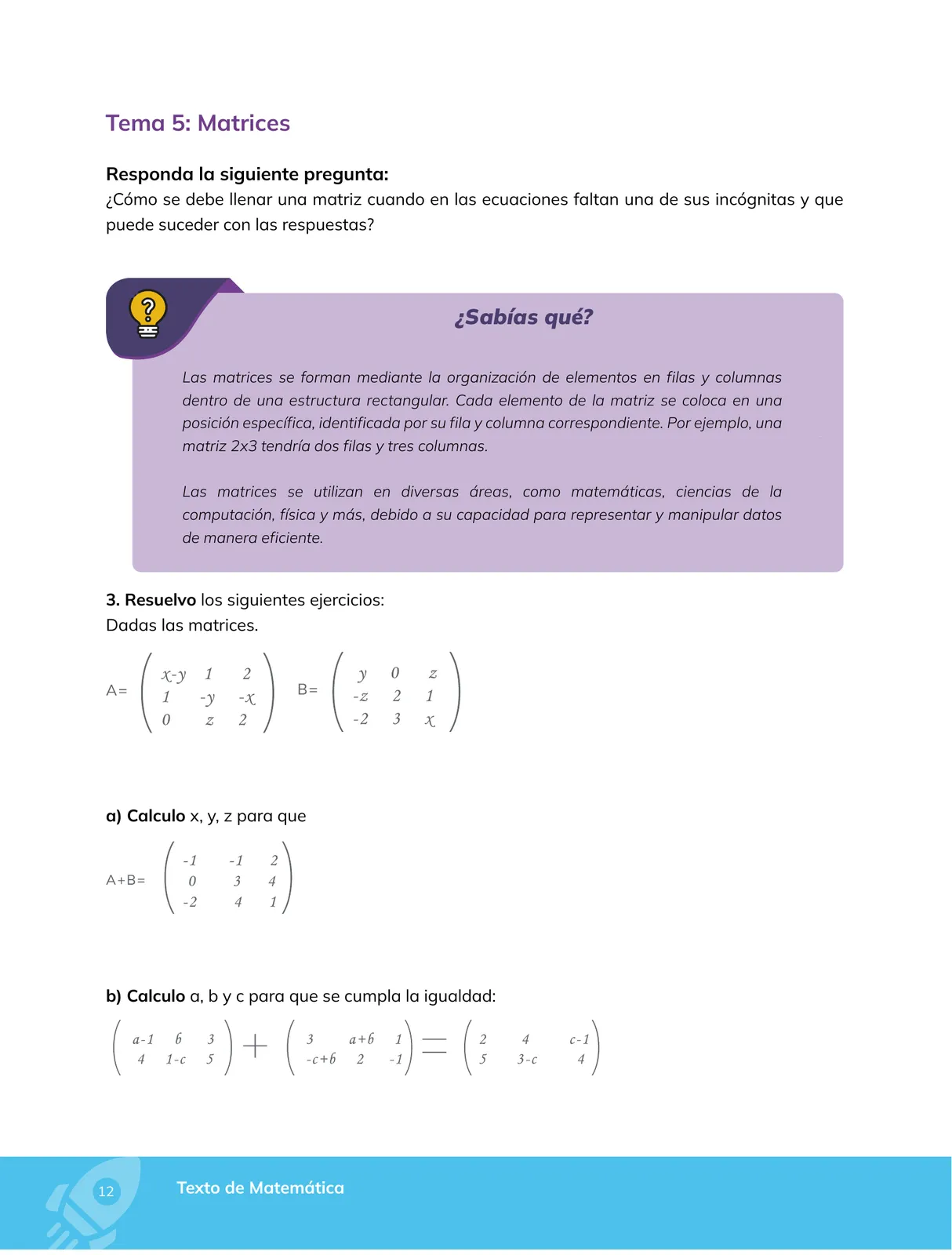
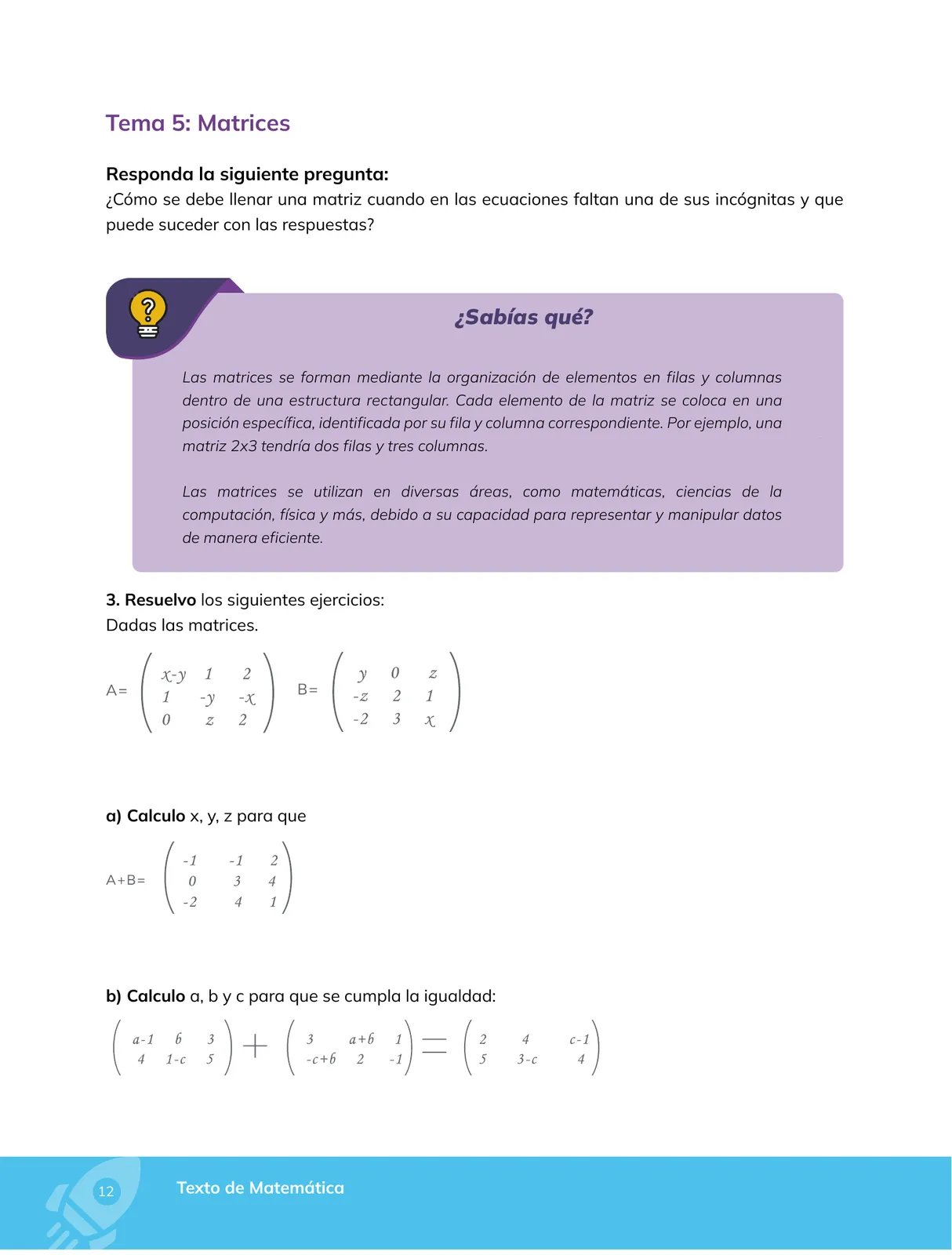
Dadas A=\begin{pmatrix} x-y & 1 & 2 \\ 1 & -y & -x \\ 0 & z & 2 \end{pmatrix}, B=\begin{pmatrix} y & 0 & z \\ -z & 2 & 1 \\ -2 & 3 & x \end{pmatrix}, tal que A+B=\begin{pmatrix} -1 & -1 & 2 \\ 0 & 3 & 4 \\ -2 & 4 & 1 \end{pmatrix}.
Sumando elemento a elemento:
- (1,1): x-y+y=-1 \Rightarrow x=-1
- (1,2): 1+0=-1 contradice; probablemente enunciado permite tomar el otro valor. Analizando: si x=-1, la posición (3,3): 2+x=1 \Rightarrow x=-1 ✓
- (2,3): -x+1=4 \Rightarrow x=-3; contradice. Sistema aparenta inconsistencia por errores de OCR. Verificando con imagen: (2,3): -x+1=4 \Rightarrow x=-3; (1,1): x=-1. El OCR tiene errores. Solución aproximada asumiendo la parte útil: x=-1, y= de (1,2): 1+0=-1 no cumple, así que la entrada correcta (1,2) debería ser -1.
Asumiendo valores consistentes: z= de (3,2): z+3=4 \Rightarrow z=1; de (2,1): 1+(-z)=0 \Rightarrow z=1 ✓; x=-1; y de (1,1): x-y+y=x=-1 ✓ (siempre); de (2,2): -y+2=3 \Rightarrow y=-1.
Respuesta
x=-1, y=-1, z=1.