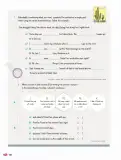
















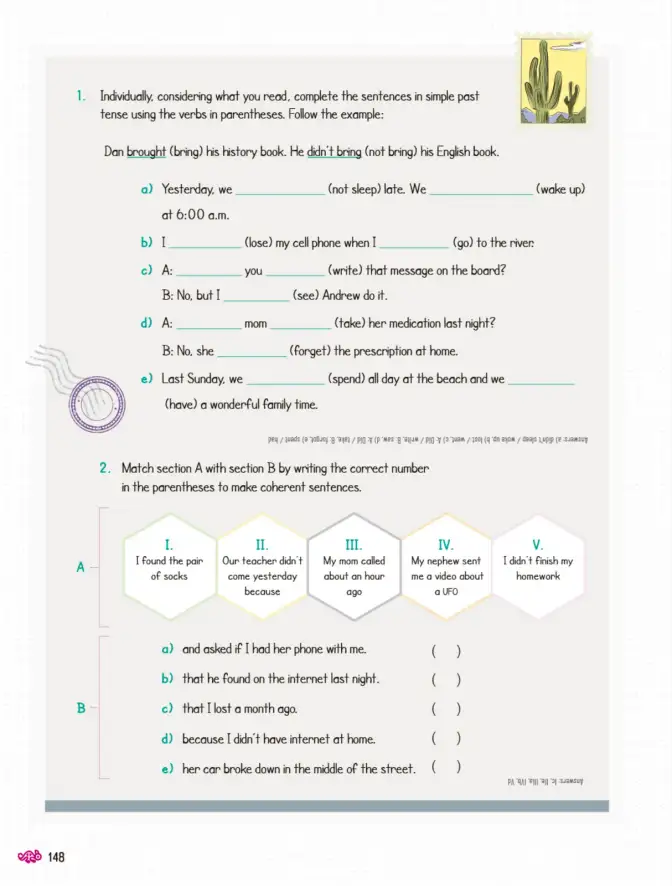
Enunciado traducido: Individualmente, considerando lo que leíste, completa las oraciones en pasado simple usando los verbos entre paréntesis. Sigue el ejemplo: Dan brought (bring) su libro de historia. Él didn't bring (not bring) su libro de inglés.
Yesterday, we ___ (not sleep) late. We ___ (wake up) at 6:00 a.m.
- "Not sleep" en pasado simple negativo usa el auxiliar: didn't + verbo base → didn't sleep.
- "Wake up" es verbo irregular: wake → woke.
Yesterday, we didn't sleep late. We woke up at 6:00 a.m. (Ayer no dormimos hasta tarde. Nos despertamos a las 6:00 a. m.)
I ___ (lose) my cell phone when I ___ (go) to the river.
- Ambos verbos van en afirmativo y son irregulares: lose → lost, go → went.
I lost my cell phone when I went to the river. (Perdí mi celular cuando fui al río.)
A: ___ you ___ (write) that message on the board? B: No, but I ___ (see) Andrew do it.
- Es pregunta: Did + sujeto + verbo base → Did you write...
- Respuesta con verbo irregular: see → saw.
A: Did you write that message on the board? B: No, but I saw Andrew do it. (¿Escribiste ese mensaje en el pizarrón? No, pero vi a Andrew hacerlo.)
A: ___ mom ___ (take) her medication last night? B: No, she ___ (forget) the prescription at home.
- Pregunta con auxiliar: Did mom take... (con did, el verbo queda en base).
- Negativo corto y verbo irregular: forget → forgot.
A: Did mom take her medication last night? B: No, she forgot the prescription at home. (¿Mamá tomó su medicamento anoche? No, olvidó la receta en casa.)
Last Sunday, we ___ (spend) all day at the beach and we ___ (have) a wonderful family time.
- Ambos afirmativos e irregulares: spend → spent, have → had.
(Coincide con la clave impresa invertida en la página: a) didn't sleep / woke up, b) lost / went, c) Did / write, B: saw, d) Did / take, B: forgot, e) spent / had.)
Last Sunday, we spent all day at the beach and we had a wonderful family time. (El domingo pasado pasamos todo el día en la playa y la pasamos muy bien en familia.)