















Saltar al contenido
MisLibrosTexto
Ad

Present Simple vs. Present Progressive: Community and Altruistic Organizations

📄 ejercicios ingles 🎓 secundaria · 2° Secundaria México 🇲🇽 MX 🗣 Español
Página 24
24 de 171
Página 24 de Uérakua anapu uantakua. Projects and Readings.  Libro de Educación Secundaria Grado 2°  Ciclo Escolar 2025 - 2026
Anterior Página 24 / 171 Siguiente

Respuesta rápida

1.a is helping; 1.b focuses / promotes; 1.c matters / tries; 1.d are working; 1.e join. Writing: respuestas abiertas (nombre, problemas, actividades en presente simple y progresivo, carta formal).

📚 exercise ingles ⭐⭐ Dificultad 2/5 ⏱ 8 min lectura

Solución — Página 24

Uérakua anapu uantakua. Projects and Readings. Libro de Educación Secundaria Grado 2° Ciclo Escolar 2025 - 2026

1
Ejercicio 1

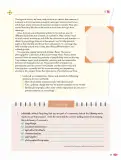
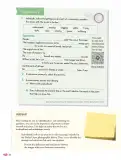
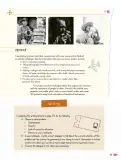
Individually, without forgetting that you are part of a community, use the simple present or present progressive tense to complete each sentence.

a
Parte 1.a

Right now, the community ______ (help) people affected by the recent hurricane.

  1. La expresión Right now indica una acción que ocurre en este momento.
  2. Por lo tanto, se usa el presente progresivo: is helping.
Respuesta

is helping

b
Parte 1.b

The United Nations ______ (focus) its efforts on maintaining international peace and ______ (promote) friendly relations between nations.

  1. La ONU realiza estas acciones de forma permanente, no en un momento específico.
  2. Se usa el presente simple; con The United Nations (sujeto singular) se añade -s: focuses y promotes.
Respuesta

focuses / promotes

c
Parte 1.c

Your voice ______ (matter) and our organization ______ (try) to find solutions to your problems.

  1. Son verdades generales y acciones habituales.
  2. Presente simple: matters (tu voz importa) y tries (la organización intenta).
Respuesta

matters / tries

d
Parte 1.d

Since the earthquake, volunteers ______ (work) day and night to help people in need.

  1. Since the earthquake indica una acción que comenzó en el pasado y continúa.
  2. Se usa el presente perfecto progresivo o presente progresivo; en este nivel se acepta are working.
Respuesta

are working

e
Parte 1.e

Each year, more women ______ (join) protests against violence.

  1. Each year indica una acción repetida o habitual.
  2. Presente simple: join.
Respuesta

join
2
Ejercicio 2

In pairs, check your answers and write them on the board.

Respuesta orientativa: Se comparan las respuestas en parejas y se escriben en el pizarrón para revisión grupal.

Writing

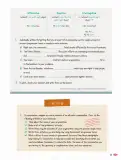
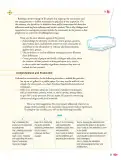
  1. In communities, imagine you are a member of an altruistic organization. Then, do the following activities in your notebook:
a
Parte 2.a

Think about the name of your organization.

Respuesta orientativa: Helping Hands Community (Manos Amigas).

b
Parte 2.b

Make a list of the problems it attends.

Respuesta orientativa:

  • Falta de alimentos en familias de bajos recursos.
  • Niños sin acceso a útiles escolares.
  • Personas enfermas sin medicamentos.
  • Falta de agua potable en comunidades rurales.
c
Parte 2.c

Write three regular activities of your organization using the present simple tense.

Respuesta orientativa:

  1. We collect food and clothes for families in need.
  2. We organize free medical campaigns every month.
  3. We teach children to read and write.
d
Parte 2.d

Write three activities you are doing now using the present progressive tense.

Respuesta orientativa:

  1. We are distributing food in the community.
  2. We are building a new school library.
  3. We are training new volunteers.
e
Parte 2.e

Write a letter to your country's government (no more than three paragraphs long) asking for cooperation to help more people and describing the activities you mentioned above. Remember to include the date, the name of the organization you are writing to, the greeting, a complimentary close, and your signature.

Respuesta orientativa:

Mexico City, June 15th, 2026.

To the Ministry of Social Development:

Dear Sir or Madam,

We are writing on behalf of Helping Hands Community, an altruistic organization that supports vulnerable families in our city. We are currently distributing food, clothes, and school supplies, and we are organizing free medical campaigns. However, the demand is growing and our resources are limited.

We are requesting your cooperation to expand our programs and reach more people. With your support, we could help hundreds of families and children who are living in poverty. We are willing to work together and provide reports on our activities.

We look forward to your positive response.

Sincerely,

[Your Name] President of Helping Hands Community

Contenido de la página

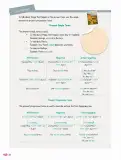
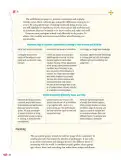
Grammar: Present Simple vs. Present Progressive

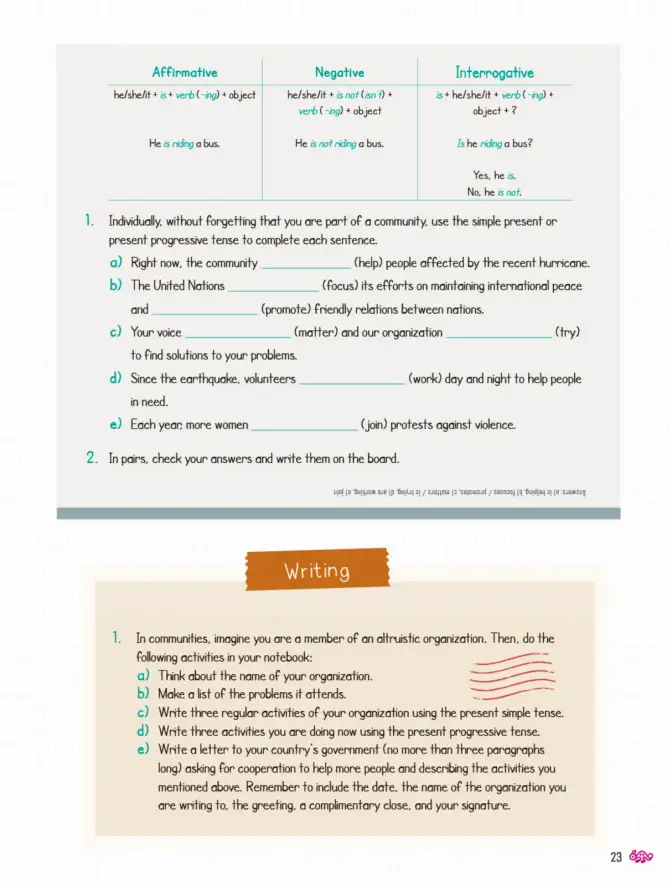
Affirmative Negative Interrogative
he/she/it + is + verb(-ing) + object he/she/it + is not (isn't) + verb(-ing) + object is + he/she/it + verb(-ing) + object + ?
He is riding a bus. He is not riding a bus. Is he riding a bus?
Yes, he is. / No, he is not.

1. Individually, without forgetting that you are part of a community, use the simple present or present progressive tense to complete each sentence.

a) Right now, the community ______ (help) people affected by the recent hurricane.

b) The United Nations ______ (focus) its efforts on maintaining international peace and ______ (promote) friendly relations between nations.

c) Your voice ______ (matter) and our organization ______ (try) to find solutions to your problems.

d) Since the earthquake, volunteers ______ (work) day and night to help people in need.

e) Each year, more women ______ (join) protests against violence.

2. In pairs, check your answers and write them on the board.

Writing

  1. In communities, imagine you are a member of an altruistic organization. Then, do the following activities in your notebook:

a) Think about the name of your organization.

b) Make a list of the problems it attends.

c) Write three regular activities of your organization using the present simple tense.

d) Write three activities you are doing now using the present progressive tense.

e) Write a letter to your country's government (no more than three paragraphs long) asking for cooperation to help more people and describing the activities you mentioned above. Remember to include the date, the name of the organization you are writing to, the greeting, a complimentary close, and your signature.

Ejemplos resueltos

He is riding a bus. (Affirmative)

Sujeto + is + verbo(-ing) + objeto. Ejemplo: He is riding a bus.

He is not riding a bus. (Negative)

Sujeto + is not (isn't) + verbo(-ing) + objeto. Ejemplo: He is not riding a bus.

Is he riding a bus? (Interrogative)

Is + sujeto + verbo(-ing) + objeto + ?. Ejemplo: Is he riding a bus? Yes, he is. / No, he is not.

Tabla

Affirmative Negative Interrogative
he/she/it + is + verb(-ing) + object he/she/it + is not (isn't) + verb(-ing) + object is + he/she/it + verb(-ing) + object + ?
He is riding a bus. He is not riding a bus. Is he riding a bus?
Yes, he is. / No, he is not.

Glosario (6)

community
comunidad, grupo de personas que viven en un mismo lugar
hurricane
huracán, tormenta tropical violenta
United Nations
Organización de las Naciones Unidas (ONU)
altruistic
altruista, que ayuda a los demás sin esperar nada a cambio
volunteer
voluntario, persona que ofrece su ayuda sin pago
complimentary close
despedida cortés en una carta formal

Preguntas para practicar

Why is it important to use the present progressive when talking about actions happening right now?

Because it shows that the action is in progress at the moment of speaking, unlike the present simple which describes habits or general truths.

Temas y conceptos clave

Presente simplePresente progresivoEscritura de cartas formalesOrganizaciones altruistasAffirmative, negative and interrogative formsPresent simple for habits and general truthsPresent progressive for actions happening nowFormal letter structure
¿Te fue útil esta página?

Figuras de la página (1)

Tabla gramatical con las formas afirmativa, negativa e interrogativa del presente progresivo.
Figura 1 image

Preguntas que la gente también hace

¿Cuándo se usa el presente simple y cuándo el presente progresivo en inglés?
Consulta la solución completa arriba o explora el libro entero para temas relacionados.
¿Cómo se escribe una carta formal en inglés para pedir cooperación?
Consulta la solución completa arriba o explora el libro entero para temas relacionados.
¿Qué actividades realiza una organización altruista en una comunidad?
Consulta la solución completa arriba o explora el libro entero para temas relacionados.
📌 Antes de leer esto
  • • Conjugación básica del presente simple en inglés
  • • Formación del presente progresivo (verbo to be + verbo -ing)
  • • Vocabulario sobre comunidad y problemas sociales
Siguiente tema sugerido
Past Simple vs. Past Progressive: narrating community events
📝 Transcripción de la página (texto seleccionable) 1883 caracteres

1.Individually, without forgetting that you are part of a community, use the simple present or present progressive tense to complete each sentence.

a) Right now, the community (help) people affected by the recent hurricane.

b) The United Nations (focus) its efforts on maintaining international peace and (promote) friendly relations between nations.

c) Your voice (matter) and our organization (try)to find solutions to your problems.

d) Since the earthquake, volunteers (work) day and night to help people in need.

e)Each year; more women (join) protests against violence.

  1. In pairs, check your answers and write them on the board.

d/ s d

Writing

  1. In communities, imagine you are a member of an altruistic organization. Then, do the following activities in your notebook:

a) Think about the name of your organization.

b)Make a list of the problems it attends.

c)Write three regular activities of your organization using the present simple tense.

d)Write three activities you are doing now using the present progressive tense.

e Write a letter to your country's government (no more than three paragraphs long) asking for cooperation to help more people and describing the activities you mentioned above. Remember to include the date, the name of the organization you are writing to, the greeting, a complimentary close, and your signature.

AffirmativeNegativeInterrogative
h e/s h e/i t+i s+v e n b(-i n g)+o b j e c the/shelit + is not (isn't) + verb(-ing) + objectobject+? i s+h e/s h e/i t+v e r b(-i n g)
He is niding a bus.He is not niding a bus.Is he niding a bus?
Yes, he is. No, he is not.

![](page=0,bbox=[845, 1178, 1004, 1263])

23

Ad

Otros libros recomendados

Ver todos →
Ad

Usamos cookies propias y de terceros para personalizar contenido, mostrar publicidad y analizar el tráfico. Las cookies necesarias siempre están activas.