Saltar al contenido
MisLibrosTexto
Ad

Planning: Portraiture Project and Artistic Interaction with Body, Space, and Time

📄 teoria otro 🎓 secundaria · 2° Secundaria México 🇲🇽 MX 🗣 Español
Página 27
27 de 171
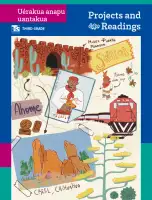
Página 27 de Uérakua anapu uantakua. Projects and Readings.  Libro de Educación Secundaria Grado 2°  Ciclo Escolar 2025 - 2026
Anterior Página 27 / 171 Siguiente

Respuesta rápida

  1. Promover empatía y conexión entre diferencias sociales, étnicas, culturales, de edad y género. 2. Investigar técnicas locales, analizar historias de vida y aplicar tecnología. 3. Cuerpo: expresiones dinámicas; espacio: exhibiciones y sonidos; tiempo: conexión entre épocas. 4. Construir una imagen comunitaria respetando la identidad y promoviendo el diálogo.
📚 theory otro ⭐⭐ Dificultad 2/5 ⏱ 5 min lectura

Solución — Página 27

Uérakua anapu uantakua. Projects and Readings. Libro de Educación Secundaria Grado 2° Ciclo Escolar 2025 - 2026

1
Ejercicio 1

Traduce al español el propósito de la exhibición y explica con tus palabras qué se busca lograr.

  1. El texto dice: "The exhibition's purpose is to promote connections and empathy towards social, ethnic, cultural, age, and gender differences existing in our society."
  2. Traducción: "El propósito de la exhibición es promover conexiones y empatía hacia las diferencias sociales, étnicas, culturales, de edad y de género que existen en nuestra sociedad."
  3. Además, se busca resaltar la importancia de la cultura y tradiciones locales mediante formas especiales de hacer cosas tradicionales, usando ideas y materiales innovadores.
Respuesta

La exhibición busca fomentar empatía y conexión entre personas diversas, valorando la cultura local y usando la creatividad para crear obras significativas.

2
Ejercicio 2

Completa el cuadro comparativo de los pasos propuestos para organizar comunidades según intereses y habilidades.

  1. El texto presenta tres columnas: "Recall and Retrieve Information", "Understand and Analyze Information" y "Use, Design, and Apply Your Knowledge".
  2. En la primera, se propone investigar técnicas artesanales características de la región para crear retratos.
  3. En la segunda, se sugiere recolectar y analizar la historia local para identificar personas a retratar, considerando a quienes sufren discriminación o violencia, o a quienes inspiran admiración.
  4. En la tercera, se plantea experimentar con tecnología para crear y exhibir los retratos.
Respuesta

El cuadro comparativo se completa con las ideas de investigar técnicas locales, analizar historias de vida y aplicar tecnología para la creación y exhibición.

3
Ejercicio 3

Explica cómo se puede interactuar artísticamente con el cuerpo, el espacio y el tiempo en un proyecto de retrato.

  1. Con el cuerpo: los retratos representan personas con características y expresiones únicas, y se pueden usar imágenes en movimiento (correr, saltar, bailar) para dar dinamismo.
  2. Con el espacio: el retrato puede ser parte de una exhibición o acompañarse de danza o paisaje sonoro, transformando el espacio de formas nuevas.
  3. Con el tiempo: al mostrar retratos de personas diversas, se crea un diálogo y conexión entre diferentes épocas, dando un continuum temporal a la obra.
Respuesta

Se interactúa con el cuerpo mediante expresiones dinámicas, con el espacio a través de exhibiciones y sonidos, y con el tiempo creando conexiones entre distintas generaciones y culturas.

Ad
4
Ejercicio 4

¿Qué busca el proyecto de retrato según la sección "Planning"?

  1. El texto indica: "The portraiture project intends to build an image of the community by creating portraits that respect the identity of participants."
  2. También busca promover conexiones y diálogo entre diferentes formas de interactuar con el mundo.
  3. Considera género, grupo étnico, edad, cultura, vestimenta y todo lo que hace únicas y diversas a las personas.
Respuesta

El proyecto busca construir una imagen de la comunidad respetando la identidad de los participantes y promoviendo el diálogo entre diversidades.

Contenido de la página

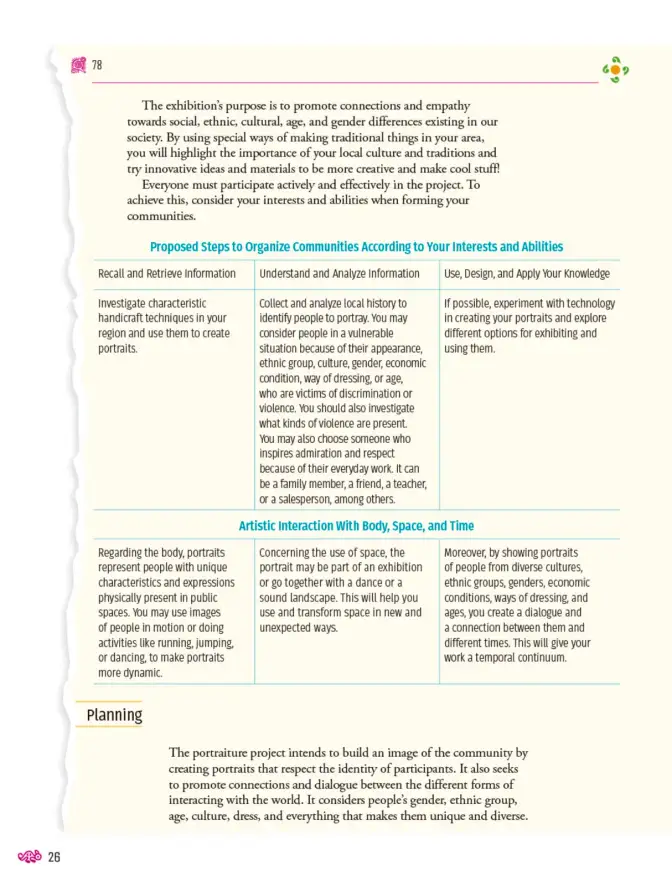
The exhibition's purpose is to promote connections and empathy towards social, ethnic, cultural, age, and gender differences existing in our society. By using special ways of making traditional things in your area, you will highlight the importance of your local culture and traditions and try innovative ideas and materials to be more creative and make cool stuff!

Everyone must participate actively and effectively in the project. To achieve this, consider your interests and abilities when forming your communities.

Proposed Steps to Organize Communities According to Your Interests and Abilities

Recall and Retrieve Information Understand and Analyze Information Use, Design, and Apply Your Knowledge
Investigate characteristic handicraft techniques in your region and use them to create portraits. Collect and analyze local history to identify people to portray. You may consider people in a vulnerable situation because of their appearance, ethnic group, culture, gender, economic condition, way of dressing, or age, who are victims of discrimination or violence. You should also investigate what kinds of violence are present. You may also choose someone who inspires admiration and respect because of their everyday work. It can be a family member, a friend, a teacher, or a salesperson, among others. If possible, experiment with technology in creating your portraits and explore different options for exhibiting and using them.

Artistic Interaction With Body, Space, and Time

| Regarding the body, portraits represent people with unique characteristics and expressions physically present in public spaces. You may use images of people in motion or doing activities like running, jumping, or dancing, to make portraits more dynamic. | Concerning the use of space, the portrait may be part of an exhibition or go together with a dance or a sound landscape. This will help you use and transform space in new and unexpected ways. | Moreover, by showing portraits of people from diverse cultures, ethnic groups, genders, economic conditions, ways of dressing, and ages, you create a dialogue and a connection between them and different times. This will give your work a temporal continuum. |

Planning

The portraiture project intends to build an image of the community by creating portraits that respect the identity of participants. It also seeks to promote connections and dialogue between the different forms of interacting with the world. It considers people's gender, ethnic group, age, culture, dress, and everything that makes them unique and diverse.

Tablas (2)

Recall and Retrieve Information Understand and Analyze Information Use, Design, and Apply Your Knowledge
Investigate characteristic handicraft techniques in your region and use them to create portraits. Collect and analyze local history to identify people to portray. You may consider people in a vulnerable situation because of their appearance, ethnic group, culture, gender, economic condition, way of dressing, or age, who are victims of discrimination or violence. You should also investigate what kinds of violence are present. You may also choose someone who inspires admiration and respect because of their everyday work. It can be a family member, a friend, a teacher, or a salesperson, among others. If possible, experiment with technology in creating your portraits and explore different options for exhibiting and using them.

| Regarding the body, portraits represent people with unique characteristics and expressions physically present in public spaces. You may use images of people in motion or doing activities like running, jumping, or dancing, to make portraits more dynamic. | Concerning the use of space, the portrait may be part of an exhibition or go together with a dance or a sound landscape. This will help you use and transform space in new and unexpected ways. | Moreover, by showing portraits of people from diverse cultures, ethnic groups, genders, economic conditions, ways of dressing, and ages, you create a dialogue and a connection between them and different times. This will give your work a temporal continuum. |

Glosario (5)

Exhibition
Exhibición, muestra pública de obras artísticas.
Empathy
Empatía, capacidad de comprender los sentimientos de otros.
Portraiture
Retratística, arte de hacer retratos.
Handicraft
Artesanía, trabajo manual tradicional.
Temporal continuum
Continuo temporal, conexión entre diferentes épocas.

Preguntas para practicar

¿Por qué es importante considerar los intereses y habilidades al formar comunidades?

Porque así cada persona participa activamente y aporta desde sus fortalezas, logrando un proyecto más efectivo y significativo.

¿Cómo puede el arte promover la empatía hacia diferencias sociales?

El arte permite visibilizar historias y rostros diversos, generando conexión emocional y comprensión hacia realidades distintas.

Temas y conceptos clave

Propósito de la exhibiciónPasos para organizar comunidadesInteracción artística con cuerpo, espacio y tiempoPlaneación del proyecto de retratoEmpatíaDiversidadRetratoComunidadArteEspacioTiempo
¿Te fue útil esta página?

Preguntas que la gente también hace

¿Cómo se puede promover la empatía a través del arte?
Consulta la solución completa arriba o explora el libro entero para temas relacionados.
¿Qué técnicas artesanales locales se pueden usar en retratos?
Consulta la solución completa arriba o explora el libro entero para temas relacionados.
¿Cómo influye el espacio en una exhibición de retratos?
Consulta la solución completa arriba o explora el libro entero para temas relacionados.
📌 Antes de leer esto
  • • Concepto de retrato
  • • Conocimiento de técnicas artesanales básicas
  • • Comprensión de diversidad cultural
Siguiente tema sugerido
Elaboración de un retrato comunitario
📝 Transcripción de la página (texto seleccionable) 2739 caracteres

The exhibition's purpose is to promote connections and empathy towards social, ethnic, cultural, age, and gender differences existing in our society. By using special ways of making traditional things in your area,you will highlight the importance of your local culture and traditions and try innovative ideas and materials to be more creative and make cool stuff!

Everyone must participate actively and effectively in the project. To achieve this, consider your interests and abilities when forming your communities.

Planning

The portraiture project intends to build an image of the community by creating portraits that respect the identity of participants. It also seeks to promote connections and dialogue between the different forms of interacting with the world. It considers people's gender, ethnic group,age, culture, dress, and everything that makes them unique and diverse.

Proposed Steps to Organize Communities According to Your Interests and Abilities

Recall and Retrieve InformationUnderstand and Analyze InformationUse, Design, and Apply Your Knowledge
Investigate characteristic handicraft techniques in your region and use them to create portraits.Collect and analyze local history to identify people to portray. You may consider people in a vulnerable situation because of their appearance, ethnic group, culture, gender, economic condition, way of dressing, or age, who are victims of discrimination or violence. You should also investigate what kinds of violence are present. You may also choose someone who inspires admiration and respect because of their everyday work. It can be a family member, a friend, a teacher, or a salesperson, among others.If possible, experiment with technology in creating your portraits and explore different options for exhibiting and using them.
Artistic Interaction with Body, Space, and Time
Regarding the body, portraits represent people with unique characteristics and expressions physically present in public spaces. You may use images of people in motion or doing activities like running, jumping, or dancing, to make portraits more dynamic.Concerning the use of space, the portrait may be part of an exhibition or go together with a dance or a sound landscape. This will help you use and transform space in new and unexpected ways.Moreover, by showing portraits of people from diverse cultures, ethnic groups, genders, economic conditions, ways of dressing, and ages, you create a dialogue and a connection between them and different times. This will give your work a temporal continuum.

cto

26
Ad

Otros libros recomendados

Ver todos →
Ad

Usamos cookies propias y de terceros para personalizar contenido, mostrar publicidad y analizar el tráfico. Las cookies necesarias siempre están activas.