

















Plan the Steps: proyecto comunitario y reported requests
Respuesta rápida
Pasos: investigar, repartir tareas, definir materiales, verificar información, difundir y documentar. Gramática: ask/request + objeto + to-infinitive; negativo con not + to-infinitive.
Solución — Página 143
Uérakua anapu uantakua. Projects and Readings. Libro de Educación Secundaria Grado 3° Ciclo Escolar 2025 - 2026
Paso 1
En comunidad, estructurar el proyecto.
- Identificar la información que se necesita investigar para la campaña; consultar Colección Nanahuatzin. De lo humano y lo comunitario. Tercer grado y la biblioteca del aula para obtener información confiable.
- Distribuir las tareas de forma equitativa, considerando que la participación colectiva es necesaria.
Respuesta orientativa: El equipo debe repartir roles (investigación, redacción, diseño, difusión) y registrar en una tabla quién hace cada tarea, asegurando que todos participen.
Paso 2
Definir los materiales que se usarán en la campaña.
- Verificar la información antes de compartirla.
- Usar los perfiles de redes sociales de la escuela para difundir los materiales.
- Pedir apoyo al docente para coordinar y solicitar permisos necesarios.
- Definir una comisión encargada de documentar las actividades con fotos y video.
Respuesta orientativa: Se puede elaborar una infografía sobre cómo detectar noticias falsas y un cartel sobre cómo identificar una infodemia; luego se difunden con autorización escolar.
Paso 3
Estar preparado para responder preguntas sobre estos temas.
Respuesta orientativa: Conviene anticipar preguntas frecuentes (¿qué es una infodemia?, ¿cómo se verifica una fuente?) y preparar respuestas breves con datos verificados.
Grammar: Requests
Una request es cuando pides a alguien que haga algo, generalmente de forma cortés. Para peticiones directas se usan please, can you, could you y would you.
Las peticiones indirectas o reportadas se usan cuando no eres tú quien hace la petición, sino que comunicas la petición de otra persona. Se usan los verbos ask o request (formal). Para formar la petición reportada se agrega la forma to-infinitive del verbo después del objeto.
- Afirmativa: subject + verb to express request + object + to-infinitive.
- He asked me to help him with that.
- Negativa: subject + verb to express request + object + not + to-infinitive.
- He asked me not to help him with that.
Respuesta orientativa: La estructura se aplica cambiando el verbo principal a ask/request y colocando el objeto antes del infinitivo con to; en negativo se inserta not antes de to.
Contenido de la página
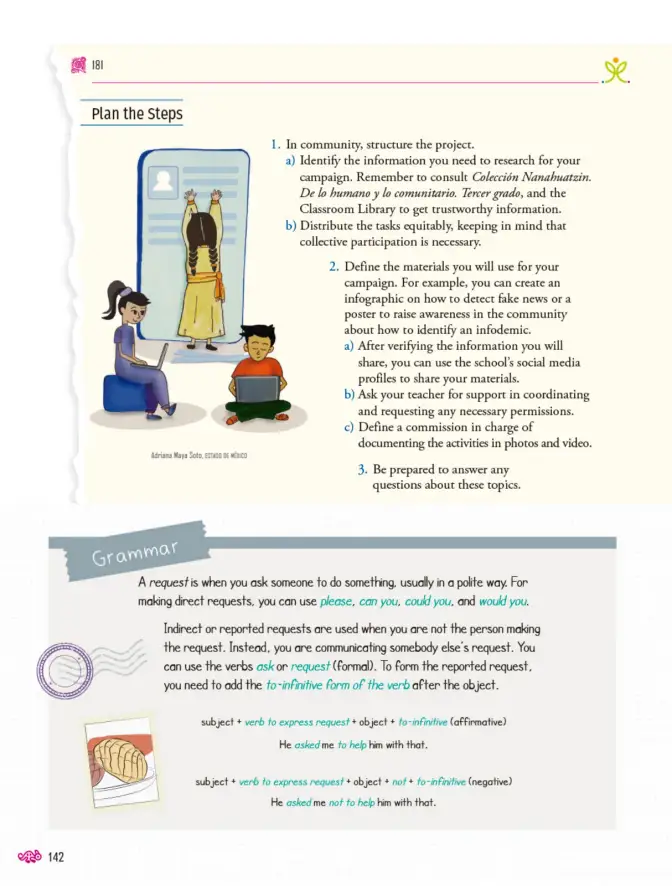
Plan the Steps
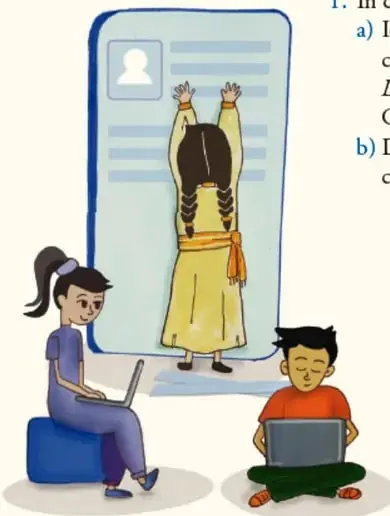
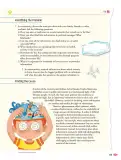
In community, structure the project. a) Identify the information you need to research for your campaign. Remember to consult Colección Nanahuatzin. De lo humano y lo comunitario. Tercer grado, and the Classroom Library to get trustworthy information. b) Distribute the tasks equitably, keeping in mind that collective participation is necessary.
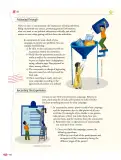
Define the materials you will use for your campaign. For example, you can create an infographic on how to detect fake news or a poster to raise awareness in the community about how to identify an infodemic. a) After verifying the information you will share, you can use the school's social media profiles to share your materials. b) Ask your teacher for support in coordinating and requesting any necessary permissions. c) Define a commission in charge of documenting the activities in photos and video.
Be prepared to answer any questions about these topics.
Grammar
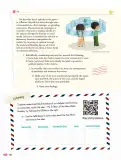
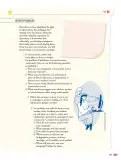
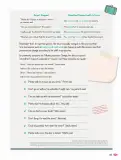
A request is when you ask someone to do something, usually in a polite way. For making direct requests, you can use please, can you, could you, and would you.
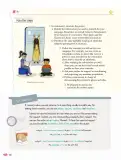
Indirect or reported requests are used when you are not the person making the request. Instead, you are communicating somebody else's request. You can use the verbs ask or request (formal). To form the reported request, you need to add the to-infinitive form of the verb after the object.
subject + verb to express request + object + to-infinitive (affirmative)
He asked me to help him with that.
subject + verb to express request + object + not + to-infinitive (negative)
He asked me not to help him with that.
Ejemplos resueltos
Transforma en petición reportada: Help me with that. (dicho a mí)
Se usa ask + objeto + to-infinitive: He asked me to help him with that.
Transforma en petición reportada negativa: Don't help him with that. (dicho a mí)
Se usa ask + objeto + not + to-infinitive: He asked me not to help him with that.
Tabla
| Tipo de petición | Estructura | Ejemplo |
|---|---|---|
| Directa | please / can you / could you / would you | Could you help me? |
| Reportada afirmativa | subject + ask/request + object + to-infinitive | He asked me to help him. |
| Reportada negativa | subject + ask/request + object + not + to-infinitive | He asked me not to help him. |
Diagrama
flowchart TD
A[Plan the Steps] --> B[1. Structure the project]
A --> C[2. Define materials]
A --> D[3. Be prepared to answer questions]
B --> B1[Research information]
B --> B2[Distribute tasks]
C --> C1[Verify information]
C --> C2[Use school social media]
C --> C3[Ask teacher for support]
C --> C4[Document activities]
Fórmulas y ecuaciones
subject + verb to express request + object + to-infinitive
subject + verb to express request + object + not + to-infinitive
Glosario (6)
- request
- petición; acción de pedir algo de forma cortés
- reported request
- petición indirecta que comunica lo que otra persona pidió
- to-infinitive
- forma verbal precedida por 'to' (to help, to go)
- infodemic
- infodemia; exceso de información, mucha de ella falsa o engañosa
- fake news
- noticias falsas difundidas como si fueran verdaderas
- campaign
- campaña; conjunto de acciones para lograr un objetivo
Preguntas para practicar
What is a reported request?
A reported request communicates what another person asked, using verbs like ask or request followed by an object and a to-infinitive.
How do you form a negative reported request?
Add not before the to-infinitive: subject + ask/request + object + not + to-infinitive.
Temas y conceptos clave
Fuentes y referencias
- Colección Nanahuatzin. De lo humano y lo comunitario. Tercer grado
- Classroom Library
Figuras de la página (3)


Preguntas que la gente también hace
¿Cómo se forman las peticiones reportadas en inglés?
¿Qué diferencia hay entre please, can you, could you y would you?
¿Cómo se dice 'Él me pidió que no lo ayudara' en inglés?
- • Verbos en presente simple
- • Pronombres objeto (me, him, her, us, them)
- • Infinitivo con to
📝 Transcripción de la página (texto seleccionable) 1782 caracteres
Plan the Steps
- In community, structure the project.
a) Identify the information you need to research for your campaign. Remember to consult Colección Nanahuatzin De io bumano y lo comunitario. Tercer grado, and the Classroom Library to get trustworthy information.b) Distribute the tasks equitably, keeping in mind that collective participation is necessary.
Define the materials you will use for your campaign. For example, you can create an infographic on how to detect fake news or a poster to raise awareness in the community about how to identify an infodemic.a) After verifying the information you will share, you can use the school's social media profiles to share your materials. b) Ask your teacher for support in coordinating and requesting any necessary permissions.c) Define a commission in charge of documenting the activities in photos and video.
Be prepared to answer any questions about these topics.
Grammar
A request is when you ask someone to do something, usually in a polite way. For making direct requests, you can use please, can you, could you, and would you.
Indirect or reported requests are used when you are not the person making the request. Instead, you are communicating somebody else's request. You can use the verbs askor request(formal). To form the reported request,you need to add the to-infinitive form of the verb after the object.
subject + venb to express request+ object + to-infinitive(affirmative)He asked me to help him with that.
subject + verb to express request+ object + not + to-infinitive (negative)He asked me not to help him with that.
181
.灾.
Adriana Maya Soto, ESTaD DE MExiCO


142
Otros libros recomendados
Uérakua anapu uantakua. Projects and Readings. Libro de Educación Telesecundaria Grado 3° Ciclo Escolar 2025 - 2026
SEP/CONALITEG
187 págs.

Uérakua anapu uantakua. Projects and Readings. Libro de Educación Telesecundaria Grado 2° Ciclo Escolar 2025 - 2026
SEP/CONALITEG
171 págs.
Uérakua anapu uantakua. Projects and Readings. Libro de Educación Telesecundaria Grado 1° Ciclo Escolar 2025 - 2026
SEP/CONALITEG
187 págs.

Uérakua anapu uantakua. Projects and Readings. Libro de Educación Secundaria Grado 2° Ciclo Escolar 2025 - 2026
SEP/CONALITEG
171 págs.
Uérakua anapu uantakua. Projects and Readings Libro de Educación Secundaria Grado 1° Ciclo Escolar 2025 - 2026
SEP/CONALITEG
187 págs.
Colección Ximhai. Múltiples lenguajes. Libro de Educación Secundaria Grado 1° Ciclo Escolar 2025 - 2026
SEP/CONALITEG
163 págs.
Matematica 9° · Secundaria Activa
MinEducación
218 págs.
Ciencias Naturales 9° · Secundaria Activa
MinEducación
318 págs.