
















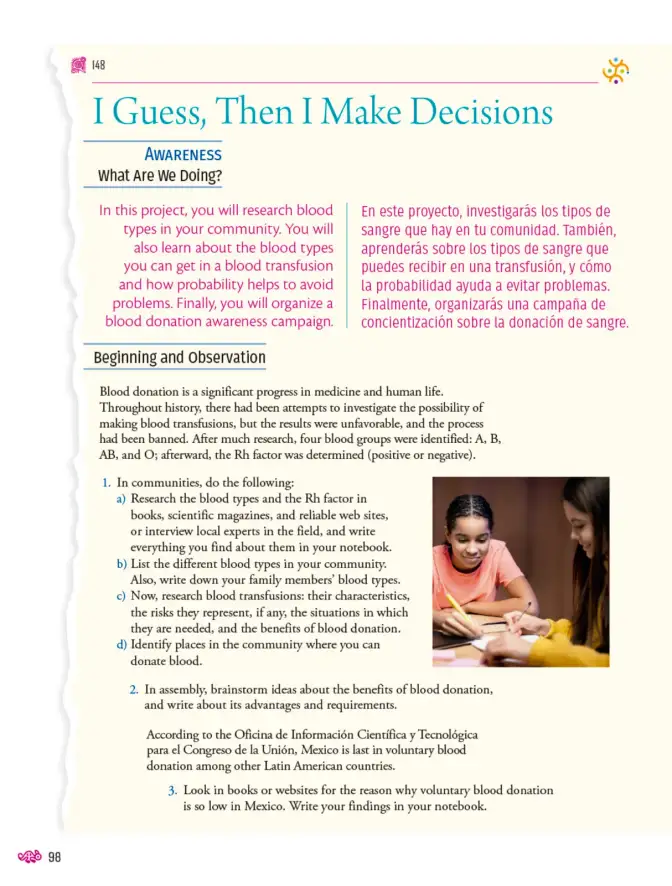
In communities, do the following: / En la comunidad, realiza lo siguiente:
Research the blood types and the Rh factor in books, scientific magazines, and reliable web sites, or interview local experts in the field, and write everything you find about them in your notebook.
Respuesta orientativa: Los grupos sanguíneos del sistema ABO son A, B, AB y O, determinados por antígenos en la superficie de los glóbulos rojos. El factor Rh es otro antígeno (D) que marca la sangre como positiva o negativa. Existen más de 40 sistemas, pero ABO y Rh son los más importantes en transfusiones.
List the different blood types in your community. Also, write down your family members' blood types.
Respuesta orientativa: En México predominan O+ (aprox. 55 %), A+ (25 %), B+ (10 %) y AB+ (3 %); los Rh negativos son minoritarios. Cada estudiante debe registrar los tipos de su familia; si se desconoce, se anota "no determinado".
Now, research blood transfusions: their characteristics, the risks they represent, if any, the situations in which they are needed, and the benefits of blood donation.
Respuesta orientativa: Una transfusión consiste en transferir sangre o componentes (glóbulos rojos, plasma, plaquetas) de un donante a un receptor. Los riesgos incluyen reacciones hemolíticas por incompatibilidad ABO/Rh, fiebre, alergias e infecciones. Se necesitan en cirugías, hemorragias, anemia grave, cáncer y partos complicados. Donar sangre salva vidas y permite obtener hemoderivados.
Identify places in the community where you can donate blood.
Respuesta orientativa: Bancos de sangre de hospitales públicos (IMSS, ISSSTE, SSA), Cruz Roja, centros de salud y campañas móviles de donación. Se puede consultar el directorio del Centro Nacional de la Transfusión Sanguínea.