
















Saltar al contenido
MisLibrosTexto
Ad

Página — Matematica 3° Secundaria (pág. 28)

📄 otro matematica 🎓 bachillerato · 3° Secundaria Perú 🇵🇪 PE 🗣 Español
Página 28
28 de 100
Página 28 de Fichas de Matemática 3 · 2024
Anterior Página 28 / 100 Siguiente
matematica

Solución no disponible aún

Esta página está en proceso de revisión.

Pídela y la resolveremos antes. Sin registro.

¿Te fue útil esta página?
📝 Transcripción de la página (texto seleccionable) 6200 caracteres

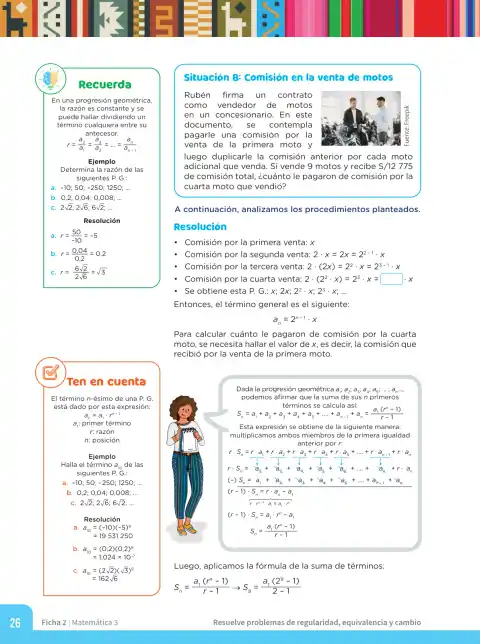
Recuerda

En una progresión geométrica,la razón es constante y se puede hallar dividiendo un término cualquiera entre su

antecesor.

r=\frac{\partial_{_2}}{\partial_{_1}}=\frac{\partial_{_3}}{\partial_{_2}}=\ldots=\frac{\partial_{_n}}{\partial_{_{n-1}}}

Ejemplo Determina la razón de las siguientes P. G.: a.-10;50;-250;1250; b 0,2;0,04;0,008;

C.2\sqrt{2};2\sqrt{6};6\sqrt{2};..

Resolución

a

r=\frac{50}{-10}=-5

b.

r=\frac{0.04}{0.2}=0.2

r=\frac{6\sqrt{2}}{2\sqrt{6}}=\sqrt{3}

Ten en cuenta

El término n-ésimo de una P. G.está dado por esta expresión: a_{n}=a_{1}\cdot r^{n-1} a: primer término r:razón n:posición

\begin{aligned}&\begin{aligned}\\ &\mathbf{E}\mathbf{j}\mathbf{e}\mathbf{m}\mathbf{p}\mathbf{l}\mathbf{o}\\&\mathbf{H}\mathbf{a}\mathbf{l}\mathbf{a}\mathbf{e}\mathbf{l}\mathbf{t}\mathbf{c}\mathbf{r}\mathbf{m}\mathbf{i}\mathbf{o}\mathbf{\rho}\mathbf{a}_{_{10}}\mathbf{d}\mathbf{e}\mathbf{l}\mathbf{a}\mathbf{s}\\&\mathbf{s}\mathbf{g}\mathbf{u}\mathbf{i}\mathbf{e}\mathbf{n}\mathbf{t}\mathbf{s}\mathbf{P}\mathbf{.}\mathbf{G}\mathbf{.}\mathbf{j}\\&\mathbf{a}\mathbf{.}\mathbf{\rho}\mathbf{-}\mathbf{l}\mathbf{0}\mathbf{;}\mathbf{5}\mathbf{0}\mathbf{;}\mathbf{\rho}\mathbf{-}\mathbf{2}5\mathbf{0}\mathbf{;}\mathbf{\rho}\mathbf{1}\mathbf{2}5\mathbf{0}\mathbf{;}\mathbf{\rho}\mathbf{s}\mathbf{\rho}\\&\mathbf{b}\mathbf{.}\mathbf{\rho}\mathbf{0}\mathbf{,}\mathbf{2}\mathbf{;}\mathbf{\rho}\mathbf{0}\mathbf{,}\mathbf{0}\mathbf{4}\mathbf{;}\mathbf{\rho}\mathbf{0}\mathbf{,}\mathbf{0}\mathbf{0}\mathbf{8}\mathbf{;}\mathbf{\rho}\mathbf{s}\mathbf{\rho}\\&\mathbf{c}\mathbf{.}\mathbf{\rho}\mathbf{2}\sqrt{\mathbf{2}}\mathbf{;}\mathbf{\rho}\mathbf{2}\sqrt{\mathbf{6}}\mathbf{;}\mathbf{\rho}\mathbf{6}\sqrt{\mathbf{2}}\mathbf{;}\mathbf{\rho}\mathbf{s}\mathbf{\rho}\\&\mathbf{R}\mathbf{e}\mathbf{s}\mathbf{o}\mathbf{l}\mathbf{u}\mathbf{c}\mathbf{i}\mathbf{o}\mathbf{n}\\&\mathbf{a}\mathbf{.}\mathbf{\rho}\mathbf{a}_{_{10}}=(-10)(-5)^{\circ}\\&=19\ 531\ 250\\&\mathbf{b}\mathbf{.}\mathbf{\rho}\mathbf{a}_{_{10}}=(0\mathbf{,}\mathbf{2})(0\mathbf{,}\mathbf{2})^{\circ}\\&=\mathbf{1,}\mathbf{0}\mathbf{24}\times\mathbf{10^{-7}}\\&\mathbf{c}\mathbf{.}\mathbf{\rho}\mathbf{a}_{_{10}}=(2\sqrt{\mathbf{2}})(\sqrt{\mathbf{3}})^{\circ}\\&=\mathbf{162}\sqrt{\mathbf{6}}\\ &\end{aligned}\\ \end{aligned}

situación B: Comisión en Ia venta de motos

Rubén firma un contrato como vendedor de motos en un concesionario. En este documento,se contempla pagarle una comisión por la venta de la primera moto y

luego duplicarle la comisión anterior por cada moto adicional que venda. Si vende 9 motos y recibe S/12 775de comisión total, icuánto le pagaron de comisión por la cuarta moto que vendió?

A continuación, analizamos los procedimientos planteados.

Resolución

Comisión por la primera venta:x

Comisión por la segunda venta:2\cdot x=2x=2^{2-1}\cdot x

●Comisión por la tercera venta:2\cdot(2x)=2^{2}\cdot x=2^{3-1}\cdot x

Comisión por la cuarta venta:2\cdot(2^{2}\cdot x)=2^{3}\cdot x=\sqrt[3]{} X

Se obtiene esta P.G.:x;2x;2^{2}\cdot x;2^{3}\cdot x;

Entonces, el término general es el siguiente:

a_{n}=2^{n-1}\cdot x

Para calcular cuánto le pagaron de comisión por la cuarta moto, se necesita hallar el valor de x, es decir, la comisión que recibió por la venta de la primera moto.

Dada la progresión geométrica :\partial_{1};\partial_{2};\partial_{3};\partial_{4};\partial_{5};\ldots;\partial_{n}..., podemos afirmar que la suma de sus n primeros +=1=.1==.. S_{n}=\bar{\alpha}_{1}+\bar{\alpha}_{2}+\bar{\alpha}_{3}+\bar{\alpha}_{4}+\bar{\alpha}_{5}+\ldots+\bar{\alpha}_{n-1}+\bar{\alpha}_{n}=\frac{\bar{\alpha}_{1}(r^{n}-1)}{r-1}

S_{n}=\bar{\alpha}_{1}+\bar{\alpha}_{2}+\bar{\alpha}_{3}+\bar{\alpha}_{4}+\bar{\alpha}_{5}+\ldots+\bar{\alpha}_{n-1}+\bar{\alpha}_{n}=\frac{\bar{\alpha}_{1}(r^{n}-1)}{r-1}

Esta expresión se obtiene de la siguiente manera:multiplicamos ambos miembros de la primera igualdad anterior por r:

\begin{array}{l}r\cdot S_{n}=\underbrace{r\cdot\bar{\alpha}_{1}+r\cdot\bar{\alpha}_{2}+r\cdot\bar{\alpha}_{3}+r\cdot\bar{\alpha}_{4}+r\cdot\bar{\alpha}_{5}+\ldots+r\cdot\bar{\alpha}_{n-1}+r\cdot\bar{\alpha}_{n}}_{\downarrow}\\r\cdot S_{n}=\underbrace{\bar{\alpha}_{2}+\bar{\alpha}_{3}+\bar{\alpha}_{4}+\bar{\alpha}_{5}+\bar{\alpha}_{6}+\ldots+\bar{\alpha}_{n}+r\cdot\bar{\alpha}_{n}}_{\downarrow}\\(-)S_{n}=\underbrace{\bar{\alpha}_{1}+\bar{\alpha}_{2}+\bar{\alpha}_{3}+\bar{\alpha}_{4}+\bar{\alpha}_{5}+\bar{\alpha}_{6}+\ldots+\bar{\alpha}_{n<1}+\bar{\alpha}_{n}}_{\downarrow}\\(-1)\cdot S_{n}=r\cdot\bar{\alpha}_{n}-\bar{\alpha}_{1}\\\overbrace{r\cdot r^{n-1}\cdot\bar{\alpha}_{1}\cdot r^{n}-\bar{\alpha}_{1}}^{\text{ 一一一一一一一一一一一一一一一一一一一一一一一一一一一一一一一一一一一一一一一一一一一一一一一一一一一一一一一一一一一一一一一一一一一一一一一一一一一一一一一一一一一一一一一一一一一一一一一一一一一一一一一一一一一一一一一一一一一一一一一一一一一一一一一一一一一一一一一一一一一一一一一一一一一一一一一一一一一一一一一一一一一一一一一一一一一一一一一一一一一一一一一一一一一一一一一一一一一一一一一一一一一一一一一一一一一一一一一一一一一一一一一一一一一一一一一一一一一一一一一一一一一一一一一一一一一一一一一一一一一一一一一一一一一一一一一一一一一一一一一一一一一一一一一一一一一一一一一一一一一一一一一一一一一一一一一一一一一一一一一一一一一一一一一一一一一一一一一一一一一一一一一一一一一一一一一一一一一一一一一一一一一一一一一一一一一一一一一一一一一一一一一一一一一一一一一一一一一一一一一一一一一一一一一一一一一一一一一一一一一一一一一一一一一一一一一一一一一一一一一一一一一一一一一一一一一一一一一一一一一一一一一一一一一一一一一一一一一一一一一一一一一一一一一一一一一一一一一一一一一一一一一一一一一一一一一一一一一一一一一一一一一一一一一一一一一一一一一一一一一一一一一一一一一一一一一一一一一一一一一一一一一一一一一一一一一一一一一一一一一一一一一一一一一一一一一一一一一一一一一一一一一一一一一一一一一一一一一一一一一一一一一一一一一一一一一一一一一一一一一一一一一一一一一一一一一一一一一一一一一一一一一一一一一一一一一一一一一一一一一一一一一一一一一一一一一一一一一一一一一一一一一一一一一一一一一一一一一一一一一一一一一一一一一一一一一一一一一一一一一一一一一一一一一一一一一一一一一一一一一一一一一一一一一一一一一一一一一一一一一一一一一一一一一一一一一一一一一一一一一一一一一一一一一一一一一一一一一一一一一一一一一一一一一一一一一一一一一一一一一一一一一一一一一一一一一一一一一一一一一一一一一一一一一一一一一一一一一一一一一一一一一一一一一一一一一一一一一一一一一一一一一一一一一一一一一一一一一一一一一一一一一一一一一一一一一一一一一一一一一一一一一一一一一一一一一一一一一一一一一一一一一一一一一一一一一一一一一一一一一一一一一一一一一一一一一一一一一一一一一一一一一一一一一一一一一一一一一一一一一一一一一一一一一一一一一一一一一一一一一一一一一一一一一一一�

Luego, aplicamos la fórmula de la suma de términos:

S_{n}=\frac{\partial_{1}\left(r^{n}-1\right)}{r-1}\rightarrow S_{n}=\frac{\partial_{1}\left(2^{9}-1\right)}{2-1}

![](page=0,bbox=[85, 154, 165, 235])

![](page=0,bbox=[85, 884, 164, 964])

![](page=0,bbox=[796, 223, 1000, 362])

![](page=0,bbox=[407, 976, 517, 1348])

26

Ficha2|Matemática3

Resuelve problemas de regularidad, equivalencia y cambio

Ad

Otros libros recomendados

Ver todos →
Ad

Usamos cookies propias y de terceros para personalizar contenido, mostrar publicidad y analizar el tráfico. Las cookies necesarias siempre están activas.