
Anexo 1 — Extensión: sesión en inglés (continuación) y referencias adicionales
Solución — Página 62
Guia Docente · Preparatoria · 2024
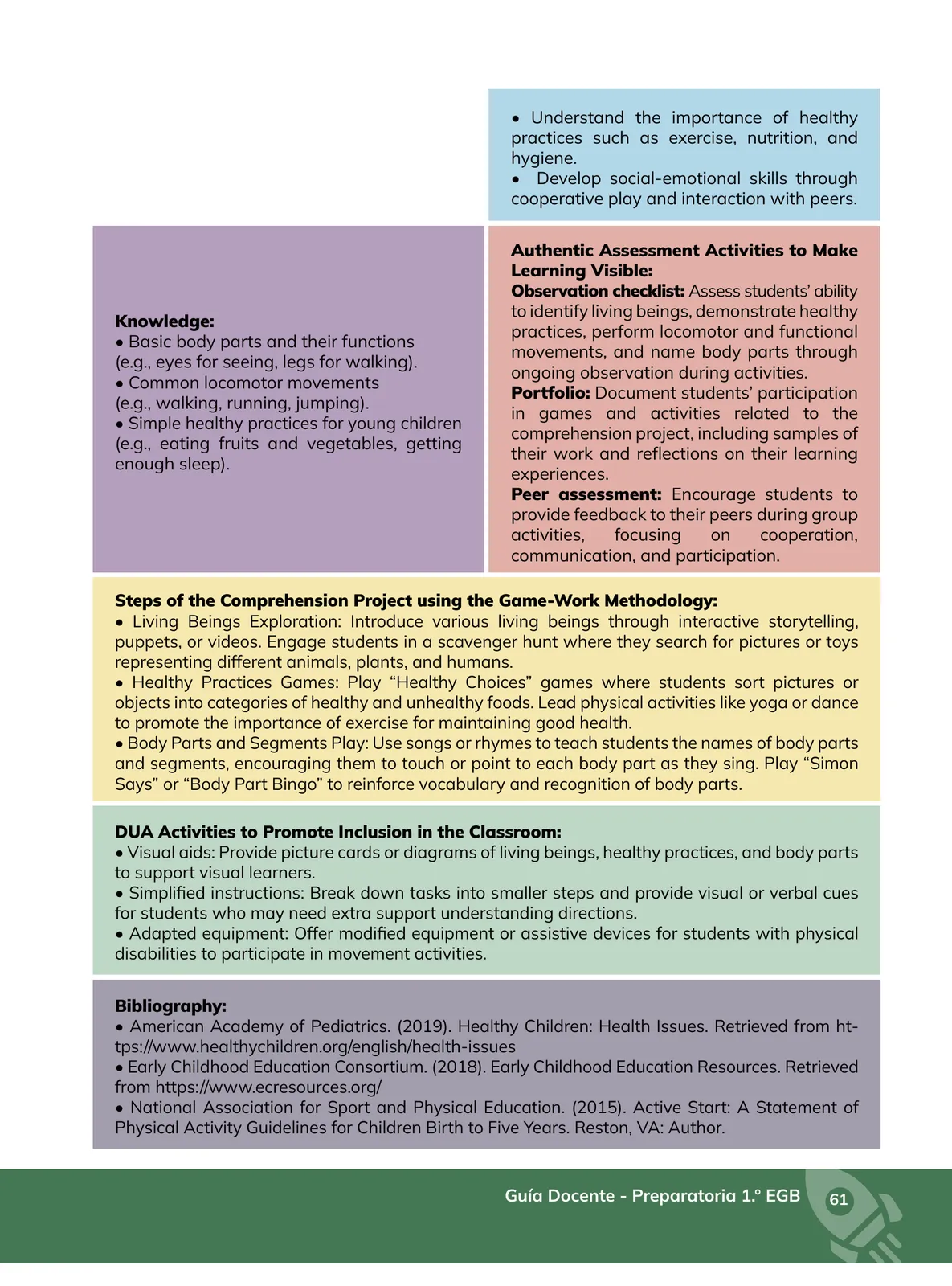
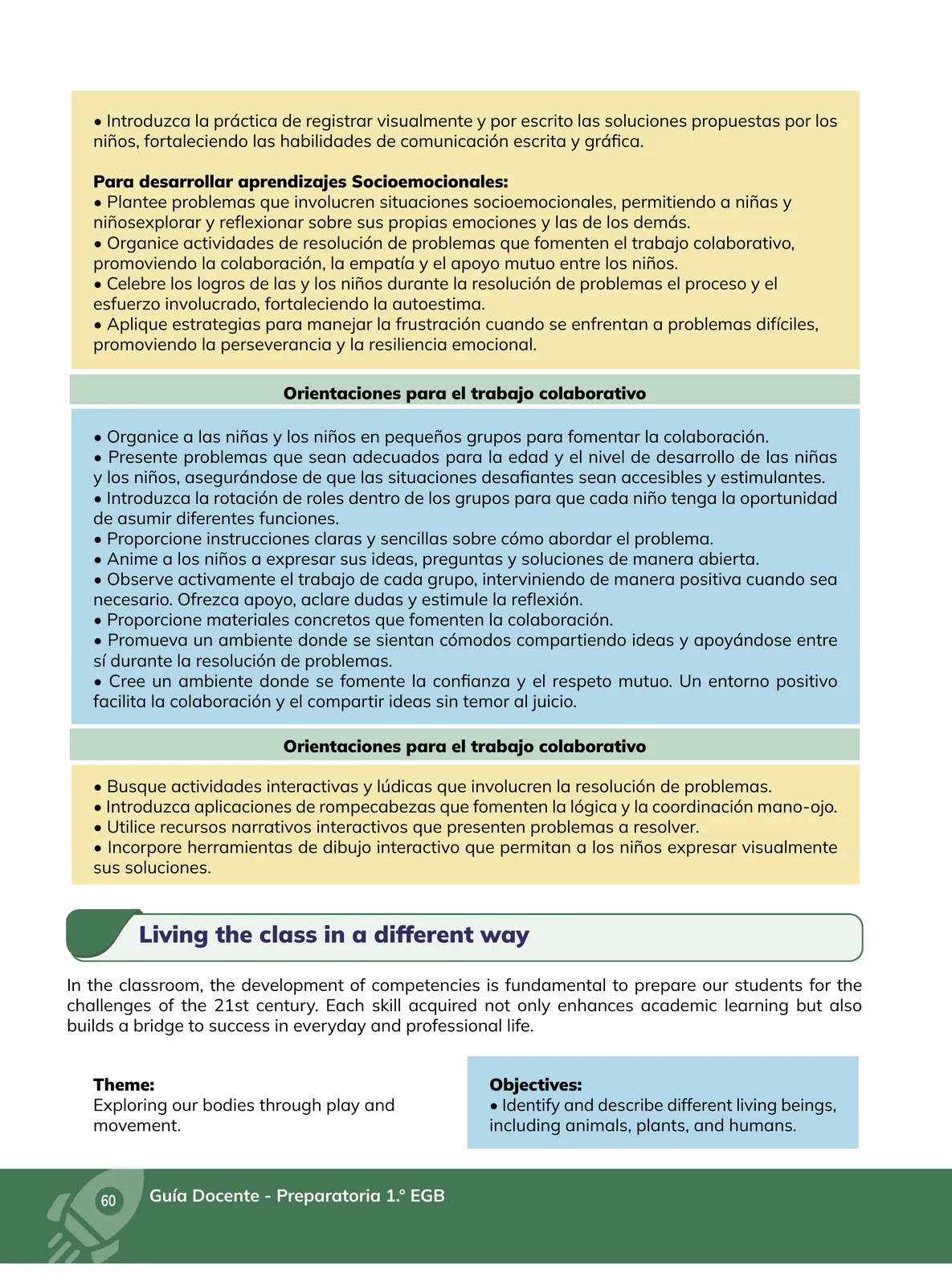
Exploring our bodies — English session (continuation)
Knowledge
- Basic body parts and their functions (e.g., eyes for seeing, legs for walking).
- Common locomotor movements (e.g., walking, running, jumping).
- Functional movements used in daily activities (e.g., bending, reaching, lifting).
- Simple healthy practices for young children (e.g., eating fruits and vegetables, getting enough sleep).
Authentic Assessment Activities to Make Learning Visible
- Observation: Assess students' ability to identify living beings, demonstrate healthy practices, perform locomotor and functional movements, and name body parts during ongoing observation during activities.
- Portfolio: Document students' participation in games and activities related to the comprehension project, including samples of their work and reflections on their learning experiences.
- Peer assessment: Encourage students to provide feedback to their peers during group activities, focusing on cooperation, communication, and participation.
Steps of the Comprehension Project using the Game-Work Methodology
- Living Beings Exploration: Introduce various living beings through interactive storytelling, puppets, and videos. Engage students in a scavenger hunt where they search for pictures or toys representing different animals, plants, and humans.
- Healthy Practices Games: Play "Healthy Choices" games where students sort pictures or objects into categories of healthy and unhealthy foods.
- Locomotor and Functional Movements: Set up obstacle courses or movement stations.
- Body Parts and Segments Play: Use songs or rhymes to teach students the names of body parts and segments. Play "Simon Says" or "Body Part Bingo" to reinforce vocabulary.
DUA Activities to Promote Inclusion in the Classroom
- Visual aids: Provide picture cards or diagrams of living beings, healthy practices, and body parts to support visual learners.
- Simplified instructions: Break down tasks into smaller steps and provide visual or verbal cues for students who may need extra support.
- Adapted equipment: Offer modified equipment or assistive devices for students with physical disabilities to participate in movement activities.
Bibliography
- American Academy of Pediatrics (2019). Healthy Children: Health Issues. Retrieved from https://www.healthychildren.org/english/health-issues
- Early Childhood Education Consortium (2018). Early Childhood Education Resources. Retrieved from https://www.ecresources.org/
- National Association for Sport and Physical Education (2015). Active Start: A Statement of Physical Activity Guidelines for Children Birth to Five Years. Reston, VA: Author.
Glosario
- observation checklist: Lista de cotejo para registrar el desempeño observado.
- portfolio: Carpeta de evidencias del aprendizaje del estudiante.
- peer buddies: Compañeros tutores que apoyan a otros estudiantes.
Fuentes
- • Ver pág. 61: Inicio de la sesión en inglés del anexo.
- • Ver pág. 63: Contraportada.
📝 Transcripción de la página (texto seleccionable) 2909 caracteres
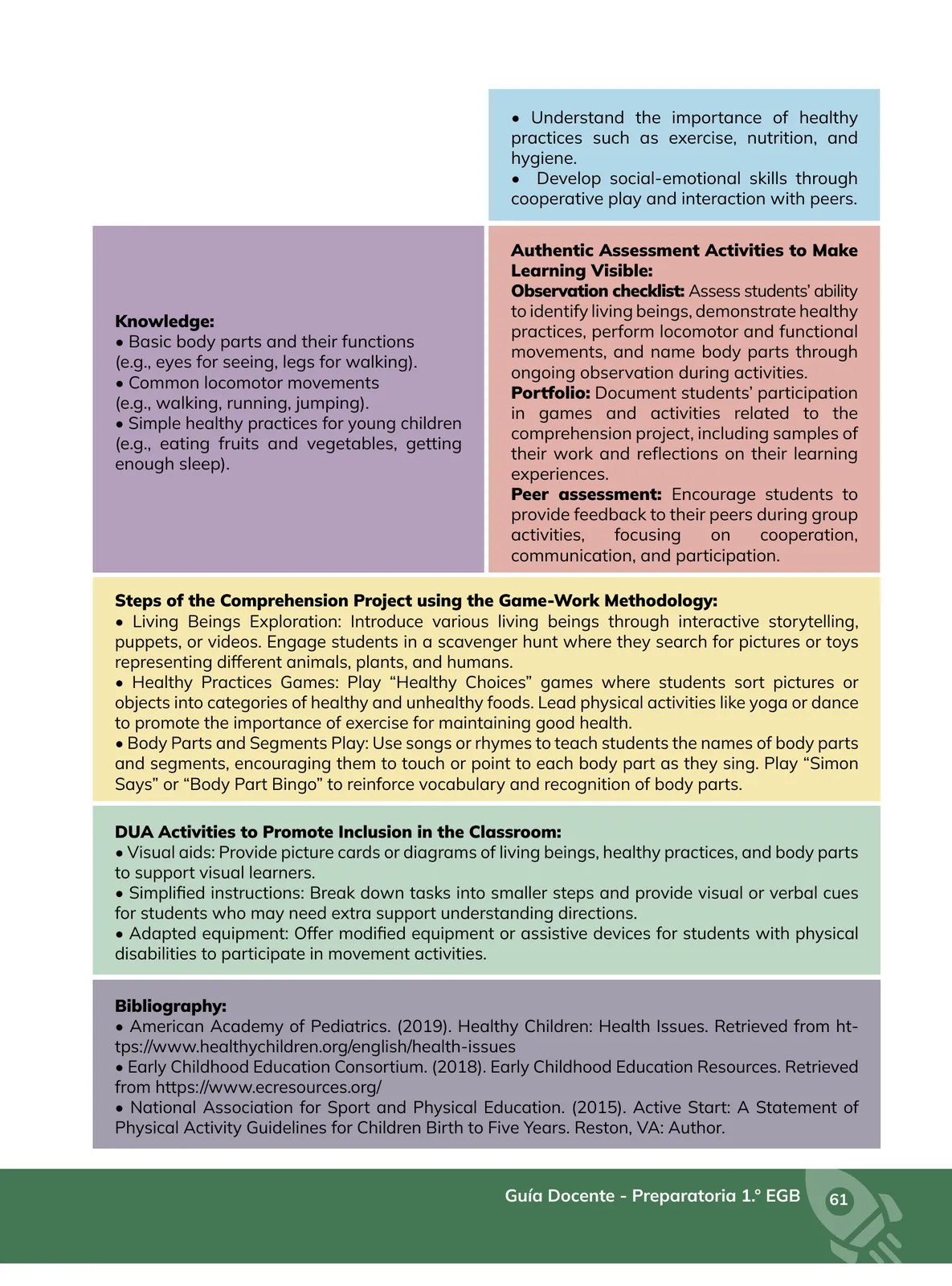
e Understand the importance of healthy practices such as exercise, nutrition, and hygiene.
e Develop social-emotional skills through cooperative play and interaction with peers.
Authentic Assessment Activities to Make Learning Visible:
Observation checklist: Assess students’ ability to identify living beings, demonstrate healthy practices, perform locomotor and functional movements, and name body parts through ongoing observation during activities. Portfolio: Document students’ participation in games and activities related to the comprehension project, including samples of their work and reflections on their learning experiences.
Peer assessment: Encourage students to provide feedback to their peers during group activities, focusing on cooperation, communication, and participation.
Knowledge:
e Basic body parts and their functions
(e.g., eyes for seeing, legs for walking).
e Common locomotor movements
(e.g., walking, running, jumping).
e Simple healthy practices for young children (e.g., eating fruits and vegetables, getting enough sleep).
Steps of the Comprehension Project using the Game-Work Methodology:
e Living Beings Exploration: Introduce various living beings through interactive storytelling, puppets, or videos. Engage students in a scavenger hunt where they search for pictures or toys representing different animals, plants, and humans.
e Healthy Practices Games: Play “Healthy Choices” games where students sort pictures or objects into categories of healthy and unhealthy foods. Lead physical activities like yoga or dance to promote the importance of exercise for maintaining good health.
e Body Parts and Segments Play: Use songs or rhymes to teach students the names of body parts and segments, encouraging them to touch or point to each body part as they sing. Play “Simon Says” or “Body Part Bingo” to reinforce vocabulary and recognition of body parts.
DUA Activities to Promote Inclusion in the Classroom:
e Visual aids: Provide picture cards or diagrams of living beings, healthy practices, and body parts to support visual learners.
e Simplified instructions: Break down tasks into smaller steps and provide visual or verbal cues for students who may need extra support understanding directions.
e Adapted equipment: Offer modified equipment or assistive devices for students with physical disabilities to participate in movement activities.
Bibliography:
e American Academy of Pediatrics. (2019). Healthy Children: Health Issues. Retrieved from ht- tps://www.healthychildren.org/english/health-issues
e Early Childhood Education Consortium. (2018). Early Childhood Education Resources. Retrieved from https: //www.ecresources.org/
e National Association for Sport and Physical Education. (2015). Active Start: A Statement of Physical Activity Guidelines for Children Birth to Five Years. Reston, VA: Author.
Guía Docente - Preparatoria 1° EGB 61
Otros libros recomendados
Ingles · 2 EGB · 2024
Ministerio de Educación del Ecuador
48 págs.
Ciencias Naturales · 2 EGB · 2025
Ministerio de Educación del Ecuador
146 págs.
Lengua Y Literatura · 2 EGB · 2025
Ministerio de Educación del Ecuador
246 págs.
Lengua Y Literatura · 2 EGB · 2024
Ministerio de Educación del Ecuador
70 págs.
Matematica · 6 EGB · 2025
Ministerio de Educación del Ecuador
218 págs.
Estudios Sociales · 6 EGB · 2025
Ministerio de Educación del Ecuador
226 págs.
Ingles · 6 EGB · 2024
Ministerio de Educación del Ecuador
50 págs.
Etnoeducacion · 6 EGB · 2024
Ministerio de Educación del Ecuador
100 págs.