
















Ejercicio 1
Ad
Grammar: must/have to (negativo e interrogativo), may/can y mustn't
📄 teoria ingles 🎓 secundaria · 1° Secundaria México 🇲🇽 MX 🗣 Español
Respuesta rápida
Mustn't = prohibición; don't/doesn't have to = no es necesario; may = permiso formal; can = permiso informal. Preguntas: Must she...? / Does she have to...? / May I...? / Can I...? Todo con verbo en forma base.
📚 theory ingles ⭐ Dificultad 1/5 ⏱ 9 min lectura
Solución — Página 165
Uérakua anapu uantakua. Projects and Readings Libro de Educación Secundaria Grado 1° Ciclo Escolar 2025 - 2026
Ejercicio 1
Negativo e interrogativo de Must y Have to
Must — Negative (traducido): la forma negativa de must significa que hay una obligación de NO hacer algo.
- Estructura: sujeto + must + not + verbo en forma base + objeto.
- Ejemplo: You must not disrespect your teachers. (No debes faltarle al respeto a tus maestros.)
Have to — Negative (traducido): la forma negativa de have to expresa lo contrario de una obligación, algo que no estás obligado a hacer.
- Estructura: sujeto + don't/doesn't have to + verbo en forma base + objeto.
- Ejemplo: We don't have to go to school on weekends. (No tenemos que ir a la escuela los fines de semana.)
Must — Interrogative: must + sujeto + verbo en forma base + objeto + ?
- Ejemplo: Must she return the books to the library? (¿Debe ella devolver los libros a la biblioteca?)
Have to — Interrogative: do/does + sujeto + have to + verbo en forma base + objeto + ?
- Ejemplo: Does she have to clean the yard every day? (¿Tiene ella que limpiar el patio todos los días?)
Diferencia clave: must not = prohibición (no lo hagas); don't have to = ausencia de obligación (no es necesario que lo hagas).
Ejercicio 2
Modales de permiso (Permission)
Aquí están los verbos modales que expresan permiso:
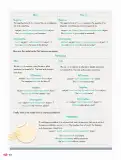
| May | Can |
|---|---|
| Usamos may para un permiso muy formal o cortés (o su negación). El verbo principal va en forma base. | Usamos can para un permiso informal (o su negación). El verbo principal va en forma base. |
| Afirmativa: sujeto + may + verbo base + objeto. The employees may take the day off. (Los empleados pueden tomarse el día libre.) | Afirmativa: sujeto + can + verbo base + objeto. She can take three cookies. (Ella puede tomar tres galletas.) |
| Negativa: sujeto + may + not + verbo base + objeto. You may not take the company's car. (No puedes tomar el auto de la empresa.) | Negativa: sujeto + can + not (can't) + verbo base + objeto. You can't smoke here! (¡No puedes fumar aquí!) |
| Interrogativa: may + sujeto + verbo base + objeto + ? May I go to the restroom, please? (¿Puedo ir al baño, por favor?) | Interrogativa: can + sujeto + verbo base + objeto + ? Can I play video games, mom? (¿Puedo jugar videojuegos, mamá?) |
Ad
Ejercicio 3
Modal de prohibición (Prohibition)
Traducido: finalmente, este es el modal para expresar prohibición. Si algo está prohibido, no está permitido y es importante que no lo hagas. Para expresar prohibición usamos mustn't (la forma negativa de must); el verbo que sigue siempre va en forma base.
- Estructura: sujeto + must + not (mustn't) + verbo en forma base + objeto.
- You must not smoke in a hospital. (No se debe fumar en un hospital.)
- He mustn't take money without permission. (No debe tomar dinero sin permiso.)
- She mustn't drive without a license. (No debe manejar sin licencia.)
Respuesta
la página completa la teoría de los modales: mustn't prohíbe, don't have to quita la obligación, may da permiso formal y can permiso informal; no trae ejercicios para resolver.
Contenido de la página
Página 164 del libro (página 165 del PDF).
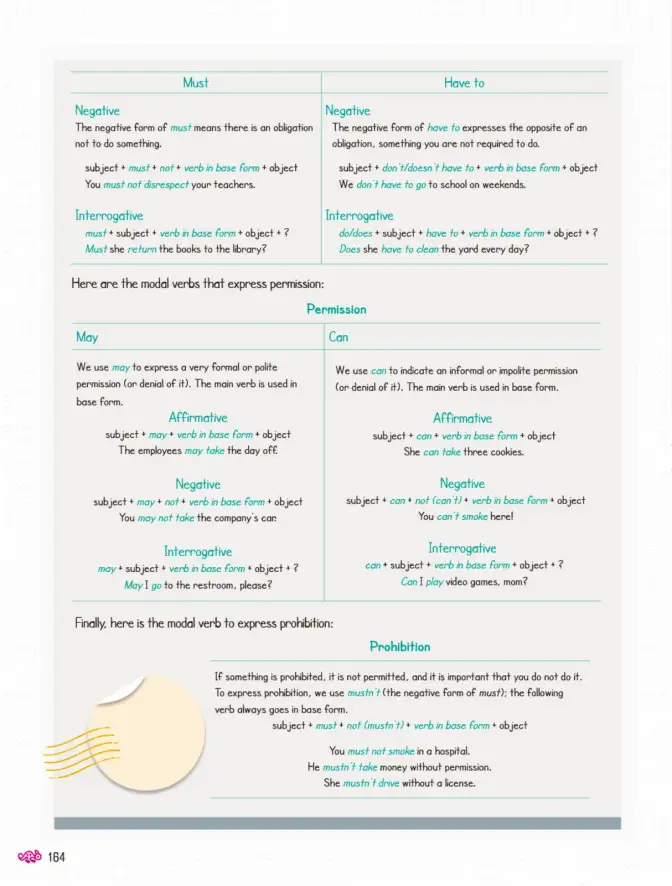
Must / Have to — Negative e Interrogative
Must Negative: The negative form of must means there is an obligation not to do something. (La negativa de must significa obligación de no hacer algo.) — subject + must + not + verb in base form + object: You must not disrespect your teachers.
Have to Negative: The negative form of have to expresses the opposite of an obligation, something you are not required to do. (La negativa de have to expresa lo contrario de una obligación, algo que no estás obligado a hacer.) — subject + don't/doesn't have to + verb in base form + object: We don't have to go to school on weekends.
Must Interrogative: must + subject + verb in base form + object + ? Must she return the books to the library?
Have to Interrogative: do/does + subject + have to + verb in base form + object + ? Does she have to clean the yard every day?
Permission (Permiso)
Here are the modal verbs that express permission: (Aquí están los modales que expresan permiso:)
| May | Can |
|---|---|
| We use may to express a very formal or polite permission (or denial of it). The main verb is used in base form. Affirmative: subject + may + verb in base form + object — The employees may take the day off. Negative: subject + may + not + verb in base form + object — You may not take the company's car. Interrogative: may + subject + verb in base form + object + ? — May I go to the restroom, please? | We use can to indicate an informal or impolite permission (or denial of it). The main verb is used in base form. Affirmative: subject + can + verb in base form + object — She can take three cookies. Negative: subject + can + not (can't) + verb in base form + object — You can't smoke here! Interrogative: can + subject + verb in base form + object + ? — Can I play video games, mom? |
Prohibition (Prohibición)
Finally, here is the modal verb to express prohibition: If something is prohibited, it is not permitted, and it is important that you do not do it. To express prohibition, we use mustn't (the negative form of must); the following verb always goes in base form. (Si algo está prohibido, no está permitido y es importante que no lo hagas; para expresar prohibición usamos mustn't.)
subject + must + not (mustn't) + verb in base form + object — You must not smoke in a hospital. / He mustn't take money without permission. / She mustn't drive without a license.
Ejemplos resueltos
You must not disrespect your teachers. vs We don't have to go to school on weekends.
Primera oración: prohibición (no debes hacerlo). Segunda: ausencia de obligación (no es necesario ir). Traducciones incluidas en solution_md.
Tabla
Tablas de modales: Must/Have to (negativo e interrogativo), Permission (May/Can con afirmativa, negativa e interrogativa) y Prohibition con mustn't (transcritas y traducidas en contenido_estructurado_md y solution_md).
Fórmulas y ecuaciones
Prohibición: sujeto + mustn't + verbo en forma base + objeto
Permiso formal: sujeto + may + verbo en forma base + objeto
Permiso informal: sujeto + can + verbo en forma base + objeto
Interrogativos: Must + sujeto...? / Do/Does + sujeto + have to...? / May/Can + sujeto...?
Glosario (4)
- Must not / mustn't
- Expresa prohibición: algo que está prohibido hacer.
- Don't have to
- Expresa que algo no es necesario u obligatorio (no es prohibido).
- May
- Modal de permiso formal o cortés: May I go to the restroom?
- Can
- Modal de permiso informal y de habilidad: Can I play video games?
Temas y conceptos clave
Verbos modales: negativo e interrogativoPermiso con may y canProhibición con mustn'tmust not (prohibición)don't have to (sin obligación)may (permiso formal)can (permiso informal)base form (forma base)
¿Te fue útil esta página?
Figuras de la página (1)
Figura 1 image
Preguntas que la gente también hace
¿Cuál es la diferencia entre mustn't y don't have to?
Consulta la solución completa arriba o explora el libro entero para temas relacionados.
¿Cómo pido permiso formalmente en inglés?
Consulta la solución completa arriba o explora el libro entero para temas relacionados.
¿Cómo se expresa prohibición en inglés?
Consulta la solución completa arriba o explora el libro entero para temas relacionados.
📌 Antes de leer esto
- • Teoría de must y have to afirmativos (página 164)
- • Estructura de preguntas con auxiliares
Siguiente tema sugerido
Práctica de modales en reglas del manual comunitario
📝 Transcripción de la página (texto seleccionable) 2227 caracteres
Here are the modal verbs that express permission:
Finally, here is the modal verb to express prohibition:
Prohibition
If something is prohibited, it is not permitted, and it is important that you do not do it.To express prohibition, we use mustn'f (the negative form of must); the following verb always goes in base form.
subject + must + not (mustn't)+ verb in base form + object
You must not smoke in a hospital.He mustn't take money without permission.She mustn't drive without a license.
| Must Negative The negative form of must means there is an obligation | Have to Negative The negative form of have to expresses the opposite of an obligation, something you are not required to do. |
| Negative not to do something. | Negative |
| subject + must + not + verb in base form + object You must not disrespect your teachers. | subject + don't/doesn't have to + verb in base fonm+ object We don't have to go to school on weekends. |
| Interrogative | Interrogative |
| must+ subject + venb in base form + object+? Must she neturn the books to the library? | do/does+ subject + have to + verb in base form+ object + ? Does she have to clean the yard every day? |
Permission
| May | Can |
| We use may to express a very fonmal or polite permission (or denial of it). The main verb is used in base form. Affirmative subject + may+ venb in base form + object The employees may take the day off. Negative subject + may + not + venb in base form + object You may not take the company's can: Interrogative may + subject + verb in base form+ object + ? MayI goto the restroom, please? | We use can to indicate an informal or impolite permission (or denial of it). The main verb is used in base form. Affirmative subject + can + venb in base fonm + object She can take three cookies. Negative subject + can + not (can't)+ venb in base form+ object You can't smoke hene! Interrogative can + subject + verb in base form+ object +? CanI play video games, mom? |

朵
164
Ad
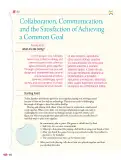
Otros libros recomendados
Colección Ximhai. Ética, naturaleza y sociedades. Libro de Educación Secundaria Grado 1° Ciclo Escolar 2025 - 2026
SEP/CONALITEG
355 págs.
Historia del pueblo mexicano. Libro de Educación Secundaria Grado 1° Ciclo Escolar 2025 - 2026
SEP/CONALITEG
331 págs.
Colección Ximhai. Lenguajes. Libro de Educación Secundaria Grado 1° Ciclo Escolar 2025 - 2026
SEP/CONALITEG
323 págs.
Fichas de Matemática 1 · 2024
MINEDU
100 págs.
Cuaderno de fichas Personal Social 1. Primer grado de secundaria · 2016
MINEDU
19 págs.
Comprensión lectora : manual para el docente de primer grado de Secundaria 2018 · 2018
MINEDU
194 págs.
Comprensión lectora 1 : manual para el docente de primer grado de Secundaria · 2017
MINEDU
130 págs.
Fichas de aprendizaje de Comunicación 1 · 2024
Julia Liliana Quiroz Espinoza y equipo
100 págs.
Ad