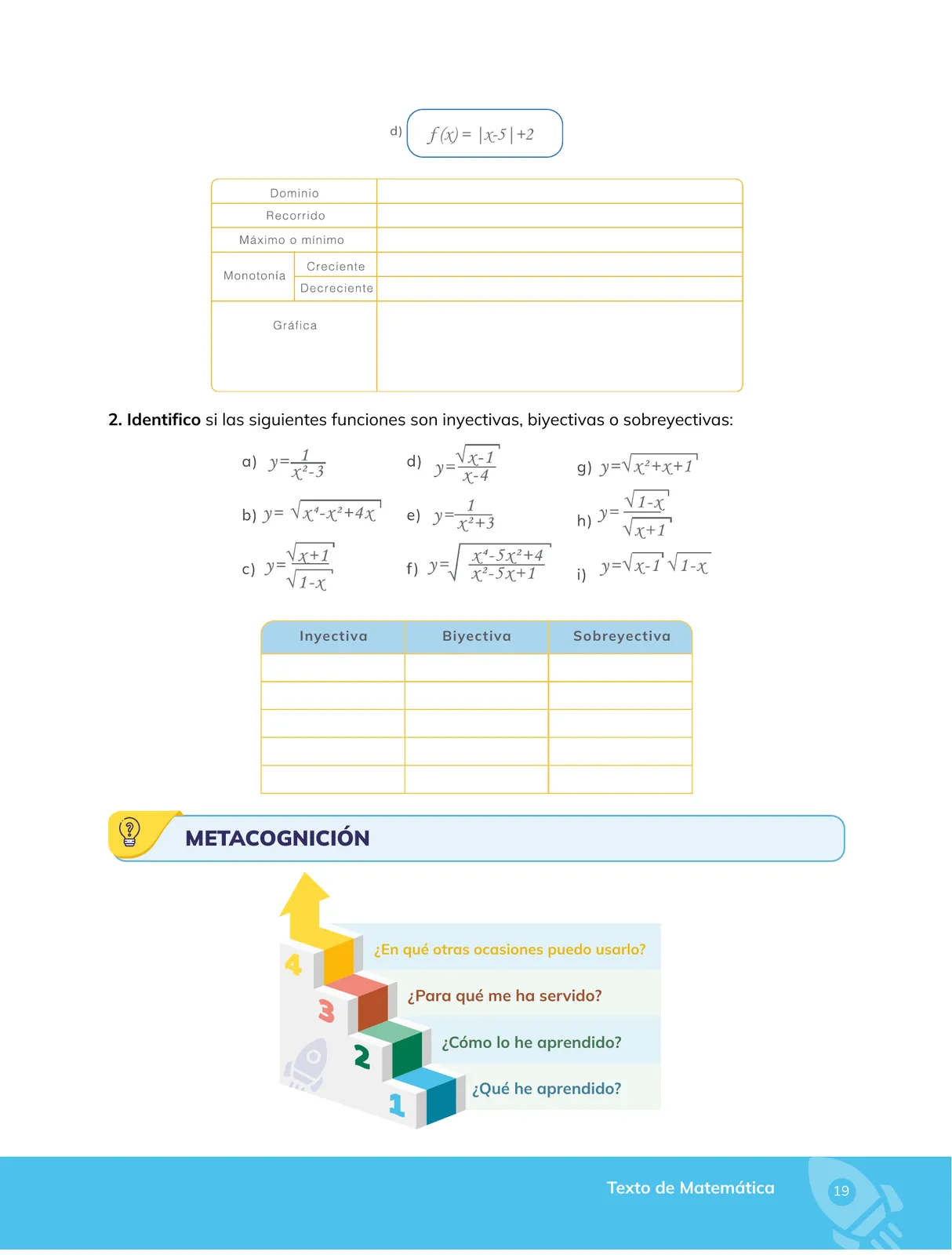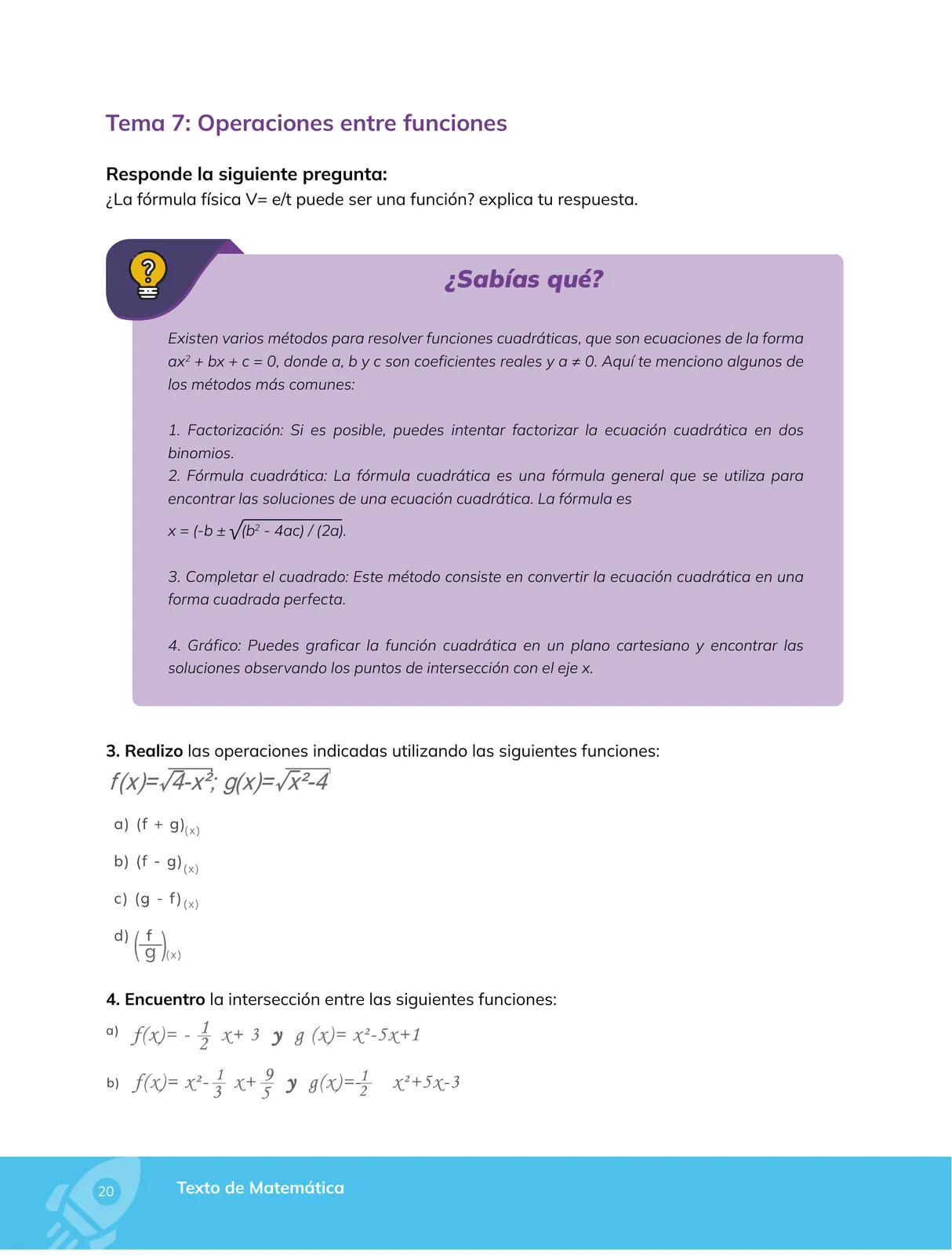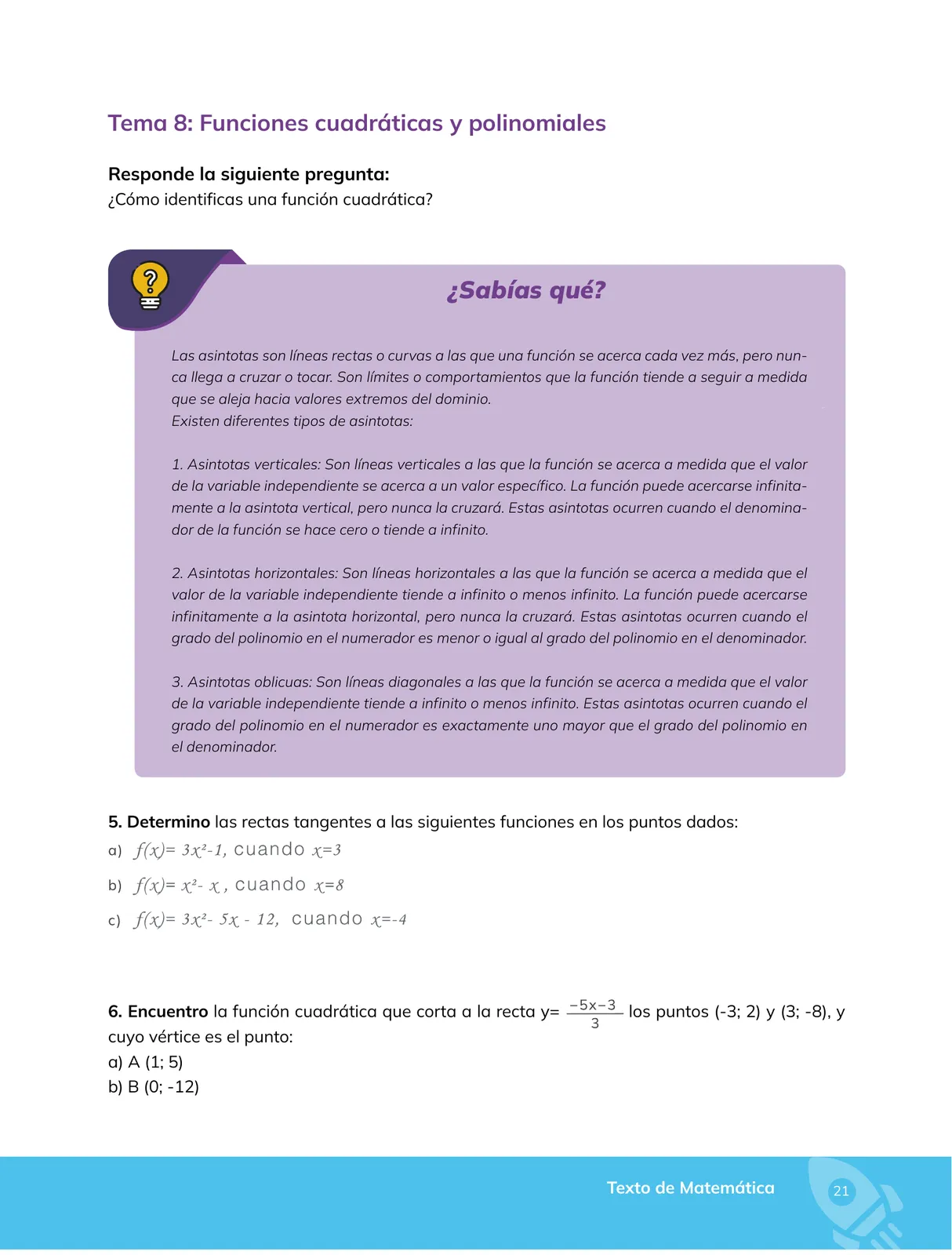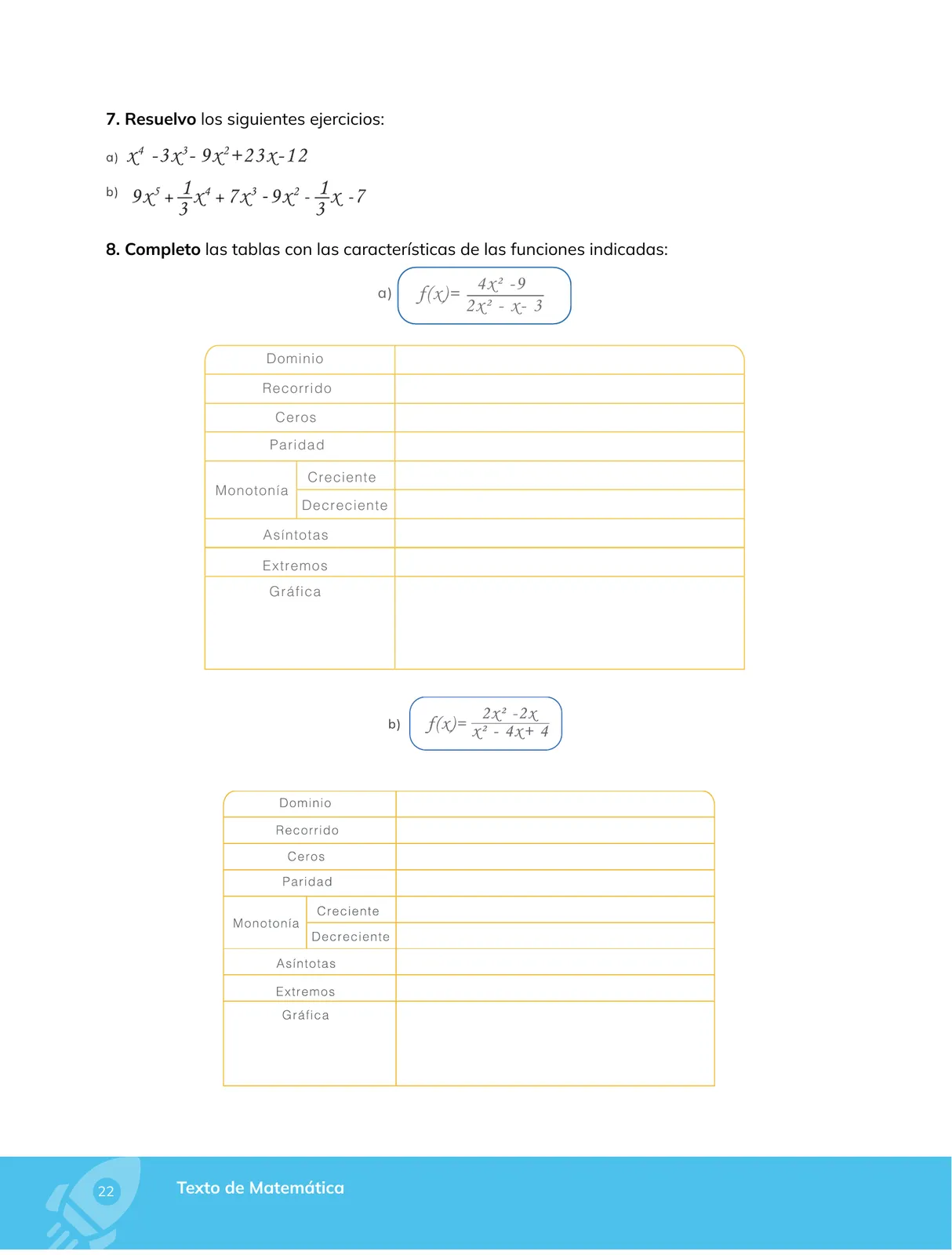

Ejercicio 8
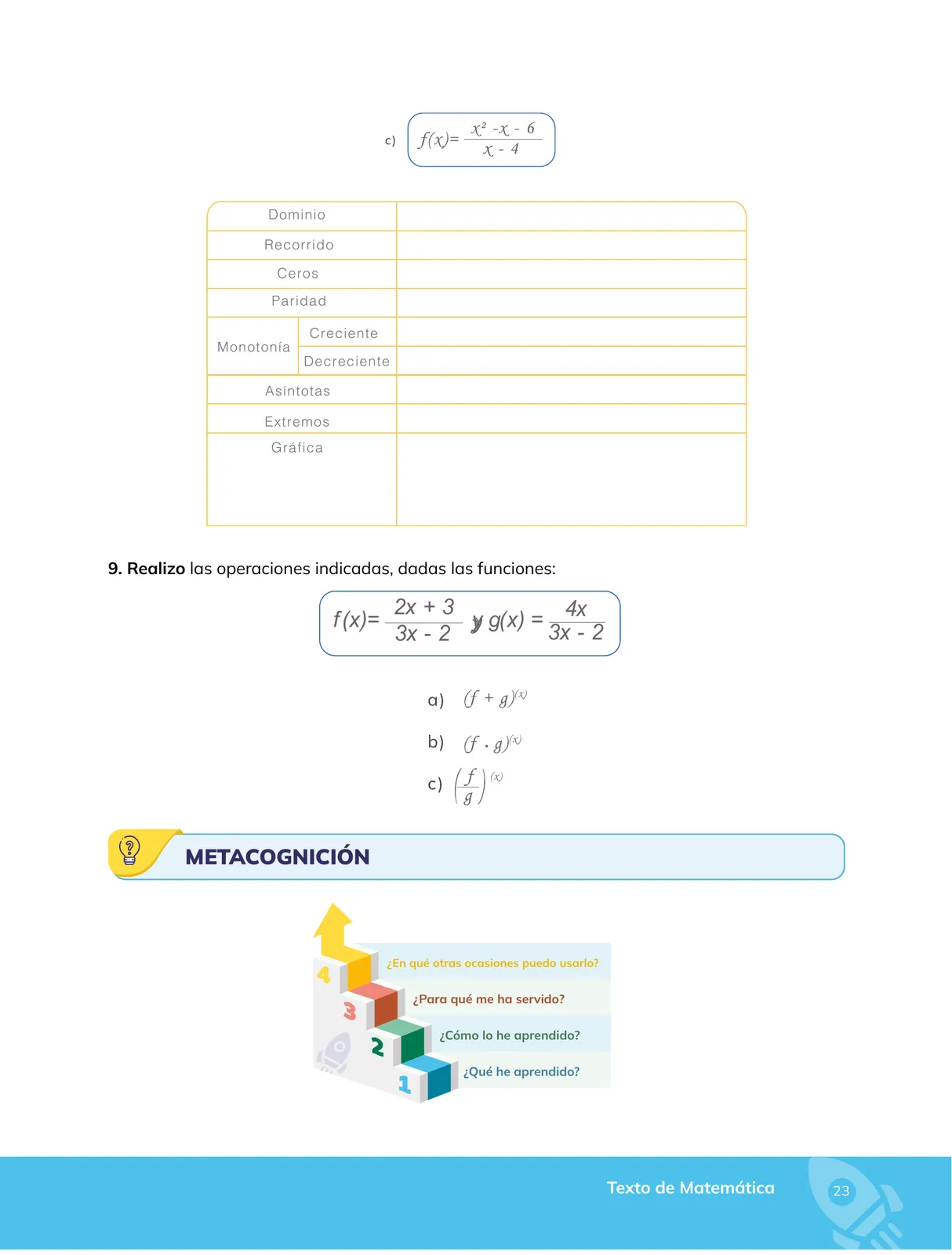
c
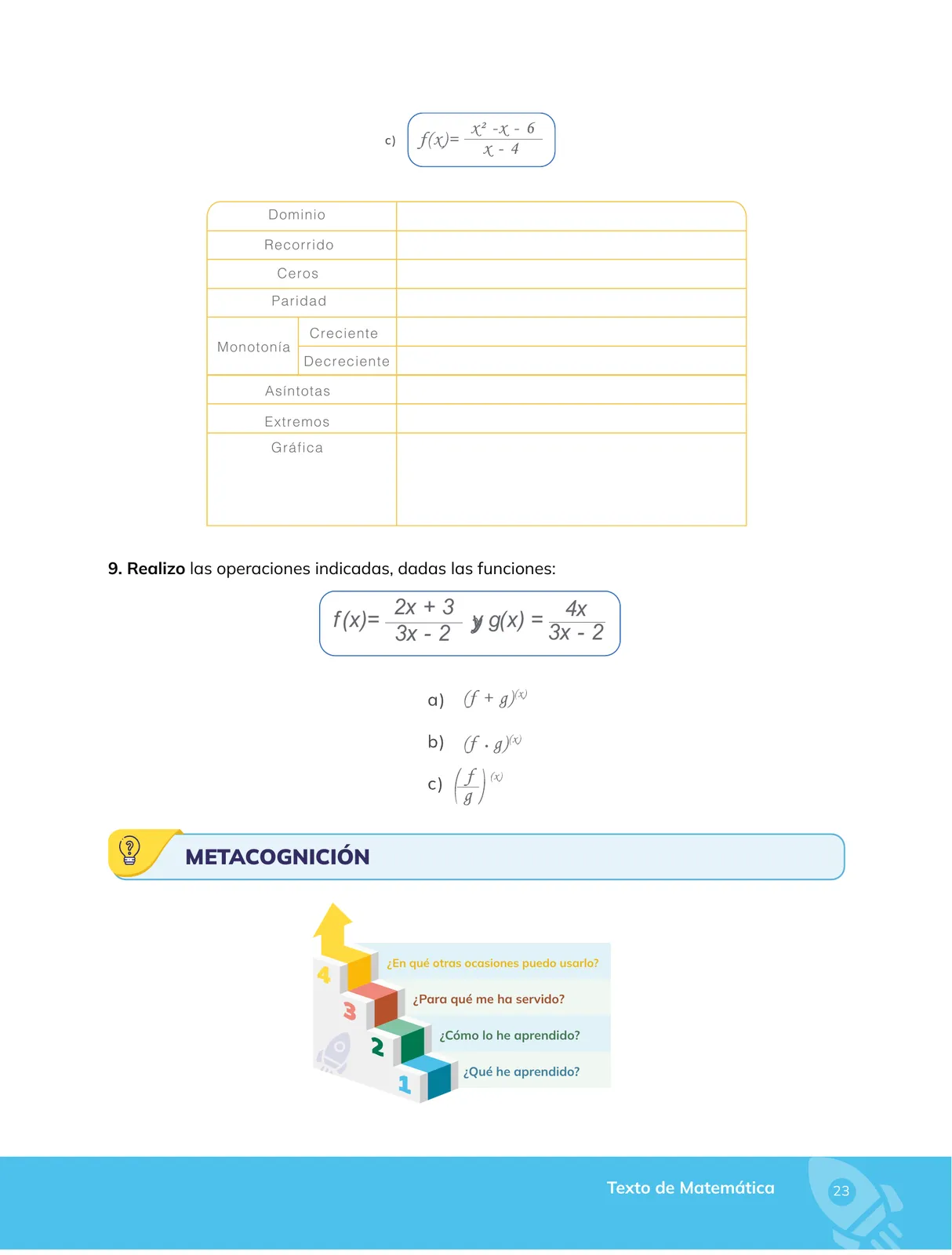
f(x)=\dfrac{x^{2}-x-6}{x-4}. Al dividir el numerador por (x-4): x^{2}-x-6=(x-4)(x+3)+6; entonces f(x)=x+3+\dfrac{6}{x-4}.
- Dominio: \mathbb{R}\setminus\{4\}.
- Ceros: x^{2}-x-6=0\Rightarrow (x-3)(x+2)=0\Rightarrow x=3,\ x=-2.
- Paridad: no par ni impar.
- Asíntotas: vertical x=4; oblicua y=x+3.
- Monotonía: f'(x)=1-\dfrac{6}{(x-4)^{2}}=0\Rightarrow (x-4)^{2}=6\Rightarrow x=4\pm \sqrt{6}. Creciente para |x-4|>\sqrt{6}; decreciente para |x-4|<\sqrt{6}.
- Extremos: máximo local en x=4-\sqrt{6}; mínimo local en x=4+\sqrt{6}.
- Recorrido: \mathbb{R}.