















Saltar al contenido
MisLibrosTexto
Ad

Present Perfect: forma afirmativa y negativa con ejercicios de completar

📄 ejercicios ingles 🎓 secundaria · 2° Secundaria México 🇲🇽 MX 🗣 Español
Página 101
101 de 171
Página 101 de Uérakua anapu uantakua. Projects and Readings.  Libro de Educación Secundaria Grado 2°  Ciclo Escolar 2025 - 2026
Anterior Página 101 / 171 Siguiente

Respuesta rápida

a) has travelled; b) haven't seen; c) have researched; d) have lived; e) have written; f) have completed; g) haven't finished; h) have called; i) has wanted; j) haven't decided; k) have read; l) have learned; m) hasn't explained.

📚 exercise ingles ⭐⭐ Dificultad 2/5 ⏱ 6 min lectura

Solución — Página 101

Uérakua anapu uantakua. Projects and Readings. Libro de Educación Secundaria Grado 2° Ciclo Escolar 2025 - 2026

1
Ejercicio 1

Completa con el present perfect del verbo entre paréntesis.

a
Parte 1.a

She ______ (travel) to many countries for her sports competitions.

  1. Sujeto She → auxiliar has.
  2. Verbo travel → participio travelled (BrE) / traveled (AmE).
  3. Oración: She has travelled to many countries...
Respuesta

has travelled / has traveled

b
Parte 1.b

We ______ (not see) that movie yet.

  1. Sujeto We → auxiliar have.
  2. Negativa: have not / haven't.
  3. Verbo see → participio seen.
Respuesta

have not seen / haven't seen

c
Parte 1.c

The students ______ (research) different sources of information about democratic decision making.

  1. Sujeto plural The students → have.
  2. Verbo research → participio researched.
Respuesta

have researched

d
Parte 1.d

They ______ (live) in our community for ten years.

  1. Sujeto They → have.
  2. Verbo live → participio lived.
Respuesta

have lived

e
Parte 1.e

I ______ (write) three emails to my teammates today.

  1. Sujeto I → have.
  2. Verbo write → participio written.
Respuesta

have written

f
Parte 1.f

We ______ (complete) many projects together this semester.

  1. Sujeto We → have.
  2. Verbo complete → participio completed.
Respuesta

have completed

g
Parte 1.g

They ______ (not finish) their homework yet.

  1. Sujeto They → have.
  2. Negativa: have not / haven't.
  3. Verbo finish → participio finished.
Respuesta

have not finished / haven't finished

h
Parte 1.h

We ______ (call) our grandparents to invite them to our games.

  1. Sujeto We → have.
  2. Verbo call → participio called.
Respuesta

have called

i
Parte 1.i

She ______ (want) to learn how to play the piano for years.

  1. Sujeto She → has.
  2. Verbo want → participio wanted.
Respuesta

has wanted

j
Parte 1.j

They ______ (not decide) the game instructions yet.

  1. Sujeto They → have.
  2. Negativa: have not / haven't.
  3. Verbo decide → participio decided.
Respuesta

have not decided / haven't decided

k
Parte 1.k

I ______ (read) that book many times.

  1. Sujeto I → have.
  2. Verbo read → participio read (se escribe igual, se pronuncia /red/).
Respuesta

have read

l
Parte 1.l

I ______ (learn) to respect other people's views.

  1. Sujeto I → have.
  2. Verbo learn → participio learned / learnt.
Respuesta

have learned / have learnt

m
Parte 1.m

The teacher ______ (not explain) the rules of the game.

  1. Sujeto singular The teacher → has.
  2. Negativa: has not / hasn't.
  3. Verbo explain → participio explained.
Respuesta

has not explained / hasn't explained

Contenido de la página

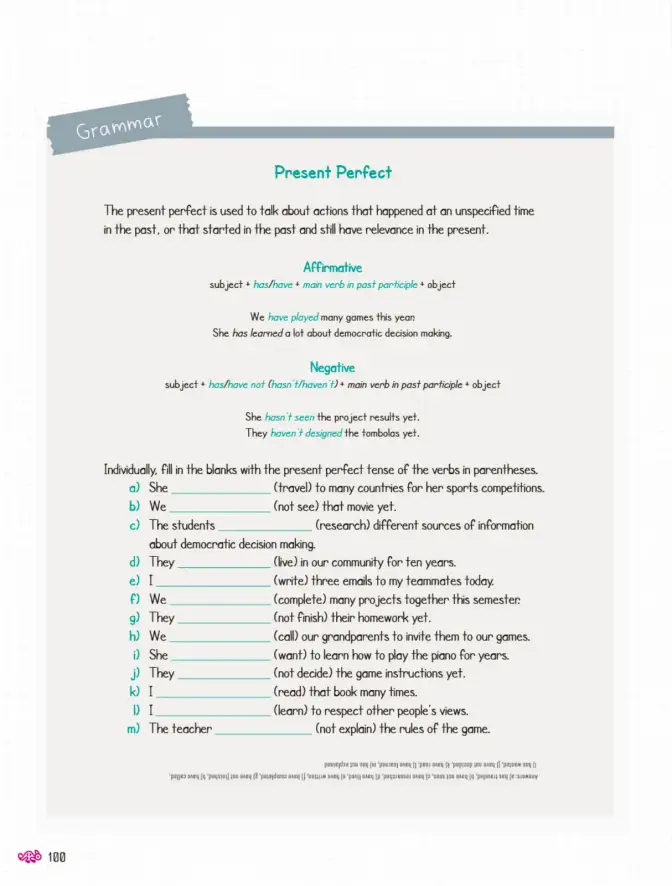
Grammar

Present Perfect

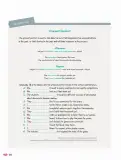
The present perfect is used to talk about actions that happened at an unspecified time in the past, or that started in the past and still have relevance in the present.

Affirmative

subject + has/have + main verb in past participle + object

  • We have played many games this year.
  • She has learned a lot about democratic decision making.

Negative

subject + has/have not (hasn't/haven't) + main verb in past participle + object

  • She hasn't seen the project results yet.
  • They haven't designed the tombolas yet.

Practice

Individually, fill in the blanks with the present perfect tense of the verbs in parentheses.

a) She ______ (travel) to many countries for her sports competitions. b) We ______ (not see) that movie yet. c) The students ______ (research) different sources of information about democratic decision making. d) They ______ (live) in our community for ten years. e) I ______ (write) three emails to my teammates today. f) We ______ (complete) many projects together this semester. g) They ______ (not finish) their homework yet. h) We ______ (call) our grandparents to invite them to our games. i) She ______ (want) to learn how to play the piano for years. j) They ______ (not decide) the game instructions yet. k) I ______ (read) that book many times. l) I ______ (learn) to respect other people's views. m) The teacher ______ (not explain) the rules of the game.

Ejemplos resueltos

We ______ (play) many games this year.

We have played many games this year.

She ______ (learn) a lot about democratic decision making.

She has learned a lot about democratic decision making.

She ______ (not see) the project results yet.

She hasn't seen the project results yet.

They ______ (not design) the tombolas yet.

They haven't designed the tombolas yet.

Tabla

Forma Estructura Ejemplo
Afirmativa subject + has/have + past participle + object We have played many games this year.
Negativa subject + has/have not + past participle + object She hasn't seen the project results yet.

Diagrama

flowchart TD
  A[Present Perfect] --> B[Affirmative]
  A --> C[Negative]
  B --> B1[subject + has/have + past participle + object]
  C --> C1[subject + has/have not + past participle + object]

Fórmulas y ecuaciones

subject + has/have + past participle + object

subject + has/have not + past participle + object

Glosario (5)

present perfect
Tiempo verbal que conecta el pasado con el presente.
past participle
Forma verbal usada con have/has (played, seen, written).
tombola
Rifa o sorteo con números; actividad lúdica escolar.
teammates
Compañeros de equipo.
views
Puntos de vista u opiniones.

Temas y conceptos clave

Present PerfectGramática inglesaTiempos verbalesAcciones con tiempo no especificadoAcciones que iniciaron en el pasado y continúanEstructura afirmativa: subject + has/have + past participleEstructura negativa: subject + has/have not + past participle
¿Te fue útil esta página?

Preguntas que la gente también hace

¿Cuándo se usa el present perfect en inglés?
Consulta la solución completa arriba o explora el libro entero para temas relacionados.
¿Cuál es la diferencia entre have y has en present perfect?
Consulta la solución completa arriba o explora el libro entero para temas relacionados.
¿Cómo se forma la negativa del present perfect?
Consulta la solución completa arriba o explora el libro entero para temas relacionados.
📌 Antes de leer esto
  • • Conjugación del verbo to have en presente (have/has)
  • • Formación del participio pasado de verbos regulares e irregulares
  • • Reconocimiento del sujeto y la persona gramatical
Siguiente tema sugerido
Present perfect: interrogative form and short answers
📝 Transcripción de la página (texto seleccionable) 1306 caracteres

Present Perfect

The present perfect is used to talk about actions that happened at an unspecified time in the past, or that started in the past and stil have relevance in the present.

Affirmative subject + has/have + main verb in past participle+ object

We have played many games this year She has learned a lot about democratic decision making.

Negative subject + has/have not (hasn't/haven't)+ main verb in past participle + object

She hasn't seen the project results yet.They haven'f designed the tombolas yet.

Individually, fill in the blanks with the present perfect tense of the verbs in parentheses.

a) She (travel) to many countries for her sports competitions.

b) We_(not see) that movie yet.

c)The students (research) different sources of information about democratic decision making.

d)They (live) in our community for ten years.

e)I (write) three emails to my teammates today.

f)We (complete) many projects together this semester:

g)They (not finish) their homework yet.

h)we (call) our grandparents to invite them to our games.

i She (want) to learn how to play the piano for years.

j) They (not decide) the game instructions yet.

kⅠ(read) that book many times.

1)I (learn) to respect other people's views.

m)The teacher (not explain) the rules of the game.

Grammar

a

100

Ad

Otros libros recomendados

Ver todos →
Ad

Usamos cookies propias y de terceros para personalizar contenido, mostrar publicidad y analizar el tráfico. Las cookies necesarias siempre están activas.